
If you are pricing your facial sculpting sessions based on the hourly rate of a standard aesthetician, you are likely working yourself toward burnout while leaving significant revenue on the table. Learning how to price facial sculpting services is not just about covering your rent; it's about valuing the deep somatic labor and specialized expertise required to move muscle and release emotional tension. It is a common struggle to fear that higher rates might alienate your client base, especially when you are trying to explain why manual sculpting carries a premium over a standard facial.
We understand that undervaluing your physical labor is a fast track to exhaustion. This guide is designed to help you master the art of value-based pricing so you can build a profitable, high-end practice that reflects your unique expertise. We will provide a clear pricing structure that secures your profit, offer strategies to communicate your value to clients with total confidence, and outline a roadmap for increasing your rates as you advance through your Face Up Method™ journey. By the end of this guide, you'll have the tools to transform your practice into a sustainable, global-standard business.
Key Takeaways
- Discover how to position your practice as a premium, non-invasive alternative to clinical aesthetics by aligning with the 2026 global shift toward somatic wellness.
- Master how to price facial sculpting services using a value-based model that prioritizes deep muscular release and specialized expertise over a simple hourly rate.
- Evaluate the financial benefits of results-oriented session pricing, such as specific protocols for jaw release, to better reflect the impact of your work.
- Learn to communicate your rates with total confidence by reframing the conversation around the sustainable, needle-free results of the Face Up Method™.
- Create a clear roadmap for scaling your business and justifying annual price increases through professional certification and waitlist management.
Understanding the Market Value of Facial Sculpting in 2026
Facial sculpting has transitioned from a niche beauty treatment into a sophisticated, high-ticket category within the global wellness industry. It stands as a premium, non-invasive alternative to clinical aesthetics, offering results that focus on structural integrity rather than surface level masking. While a Rhytidectomy (surgical facelift) offers a permanent surgical change, modern clients increasingly seek methods that preserve natural expression and promote long term tissue health. By 2026, the market has pivoted sharply toward holistic rejuvenation, where the goal is not just to look younger, but to feel more regulated within one's own body.
Traditional "relaxation" facials often focus on skin hydration and superficial massage, but sculpting commands a higher rate because it is an active intervention. It requires an intimate knowledge of facial anatomy and the ability to manipulate deep tissue to create visible lift. Understanding how to price facial sculpting services requires a departure from the "cost-plus" mentality used in standard beauty salons. Instead, you must look at the specific outcomes you provide. Value based pricing for somatic facial therapy is the practice of setting rates based on the profound emotional and physical relief achieved, rather than the chronological length of the session.
The Rise of the "Somatic Aesthetician"
The modern practitioner is no longer just a skin therapist; they are a facilitator of deep muscular and emotional release. When you address chronic jaw tension or the "holding patterns" in the brow, you provide a level of relief that standard treatments cannot match. Positioning your practice as a rejuvenation studio emphasizes this specialized focus. Clients are willing to pay a premium for practitioners who hold a Face Up Method Certification, as it signals a commitment to professional accreditation and global standards. This specialized training builds a level of trust that allows you to move away from commodity pricing and toward a model that reflects your unique expertise.
The Practitioner Energy Factor
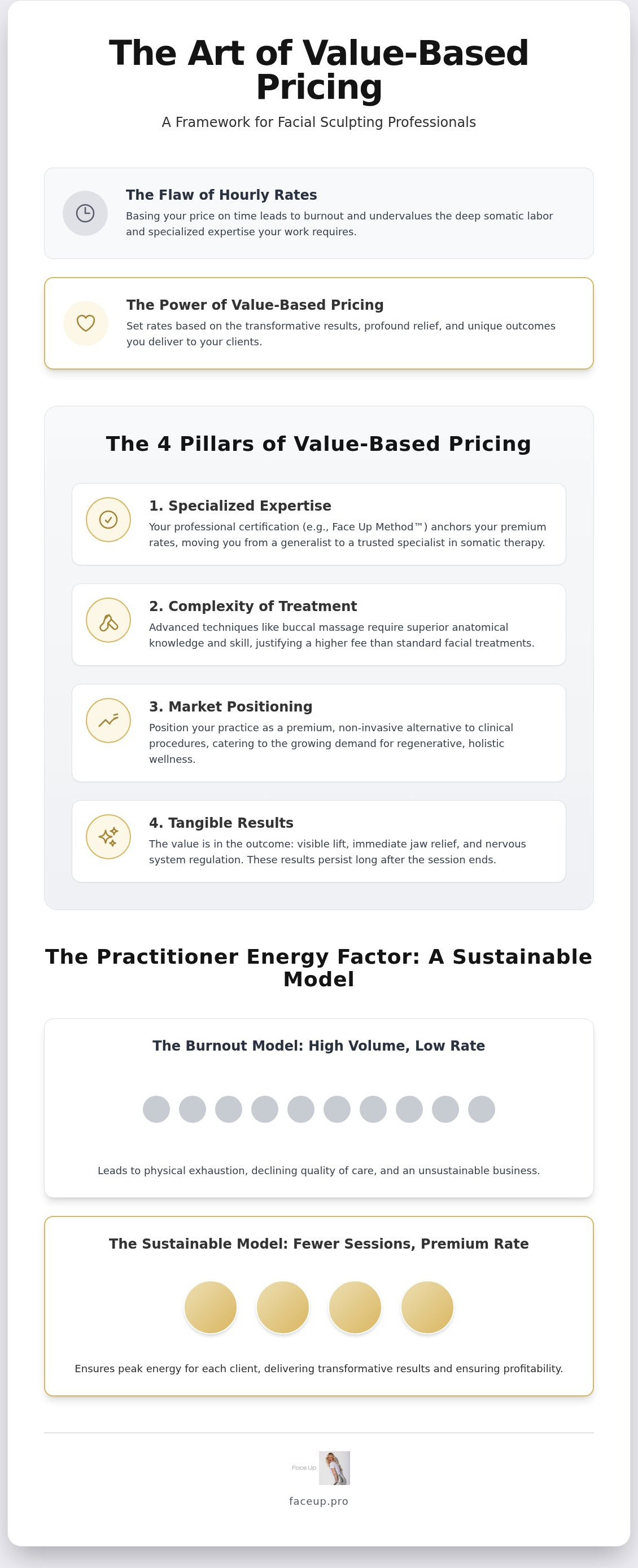
A critical gap in many pricing guides is the failure to account for the practitioner's physical health. Manual sculpting is an athletic endeavor that requires sustained pressure and precise movements. To maintain the high standard of care your clients expect, you cannot treat ten people a day without facing burnout. Setting a daily capacity limit is essential for a sustainable business model. When you determine how to price facial sculpting services, you must factor in the reality that you are performing fewer, higher quality sessions. Charging more for these focused interventions ensures that you can provide the same level of transformative energy to your last client of the day as you did for your first.
The 4 Pillars of Value-Based Pricing
Moving beyond the simple labor plus materials formula is the first step toward a sustainable practice. When you determine how to price facial sculpting services, you must look at the value you generate for the client rather than the overhead of your massage oil or room rent. The four pillars of this model ensure your rates reflect your standing as a specialist rather than a generalist. This shift allows you to attract clients who value results over discounts.
The first pillar is specialized expertise. Obtaining a facial sculpting certification provides a professional anchor that justifies premium rates. The second pillar is the complexity of the treatment. A session involving buccal massage requires a higher level of anatomical skill and risk management than standard lymphatic drainage, which should be reflected in your fee. Third, consider market positioning. While the latest plastic surgery statistics show continued demand for surgical interventions, there is a massive, growing segment of clients seeking non-invasive, regenerative alternatives. Finally, focus on tangible results. A visible lift, immediate jaw relief, and nervous system regulation provide value that persists long after the client leaves your table.
Leveraging Your Certification as a Price Anchor
Your certification validates your premium rates by moving you out of the general beauty category and into specialized somatic therapy. By utilizing your listing in a global practitioner directory, you prove your professional standing to prospective clients before they even book. The Face Up Method™ is a proprietary system that goes beyond surface level aesthetics. It's a holistic approach to muscular health. If you're ready to elevate your practice, you might consider how the Face Up Method Certification can transform your business trajectory and client perception.
Market Research: Knowing Your Local Landscape
Conducting a competitor audit is about finding the "premium gap" in your city. It's not about matching the lowest price in town. In 2026, standard 60 minute facial rates in the Northeast US range from $120 to $165, while West Coast averages sit between $115 and $160. However, these figures are for basic skin services. Facial sculpting, particularly when it includes somatic work, should sit well above these benchmarks. You aren't competing with $90 Southeast facials; you're competing with the cost and downtime of clinical aesthetics. For instance, Botox currently averages $15 per unit. Your service offers a natural, biostimulatory alternative that justifies its own unique price point based on the skill involved.
Comparing Pricing Models: Hourly vs. Results-Based
Standard hourly rates are the default for many in the beauty industry, yet they often create a glass ceiling for highly skilled practitioners. When you charge by the hour, you essentially penalize yourself for becoming more efficient and effective. If a master practitioner can achieve in 45 minutes what a novice does in 90, the expert shouldn't be paid half as much for better results. This is why understanding proven pricing strategies is vital for anyone learning how to price facial sculpting services. By shifting to a results-based model, you decouple your income from the clock and align it with the transformation you provide.
A results-oriented approach, such as offering a specific "Jaw Release Protocol," focuses the client's investment on the relief of tension and the visible sculpting achieved. The Face Up Method™ encourages this holistic perspective, viewing each session as part of a larger somatic journey rather than a one-off appointment. Transitioning existing clients from a "per-hour" mindset requires clear communication about the cumulative benefits of the work. You aren't just selling a session; you're selling a cumulative structural change that requires a multi-session commitment to reach full potential.
Designing High-Value Service Packages
Creating a "Transformation Series" is one of the most effective ways to stabilize your revenue and improve client outcomes. A series of six sessions, for example, allows for deep, cumulative sculpting that a single visit cannot replicate. When you incorporate a Somatic Bodywork Session into these packages, you naturally increase the price point by addressing the nervous system alongside the musculature. This integration differentiates your practice from standard beauty therapists who may only focus on skin-deep results. Packages also improve client retention, as the commitment to a series ensures the client stays for the full duration of the sculpting process.
The "Introductory Session" Pricing Strategy
The first visit is your opportunity to demonstrate the value of your specialized method while mapping out a long-term plan. How to price facial sculpting services for new clients involves a delicate balance between accessibility and premium positioning. You don't want to discount so deeply that you attract bargain hunters who won't commit to a full plan. Instead, consider pricing the initial consultation at a rate that reflects your expertise but includes a comprehensive somatic assessment. This session serves as a gateway, allowing you to explain the proprietary nature of the Face Up Method™ and how a structured series of treatments will address their specific concerns. By the end of this first meeting, the client should see a clear roadmap for their rejuvenation, making the transition to a high-value package a natural and professional next step.
How to Communicate Your Rates and Justify Premium Pricing
Mastering how to price facial sculpting services is only half the battle; the other half is communicating that price with unwavering authority. When a client asks about your rates, they aren't just looking for a number. They're looking for the assurance that their investment will yield a transformation that surface level treatments cannot provide. Reframing the conversation from "cost" to "value" allows you to highlight the unique, non-invasive benefits of your work. Unlike clinical aesthetics, your method involves no needles, no downtime, and results that look entirely natural because they work with the body's own regenerative systems.
Transparency is a hallmark of a professional practice. Listing your rates clearly on your website filters for ideal clients and establishes a foundation of trust. It signals that you're confident in the value you provide. Beyond aesthetics, many clients seek out tmj massage therapy for its functional health benefits. When you explain that your work addresses chronic pain and nervous system regulation, the conversation shifts from a luxury "beauty" expense to a necessary "wellness" investment.
Handling the "Why is it so expensive?" Objection
Visual and Social Proof as Pricing Support
Your portfolio is your most persuasive pricing tool. Use before and after images to demonstrate the structural lift your hands can achieve. Testimonials that mention "feeling lighter" or "sleeping better" validate the high-ticket nature of somatic work. Professionalism also extends to your environment and equipment. Showcasing a specialized tmj massage tool as part of your professional setup reinforces the technical depth of your practice. If you're ready to start charging what your skill is truly worth, you can apply for Face Up Method Certification to join our global community of elite practitioners.
Scaling Your Practice with Face Up Certification
Specialized credentials act as a catalyst for professional growth and long-term financial stability. When you hold a recognized certification, you are no longer competing with every local beauty salon; you are part of an elite tier of somatic practitioners. This distinction is vital when you evaluate how to price facial sculpting services during your annual business review. Certification provides the objective proof of quality that allows you to implement consistent rate increases without the fear of losing your core clientele. It moves you from a transactional relationship with your clients to one built on professional authority and verified results.
Building a waitlist is the ultimate indicator that your prices are correctly aligned with your value. When your schedule is consistently full for weeks or months in advance, it's a clear signal from the market that your expertise is in high demand. At this stage, your pricing strategy shifts from merely attracting new clients to managing your professional capacity. You can begin to move from a practitioner role into a mentor or educator position within the Face Up ecosystem. This progression allows for a more diverse revenue stream, where you can offer specialized workshops or contribute to professional development platforms, further establishing your authority in the global market while increasing your own influence and income.
The Path to Premium: From Generalist to Specialist
Industry data suggests that specialists often earn 30% to 50% more than general beauty therapists. By focusing your practice on a niche like somatic facial work or deep jaw release, you solve specific, painful problems that generalists simply cannot address. Leveraging the global Face Up brand helps you attract high-end clientele who are specifically looking for the "Face Up Method™" rather than a generic facial massage. This specialization simplifies the question of how to price facial sculpting services, as your rates are anchored to the specific, high-value outcomes you deliver. You become the go-to expert in your region for a very specific type of healing and rejuvenation.
Investing in Your Professional Future
The return on investment for professional training and accreditation extends far beyond your initial course fee. In 2026, the demand for non-invasive, somatic-based rejuvenation is at an all-time high, and practitioners who invest in their skills now are positioning themselves at the forefront of this major industry shift. It's an investment in a career path that offers both financial rewards and deep professional fulfillment. Joining a community of global practitioners provides the ongoing support and peer validation necessary to maintain a high-standard practice in a competitive environment. If you are ready to elevate your practice and join an ecosystem dedicated to excellence, Apply for the Face Up Method Certification today and take the first step toward a more profitable, impactful future.
Secure Your Future in Somatic Aesthetics
Transitioning to a value based model is the most effective way to ensure your practice remains both profitable and sustainable. By moving away from hourly rates and embracing results oriented session pricing, you align your income with the profound physical and emotional transformations you provide. Mastering how to price facial sculpting services allows you to reflect your status as a specialist rather than a generalist. This shift not only protects you from burnout but also attracts high end clients who value natural, needle free rejuvenation.
Your professional journey is supported by a proprietary ecosystem. Joining a community of global practitioners ensures you stay at the forefront of proprietary somatic techniques used by top professionals worldwide. Our high ticket training is designed for career longevity, providing you with a listing in our global directory to verify your professional standing. Master the Face Up Method™ and elevate your practice income today. You have the skill to change lives; it's time your pricing reflected that impact.
Frequently Asked Questions
What is the average price for a facial sculpting session in 2026?
Average prices for specialized sculptural massage in major hubs like New York City reach approximately $160 for a 50 minute session. While standard 60 minute facials across the Northeast and West Coast often range between $115 and $165, sculpting is a distinct premium category. When determining how to price facial sculpting services, you must evaluate your specific regional market and the level of somatic depth you provide to set a competitive rate.
Should I charge more for buccal massage than a regular facial?
You should absolutely charge a premium for buccal massage because it requires advanced intra oral techniques and a higher level of anatomical training. Unlike a regular facial that focuses on the skin's surface, buccal work involves manual manipulation of the muscles from within the oral cavity. This complexity demands more physical effort and specialized skill. It justifies a higher price point than standard relaxation treatments because the results are more structural.
How do I raise my prices for existing clients without losing them?
Raising rates for existing clients is best handled by giving ample notice and reinforcing the increased value they receive. Send a professional announcement at least 30 to 60 days in advance. Explain that your new pricing reflects your advanced certifications and the enhanced results your method now delivers. Most loyal clients will understand that your professional growth directly benefits their own rejuvenation journey and will stay for the results.
Does a facial sculpting certification really allow me to charge more?
A specialized certification allows you to move out of the generalist category and into a high ticket niche. When you hold a professional credential like the Face Up Method Certification, you provide a verified standard of quality that justifies a higher fee. It signals to your clients that you've invested in elite training. This builds the trust necessary to sustain premium rates in a competitive market where generalists struggle to differentiate.
What overhead costs should I include when pricing my beauty services?
Your pricing must cover fixed and variable costs such as studio rent, professional insurance, and specialized equipment. Don't forget to account for administrative expenses like your Face Up App Subscription and marketing efforts. Many practitioners also factor in "physical labor" costs to prevent burnout. This ensures your business remains profitable while allowing you to maintain a sustainable daily capacity. It protects your long term health and your business's bottom line.
Is it better to charge by the hour or by the treatment type?
Results based pricing is generally superior to hourly rates because it focuses on the transformation rather than the clock. Charging by the treatment type, such as a "Jaw Release Protocol," allows you to value your expertise and the relief you provide. When you learn how to price facial sculpting services, shifting to this model ensures that your efficiency as a master practitioner doesn't lead to a decrease in your income as you get faster.
How often should I review and adjust my service menu pricing?
You should review your service menu at least once a year to ensure your rates keep pace with inflation and your growing expertise. Some practitioners prefer a bi annual review if they are rapidly gaining new certifications or if local market demand shifts. Regular adjustments prevent you from falling behind industry standards. They help you maintain a healthy profit margin as your practice evolves and your reputation in the community grows.
Can I charge a premium if I don’t have a medical degree?
You can certainly charge a premium without a medical degree by positioning yourself as a somatic specialist. While you don't perform medical procedures like Botox or fillers, your work offers deep muscular release and structural rejuvenation that clinical aesthetics cannot replicate. By focusing on your specialized manual skills and the unique somatic benefits of your method, you create a high value category all your own. Clients pay for the results you achieve with your hands.


