

The most helpful response to a client’s emotional release is often to do less, not more. Knowing how to handle emotional release in clients means staying calm, checking whether they want to continue, and respecting their pace instead of interpreting their feelings or offering advice. If they feel overwhelmed, pause and help them reconnect with the present through simple grounding.
It can feel unsettling when emotion surfaces during body-focused work, especially if you’re unsure whether to speak, stay quiet, or stop. A steady, respectful response can preserve the client’s sense of choice without turning the moment into a conversation they haven’t asked to have.
This guide explains what emotional release can involve and why a client might seek it. It covers how the process may unfold, how to respond when feelings arise, and how grounding can help someone return to steadiness. You’ll also find a clear distinction between offering attentive support and going beyond your role, so care remains compassionate and appropriately bounded.
Key Takeaways
- Recognize that emotion may surface during body-focused work, and meet it with calm attention rather than interpretation.
- Acknowledge the client’s experience and preserve their choice about whether to talk, pause, or continue.
- Use simple grounding, such as slow breathing or orienting to the room, when a client feels overwhelmed.
- Understand why clients may seek emotional release and when their needs call for support beyond a bodywork session.
Beyond the Surface: What is Emotional Release Therapy?
Emotional release therapy uses approaches such as somatic awareness to explore feelings connected with physical sensations. A client may notice bracing, trembling, or tension as emotions such as grief or anger arise. The work doesn’t require reliving every painful detail. Instead, the therapist helps the client notice what’s happening in the present, at a manageable pace. For example, a client might name tightness in their jaw and observe whether it shifts with a slower breath.
In U.S. practice, ethical support means respecting consent, personal boundaries, and the limits of professional training. Massage therapists without counseling training shouldn’t counsel clients about traumatic or painful memories. Counseling is a distinct professional service that may require qualifications beyond a massage therapist’s training. If distress feels too difficult for a client to manage alone, a massage therapist may suggest professional counseling. These boundaries distinguish supportive bodywork from mental health treatment.
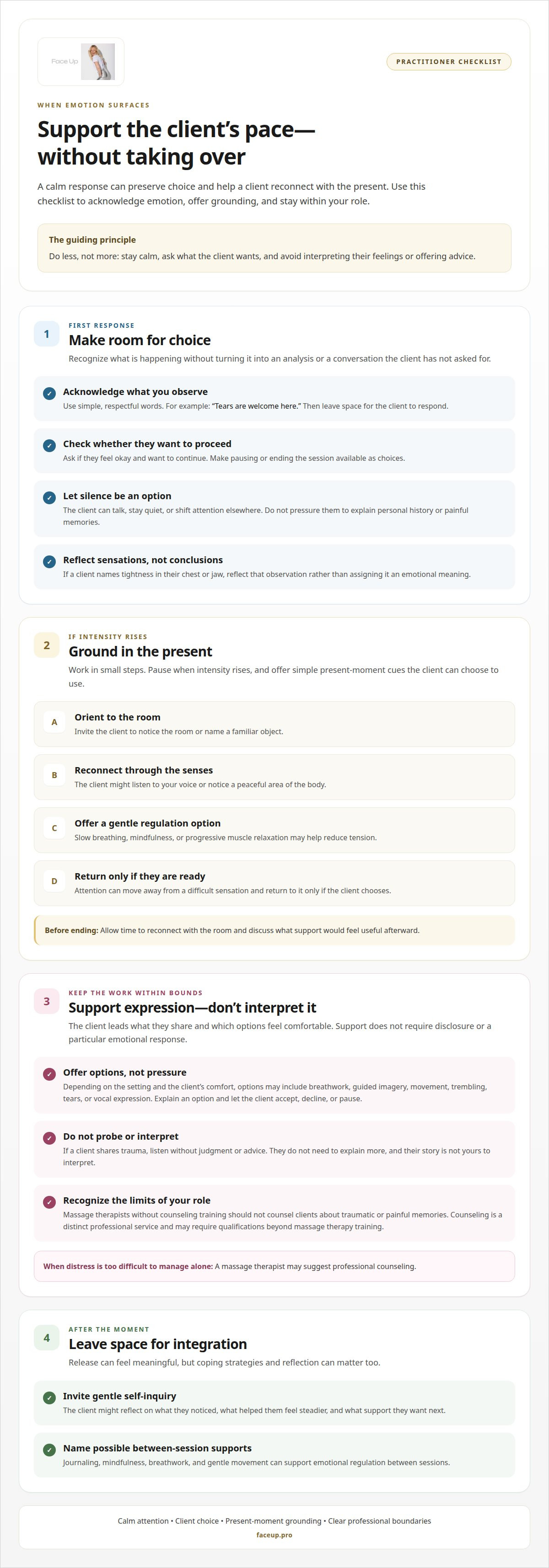
In an intense moment, practical self-soothing can start with a choice: pause, continue, or end the session. The therapist can ask whether the client feels okay and wants to proceed, then allow quiet instead of filling it with questions. If the client feels more stressed, they might orient to the room, notice the therapist’s voice, or take a slow breath. The aim is to support the client’s agency, not interpret their tears or explain what they mean.
Afterward, gentle self-inquiry can help connect the experience to daily life. The client might reflect on what they noticed, what helped them feel steadier, and what support they want next. Journaling, mindfulness, breathwork, and gentle movement can support emotional regulation between sessions. Approaching a feeling with curiosity, such as “What do I notice in my body?” can be more useful than judging the emotion or demanding it disappear. Release can be meaningful, but coping strategies and integration matter too.
How Does the Emotional Release Process Work?
Emotional expression can unfold through conversation, creative work, or body-focused approaches. The therapist’s role is to support the client’s chosen pace and make room for different ways of expressing a feeling.
Acknowledging Emotional Expression
Acknowledging emotion means calmly recognizing what the client is showing without deciding what it means. Simple, respectful words can help a client feel accepted without pressuring them to explain trauma or personal history. A therapist might say, “Tears are welcome here,” then leave space for the client to respond. This recognizes the moment without turning it into an analysis.
Notice the client’s words and sensations rather than assigning meaning to them. If someone says their chest feels tight, reflect that observation instead of suggesting it proves a particular emotional pattern. Acknowledgment also means allowing silence to remain comfortable. The client can choose whether to talk, stay quiet, or shift their attention elsewhere.
Facilitating Emotional Release
Facilitating release means offering gentle ways to express emotion while keeping the client involved in each choice. Depending on the setting and the person’s comfort, approaches may include breathwork, guided imagery, movement, trembling, tears, or vocal expression. A therapist can suggest an option, explain what it involves, and invite the client to accept, decline, or pause.
Creative expression can make a hard-to-name feeling easier to explore. For example, a client might draw the emotion as a shape, color, or object, then decide what to do with the image. A brief drawing exercise can take 10 or 20 seconds. The picture doesn’t need interpretation; the client can describe what stands out or simply set it aside.
Some people prefer words, while others find movement or imagery more accessible. The useful approach is one the client chooses and can engage with comfortably, rather than a technique imposed to produce a particular response.
Boundaries Around Emotional Disclosure
Maintaining boundaries means supporting expression without asking clients to reveal more than they choose. Therapists can avoid probing into painful memories and let clients decide whether to explain what they’re feeling. This protects choice and keeps the session focused on the support being offered.
If a client shares trauma, listen without judgment or advice, and don’t interpret their story. A therapist can say, “You don’t need to explain more,” then bring attention back to the client’s immediate experience. Respecting that limit keeps emotional work collaborative rather than pressuring the client to disclose more.
Grounding and managing emotional overwhelm
Grounding helps clients stay connected to the present as emotions and bodily sensations shift. Practitioners can observe whether the client remains oriented, communicates, and can choose what happens next.
Grounding During and After Emotional Work
Grounding uses present-moment cues to support regulation during intense emotional work and after a release. For example, invite the client to notice the room, listen to your voice, or name a familiar object. Slow breathing, mindfulness, and progressive muscle relaxation can also help reduce tension.
Work in small steps and pause when intensity rises. A client might shift their attention from a difficult sensation to a peaceful area of the body, then return only if ready. Moving between activation and safety can help the client stay engaged without demanding more than they can manage. Before ending, allow time to reconnect with the room and discuss what support would feel useful afterward.
Emotional Containment
Emotional containment means making space for a feeling while helping the client stay within a manageable level of activation. This matters because emotional work can become overwhelming if intensity keeps rising without a pause or a return to present-moment cues.
A practitioner can suggest a break, invite the client to feel their feet against the floor, or guide their attention to a steady breath. Keep language simple and allow the client to respond at their own pace. If they feel frightened or unable to continue, pause the work and focus on immediate safety and support rather than pushing for further release.
Recognizing Flooding and Dissociation
In healthy emotional release, the client can generally notice sensations, respond to the practitioner, and express a preference. Flooding may involve distress that feels too intense to manage. Dissociation can include numbness, disconnection, fatigue, or immobility. These signs call for careful attention, not rushed interpretation or diagnosis.
Check whether the client can orient to the room, hear your voice, and choose a next step. If these abilities are reduced, stop deepening the emotional work and use grounding cues. Treat a client’s report of feeling overwhelmed as meaningful, even when outward signs seem subtle. This keeps support focused on the client’s present capacity, not an assumed healing process.
Reasons clients may seek emotional release
A client may seek emotional release when persistent tension or stress feels difficult to explain with words alone. Somatic awareness offers another way to notice experience: someone might recognize a clenched jaw, shallow breathing, or a braced abdomen alongside sadness or anger. These sensations don’t prove that an emotion is hidden in the body. They can give the client a focused starting point for exploring what they feel now. For practitioners asking how to handle emotional release in clients, it helps to treat these sensations as observations, not conclusions.
Some people want to understand emotional patterns that surface during body-focused work. For example, someone might feel irritated during an ordinary interaction, then notice the same response alongside shoulder tension. Gentle attention to the sensation can help them become curious about their experience without forcing a memory or explanation. The aim is awareness, not a dramatic release or a particular emotional outcome.
Others may hope to feel safer expressing emotions they usually contain. A respectful therapeutic relationship matters: the client needs room to choose what to share, pause, or leave unexplored. Someone may notice grief during a session but prefer to stay with the physical sensation rather than discuss its history. Knowing how to handle emotional release in clients includes respecting that choice as part of the work.
Emotional release may also appeal to clients seeking a connection between bodily experience and emotional wellbeing. Tears, a change in breathing, or a sense of softening can prompt someone to notice what is happening, but they don’t prove a problem is solved. Sustainable change may involve integration and coping practices, since release alone may not address underlying concerns. Focus on the client’s reasons for exploring, their present comfort, and what support helps them stay engaged.
For a gentle way to explore body awareness and tension, discover somatic approaches to facial release.
Face Up: Jaw Release Course
The Jaw Release Course offers a focused way to explore jaw tension through guided self-practice. For readers interested in the body-awareness aspect of emotional release, it can support noticing how the jaw feels and approaching that area with care. It isn’t a replacement for mental health care or trauma therapy when those supports are needed.
Choose this course for personal practice focused on the jaw, rather than to facilitate another person’s emotional processing. Practitioners seeking structured learning can explore Face Up Method Certification, while the Face Up App Subscription supports daily self-practice rituals.
To learn more about the Jaw Release Course or discuss which Face Up offering fits your needs, contact Face Up.
Carry Care Beyond the Session
Make thoughtful care part of your ongoing practice. Learning how to handle emotional release in clients means continuing to respect their choices while staying clear about the support you can provide. Small, consistent practices can build body awareness without treating emotional expression as something to force or measure.
For personal exploration, the Jaw Release Course and Face Up App Subscription offer guided ways to engage in self-practice. Practitioners looking to develop their skills can explore Face Up Method Certification. Each offering supports a different next step, depending on whether your focus is personal practice or practitioner learning.
If you’d like to explore which direction suits your goals, contact Face Up. A considered next step can help you continue with curiosity, care, and respect for each person’s pace.
Frequently Asked Questions
Are there any risks or things to consider?
Yes. Emotional intensity can increase briefly after a session, and release alone may not address underlying issues. A client with a trauma history, especially complex trauma, should work with a trained therapist. Emotional release isn’t a substitute for medical or psychiatric care when needed. Suicidal thoughts or active self-harm call for specialized support rather than bodywork alone.
What is the Theory Behind Emotional Release?
Several approaches connect emotional experience with bodily sensations and nervous system responses. Polyvagal Theory describes social engagement, fight-or-flight activation, and freeze or shutdown as autonomic nervous system states. In this framework, a person may feel disconnected or immobile when overwhelmed. These ideas can offer a way to discuss body responses, but shouldn’t be used to diagnose a client or assume what a sensation means.
What kind of results or benefits can you expect?
Emotional release work can help a person notice their reactions and identify coping strategies that support daily regulation. For example, a client might recognize that breathwork or gentle movement helps them respond to stress with greater awareness. Integration matters: reflecting on what the experience brought up can guide next steps. The value lies in learning about personal responses, not pursuing a dramatic release.
Who Can Benefit from This Approach?
People interested in exploring the relationship between bodily sensations and emotions may find somatic approaches relevant. For example, someone who notices recurring tension during stressful situations may want to build awareness of that response. Specialized practices such as Minsu’s Healing Oasis utilize gentle hands-on modalities like craniosacral therapy to support nervous system regulation and physical ease. The approach should fit the person’s needs and capacity. Clients dealing with complex trauma should work with a trained therapist, while people in crisis need specialized care.
What is emotional release in a therapy or counseling session?
In therapy or counseling, emotional release describes feelings becoming more openly expressed during therapeutic work. This might involve tears, words, or changes in bodily sensations as a person explores an experience. The process can include talk therapy, expressive arts, or somatic practices. Bodywork and counseling are distinct forms of support, and practitioners should work within their training and scope.
How can therapists respond when a client becomes emotionally overwhelmed?
Pause the activity and ask what the client needs, including whether they want to stop or take a break. Keep your voice steady, offer a simple grounding option, and avoid probing for the story behind their distress. Before the session ends, allow time to discuss the client’s immediate support needs. If they remain frightened or overwhelmed, help them consider appropriate mental health support.


