

A signature facial isn’t defined by one fixed sequence. It brings a spa’s distinctive techniques and products together with choices shaped by a person’s skin type and concerns. Creating a signature facial treatment means balancing a recognizable approach with individual needs, so the experience feels personal without repeating the same steps for everyone.
A facial may include cleansing, exfoliation, massage, extractions, and a mask, but the right combination depends on the consultation. That conversation guides treatment choices and helps adapt the experience for sensitive or acne-prone skin.
This guide explains what sets a signature facial apart, how consultation informs the plan, and how common steps and product choices can be adjusted for different skin needs. A facial’s defining style can come from its techniques and treatment philosophy, not from simply adding more steps.
Key Takeaways
- Shape a signature facial around skin type, concerns, and goals while keeping the treatment’s distinctive approach clear.
- For sensitive or acne-prone skin, treatment choices matter: some exfoliation methods may be unsuitable and need careful consideration.
- Understand how cleansing, exfoliation, extractions, massage, and masks can be selected or adjusted as part of a facial.
- Learn how consultation guides treatment selection, and when Face Up Sculpting Treatment may suit your interest in facial sculpting.
What is a Signature Facial?
A signature facial combines a spa’s distinctive techniques and skincare with choices tailored to the client. For a spa, creating a signature facial treatment starts with defining its purpose, then shaping the steps around skin needs and goals.
Signature Facial Definition
A signature facial is a spa-specific treatment with a recognizable approach, expressed through its techniques, products, or philosophy. Its identity can stay consistent even as selected steps change for each client.
For example, a spa might keep its characteristic massage while adapting the exfoliation or mask. The approach to creating a signature facial treatment should distinguish the experience without making every appointment identical.
Personalizing Skin Treatments
Personalization matches treatment steps to skin type, concerns, and goals. A client seeking hydration may need a different plan from someone focused on exfoliation or relaxation.
The esthetician can identify the main priority, then select suitable steps and products. Adjusting the exfoliation method or mask, for example, keeps the plan relevant instead of adding techniques without a clear purpose.
Treatment Duration
Personalization can affect appointment length because every selected step takes time. Some signature facials are tailored to the individual and may take longer than treatments on a regular service list.
The sequence should allow enough time for the selected techniques without adding steps just to extend the visit. A focused plan may be more appropriate than a longer one.
In the United States, esthetician licensing, sanitation, and scope-of-practice requirements vary by state and locality. Facial services must follow the rules that apply where they’re provided.
Creating and providing a signature facial involves costs such as products, staff time, equipment, and selected techniques. A spa’s price depends on the case and is given after a quote request. Because professional skin resurfacing and facial services carry ongoing appointment costs, clients frequently weigh clinic visits against targeted resurfacing alternatives like the Skin Culture Home Skin Peel.
To price and market a facial, account for its treatment steps and product costs. Describe its intended focus and audience clearly, without promising specific skin results.
Sensitive and acne-prone skin considerations
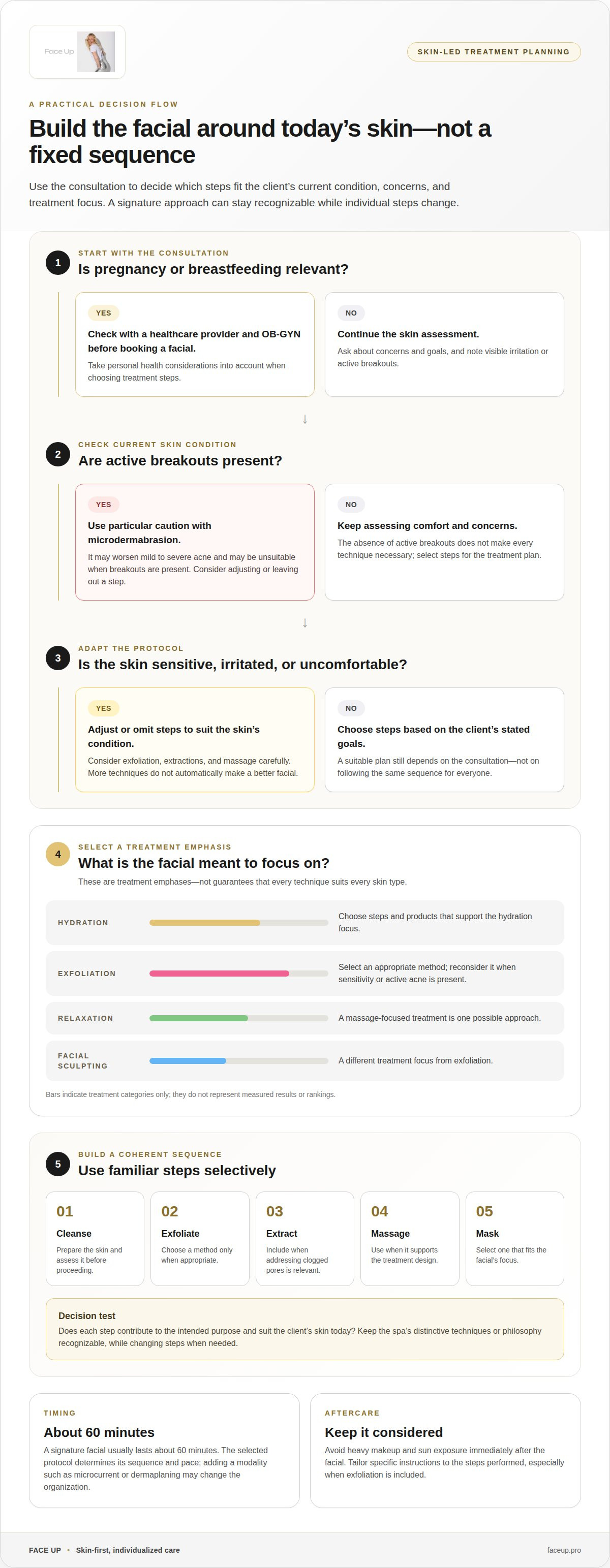
Sensitive or acne-prone skin can affect which facial steps are suitable. Before choosing exfoliation, extractions, or massage, consider visible irritation, active breakouts, and the client’s stated concerns.
Microdermabrasion may worsen mild to severe acne, so it may be unsuitable when breakouts are present. A signature facial isn’t a fixed set of techniques: leaving one out may be more appropriate than following a standard sequence. Let skin comfort and current condition guide the choice.
Facials can be grouped by their main focus, such as hydration, exfoliation, or relaxation through massage. These categories describe the treatment’s emphasis, not a guarantee that every technique suits every skin type. For example, a facial designed around exfoliation may need a different approach for someone with active acne than a massage-focused treatment.
When planning a treatment, distinguish a long-term concern from what’s happening that day. Acne-prone skin with active breakouts calls for particular caution around microdermabrasion. Sensitivity also makes it important to identify which steps to adjust or omit, rather than assuming that more techniques create a better facial.
Pregnancy and breastfeeding are also relevant to facial selection. People who are pregnant or breastfeeding should check with their healthcare provider and OB-GYN before booking a facial. This conversation can help account for personal health considerations when choosing treatment steps.
Aftercare matters, too. Avoid heavy makeup and sun exposure immediately after a signature facial. These precautions keep the post-treatment routine focused while the skin settles. Tailor specific instructions to the steps performed, especially when exfoliation is part of the facial.
If your interest is facial sculpting rather than exfoliation, explore facial sculpting approaches as a different treatment focus.
Typical facial steps and products
A signature facial commonly follows a sequence of cleansing, exfoliation, extraction, facial massage, and a mask. For practitioners, creating a signature facial treatment means arranging these familiar steps into a coherent experience, then selecting techniques and products that support its purpose.
- Cleansing: Begin with a cleanser suited to the treatment plan. This prepares the skin for later steps and helps the esthetician assess it before proceeding.
- Exfoliation: Choose an exfoliation method that fits the protocol. Dermaplaning, microdermabrasion, or another approach may be considered when appropriate.
- Extraction: Include this step when addressing clogged pores is relevant. It isn’t automatically necessary for every client or facial.
- Massage: Add facial massage where it supports the treatment’s design. Its technique and place in the sequence can distinguish one protocol from another.
- Mask: Finish the main treatment steps with a mask selected for the facial’s focus. A jelly mask is one possible option.
Products work best as a considered skincare plan, not as unrelated additions. For example, the cleanser, exfoliation method, and mask can all support the same treatment focus. A facial shaped by a spa’s philosophy might also feature a distinctive massage technique or mask application. When creating a signature facial treatment, connect each choice to the experience you want clients to recognize.
A signature facial usually lasts about 60 minutes. That session can accommodate several steps, but the chosen protocol determines its sequence and pace. Adding a modality such as microcurrent or dermaplaning may change how the appointment is organized, so neither should be treated as an automatic addition.
A useful test when creating a signature facial treatment is whether every step contributes to its purpose. Define the essential sequence first, then choose optional techniques and products that strengthen its identity. This creates a consistent structure while leaving room for thoughtful adjustments to the plan.
Consultation and treatment selection
A consultation turns a facial menu into a treatment plan. It gives the esthetician a chance to understand the client’s skin concerns, health history, and goals before selecting techniques. A first-time client concerned about sensitivity, for example, may need a different approach from a regular spa client seeking a familiar facial.
Use the conversation to clarify what matters most, then connect each choice to that priority. The esthetician can explain the proposed steps and talk the client through the treatment. This makes the plan clear rather than leaving the client with a sequence of unfamiliar procedures.
- Skin goals: Clarify whether the priority is hydration, exfoliation, relaxation, or another concern.
- Current condition: Discuss sensitivity, active acne, and other relevant skin concerns.
- Health history: Consider health factors that may affect the selected modalities.
- Treatment plan: Match each step to the client’s needs, and explain any adjustment.
A customized facial can suit anyone, especially clients with significant skin concerns or first-time clients who feel nervous about treatment. A signature facial may suit regular spa clients with few health-history complications and skin concerns. Suitability still depends on the techniques in its protocol. A facial containing microdermabrasion, for example, calls for a different assessment than one without it.
Pregnancy and breastfeeding also belong in the conversation. People who are pregnant or breastfeeding should check with their healthcare provider and OB-GYN before booking a facial. This helps inform treatment selection based on their individual circumstances.
The consultation should end with a clear, tailored plan: chosen steps, relevant adjustments, and an explanation of how each supports the client’s goal. If the main interest is facial tension rather than skincare steps, explore a facial sculpting approach as a distinct treatment focus.
Face Up: Face Up Sculpting Treatment
Face Up Sculpting Treatment offers a distinct option if you’re interested in facial sculpting rather than a product-led skincare facial. Its holistic method focuses on releasing deep muscular and emotional tension in the face and neck, supporting natural rejuvenation without invasive procedures.
This approach may suit you if you’re looking for hands-on work with facial tension and a treatment centered on the face and neck. It differs from a traditional facial sequence built around cleansing, exfoliation, extractions, and masks. The focus is on tension patterns, not selecting skincare products for a particular skin concern.
Choose between these approaches according to your goal: a skincare-focused facial centers on its planned skin-care steps, while Face Up Sculpting Treatment centers on facial sculpting. If you’re drawn to an approach focused on facial tension and sculpting, book a Face Up treatment.
Choose the Next Step That Fits Your Goals
Let your next step reflect the experience you want to create or receive. For practitioners, creating a signature facial treatment is an ongoing process of refining a clear philosophy and building skills around it. For someone seeking personal facial care, the right direction may be a hands-on treatment or guided practice at home.
Face Up offers different ways to engage with facial sculpting and self-practice. Face Up Method Certification is for practitioners, while the Face Up App Subscription supports daily self-practice rituals. The Jaw Release Course offers another learning path focused on jaw release. Each serves a different purpose, so choose the one that aligns with your interest.
If you’d like to explore a personal treatment, start a conversation with Face Up about your facial goals. Take the next step at your own pace and choose an approach that feels relevant to you.
Frequently Asked Questions
What is a signature facial treatment?
A signature facial treatment is a spa’s distinctive approach, shaped by its techniques, products, or treatment philosophy. It can still be adapted for the person receiving it. A spa might keep its recognizable massage style while adjusting exfoliation or mask choices to match a client’s priorities. The defining element is the spa’s approach, not a universal recipe.
How do you design a signature facial step by step?
Start by defining the facial’s purpose, such as hydration, relaxation, or exfoliation. Identify the intended client and the skin concerns the treatment should address. Choose a core sequence, then decide which optional techniques support that purpose. Finally, document how the treatment can be adapted, what the client should expect, and which steps may be unsuitable for particular concerns.
How do you choose ingredients and products for different skin types?
Choose products according to the treatment goal and the client’s reported skin needs, not simply because an ingredient is trending. A facial focused on hydration, for example, should have a product plan that supports that focus throughout the session. Keep the selection coherent: the cleanser, exfoliation method, and mask should fit the same treatment design, with adjustments when sensitivity or active acne affects suitability.
What facial treatment steps and techniques are safe and effective?
No single technique is appropriate for every client. Select steps according to skin condition, relevant health history, and the facial’s purpose. Microdermabrasion, for instance, may worsen mild to severe acne, so it may be unsuitable in that situation. A considered protocol explains why each technique is included and allows the esthetician to omit a step that doesn’t suit the client.
How long should a signature facial take, and how often should clients book one?
A signature facial usually takes about 60 minutes, though the selected steps can affect the appointment. Booking frequency depends on the treatment and the client’s goals. Visible effects generally last two to four weeks, while a Glow Signature Facial is recommended every four to six weeks for maintenance. That schedule applies to that named facial, not automatically to every customized treatment.
How does a signature facial differ from a classic or customized facial?
A signature facial reflects a spa’s treatment style, while a customized facial describes how the service is adapted to an individual’s needs. A classic facial usually refers to a familiar, established format. These ideas can overlap: a spa can deliver its signature approach while tailoring steps, such as the exfoliation method or mask, to the client.


