

A beauty ritual can care for your appearance without making appearance its purpose. Holistic beauty rituals for self-love focus on how you treat yourself, while self-care describes actions that support your well-being. A mindful facial massage, for example, can be self-care; approaching it with patience and respect for your body can make it an expression of self-love.
Beauty habits can become focused on fixing perceived flaws or seeking approval, even when they start with good intentions. This guide explains how self-love and self-care differ in beauty, shares practical ways to make rituals more present and personal, and explores how to keep expectations realistic. You’ll also learn to notice whether a practice supports your relationship with yourself, rather than making your reflection the only measure of success.
Key Takeaways
- Set an intention before a beauty ritual, then notice whether it reflects your own values rather than a desire for approval.
- Make skincare or self-massage more mindful by slowing down and paying attention to the experience, not just the outcome.
- Track changes in mood and how you feel over time, as well as any visible changes, to set realistic expectations.
- Choose goals such as patience or gratitude, and adjust habits that make you feel focused on comparison or flaws.
1. How can I maintain high self-concept clarity during my beauty rituals?
Start with an intention that reflects your values, not someone else’s ideal. Pause for 30 seconds before skincare and choose a quality to practice, such as patience. Take three breaths, then ask what the ritual means to you. A journal can help you notice whether your choices still fit your beliefs and needs.
Consistency can make a routine familiar, but flexibility keeps it personal. Korean skincare is often described as a 10-step routine centered on layered hydration and nourishment; you can choose a simpler sequence that suits your time and skin. Treat each step as an option, not a test. A mindful 15 minutes of moisturizing without television or social media may feel more grounding than completing every step distractedly.
Self-love rituals and routines overlap, but they serve different purposes. A routine repeats an action, such as washing your face; a ritual adds attention and meaning, such as noticing how your hands move during a gentle massage. For a simple morning practice, breathe, cleanse, moisturize, and name an intention. In the evening, cleanse, moisturize slowly, and note one feeling in your journal. Ayurvedic daily routines may include going to sleep before 10:00 p.m.; adapt any practice to your circumstances rather than treating it as a rule.
At-home holistic beauty rituals support private, repeatable practice, while a professional spa treatment offers care in a practitioner-led setting. At-home product costs depend on what you choose; professional treatment pricing depends on the case and is given after a quote request, with factors such as the service and session needs. Essential oils and DIY mixtures can irritate or cause sensitivity, so avoid concentrated oils and stop using a mixture if discomfort occurs.
If self-worth concerns become overwhelming or you may harm yourself, call or text 988 in the United States; according to the 988 Suicide & Crisis Lifeline, dialing 988 reaches its support line. Self-love practice can be powerful, but it doesn’t replace urgent help.
2. What is the difference between self-love and self-care in beauty?
Self-care is the action; self-love is the respect that guides it. Cleansing your face can support well-being, while choosing a gentle approach reflects kindness toward your body. Notice the feeling behind each step: are you nourishing yourself, or trying to correct a feature for outside approval? That distinction can turn an ordinary morning routine into a more intentional practice.
For facial massage or gua sha, begin with clean hands and comfortable skin. Apply a product that lets your fingers or tool glide, then use light pressure and slow movements. Avoid irritated or broken skin, and stop if the practice causes pain or discomfort. The aim is mindful attention, not force or a promised change in appearance.
Massage can also draw attention to the body beyond the face. Lomi lomi, a Polynesian and Hawaiian massage practice, combines healing touch, breath, and prayer. Monoi oil, an all-over moisturiser infused with tiare flowers, offers another example of care shaped by nature and cultural meaning. These traditions aren’t interchangeable; approach each with respect for its context.
Scalp care can be simple: use your fingertips to move gently across your scalp while washing or conditioning your hair. Focus on pressure and sensation rather than pulling at your hair. In Ayurveda, abhyanga refers to self-massage as part of personal care; a mindful version can involve slowly applying oil to your body and noticing how it feels. Keep the practice comfortable and suited to you.
A mindful bath can also create a quiet pause. Set out a towel, adjust the water to a comfortable temperature, and wash from head to toes while appreciating what your body does each day. If guided instruction would support your facial self-massage practice, explore facial sculpting guidance.
3. How long does it take to notice benefits from mindful beauty rituals?
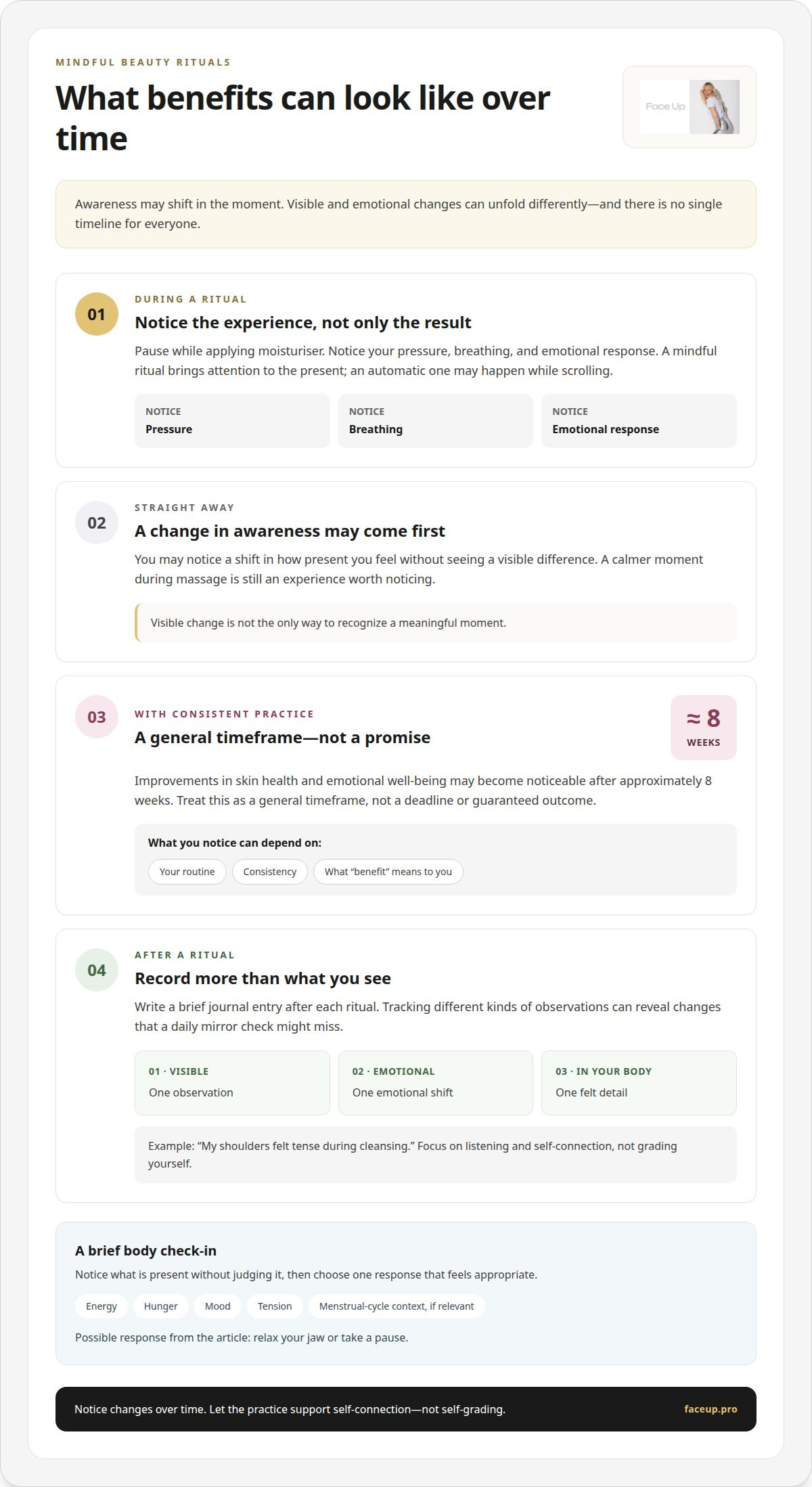
There isn’t one timeline for every benefit. A habitual ritual follows familiar motions, such as cleansing while scrolling; a mindful one brings your attention to the present moment. You may notice a change in awareness straight away, without seeing a visible difference. For example, pause while applying moisturiser and notice your pressure, breathing, and emotional response. This can help you distinguish a caring practice from an automatic task.
Visible and emotional shifts unfold differently. With consistent practice, improvements in skin health and emotional well-being may become noticeable after approximately 8 weeks. Treat that as a general timeframe, not a deadline or promise. Your routine, consistency, and what you mean by “benefit” all shape what you notice. A calmer moment during massage counts as an experience worth recording, even if your appearance hasn’t changed.
Use a brief body check-in to ground your attention before or after skincare. Notice your energy, hunger, mood, tension, and any menstrual-cycle context that feels relevant. Name what you observe without judging it, then choose one response, such as relaxing your jaw or taking a pause. This practice supports acceptance by helping you respond to what’s present, rather than relying only on a mirror.
Mindful eating can extend the same attention beyond beauty care. At a meal, set aside your phone, notice the food’s taste and texture, and check how your hunger changes as you eat. This isn’t a test of perfect focus; if your attention wanders, gently return to the next bite. The practice makes eating a distinct moment of care instead of another task completed on autopilot.
To track your experience, write a brief journal entry after each ritual. Record one visible observation, one emotional shift, and one detail about how you felt, such as “my shoulders felt tense during cleansing.” Reviewing entries over time can reveal changes that a daily mirror check might miss. Focus on listening and self-connection, not grading yourself.
4. Avoiding appearance-focused beauty habits
Give each ritual a goal unrelated to changing your appearance. Before cleansing, choose patience; while applying moisturiser, practise gratitude for your hands. This small step shifts attention towards well-being and the connection between your actions and values. It also gives you a clear way to assess whether the ritual feels supportive.
Notice the thought that comes up when you look in the mirror. If you find yourself searching for flaws, turn your attention to the sensation of washing your face or applying moisturiser. You can also limit mirror time during the ritual and focus on how a product feels. These choices interrupt appearance-based checking without asking you to criticise yourself.
Social media can make comparison feel automatic. If an image leaves you judging your face or body, close the app and name one thing your body helped you do today, such as walking outside or holding a cup. Online images show only part of someone’s life. Turning away from comparison protects your mental space and makes room for your own experience.
Use a body-focused practice to build respect beyond appearance. As you wash from head to toe, notice what each part of your body does for you. You might appreciate your feet for carrying you or your hands for helping you work and connect with others. This shifts the measure of beauty towards function, presence, and strength.
After a ritual, record one internal change in a journal, such as feeling calmer or more confident. Let that observation matter alongside visible outcomes. If a habit repeatedly leaves you feeling inadequate, adjust it: shorten mirror checks, change the goal, or pause the practice. Explore guided facial sculpting as one way to bring mindful attention to your routine.
Face Up
Face Up offers ways to bring mindful facial practice into your personal routine or professional path. For daily self-practice, the Face Up App Subscription provides guided rituals, while the Jaw Release Course supports focused learning around jaw tension. A Face Up Sculpting Treatment offers a practitioner-led experience for those who prefer hands-on care. Practitioners can explore the Face Up Method Certification to develop their skills in the method.
Choose the format that suits your intention: building a consistent practice, learning a specific technique, experiencing a treatment, or developing professional expertise. Each can complement a thoughtful approach to beauty, where attention and care matter alongside appearance. To discuss which Face Up option fits your goals, contact Face Up.
Let your next ritual reflect what you need
Your next step doesn’t need to be a complete routine or a visible transformation. Choose one small practice that feels meaningful today, then let your needs guide how it changes over time. The value of holistic beauty rituals for self-love lies in the attention you bring, not in meeting someone else’s standard. A moment of care can be enough to reconnect with yourself.
If you’d like support developing a more mindful facial practice, explore Face Up’s self-practice programs, professional training, or bodywork. Choose the path that feels aligned with your intention, and allow your practice to develop at your own pace.
Contact Face Up to explore a thoughtful next step, and keep making space for care that feels like your own.
Frequently Asked Questions
What is the difference between self-love and self-care in beauty?
Self-care is the choice to tend to a need; self-love is the respect behind that choice. For example, you might simplify skincare during a demanding week because you value ease, not because you’ve failed at a routine. A useful test is whether your beauty choices leave room for your preferences, limits, and changing circumstances, rather than demanding constant correction.
Can I practice self-love in beauty if I have skin conditions like eczema?
Yes. Self-love can mean responding thoughtfully to your skin’s needs, including choosing not to do a beauty step that feels uncomfortable. Keep your ritual focused on actions that already suit you, such as a quiet pause or gentle breathing. For skincare choices during an eczema flare or when symptoms change, seek advice from a qualified health professional familiar with your situation.
How can I maintain high self-concept clarity during my beauty rituals?
Choose a personal value to guide your ritual, then use it as a reference point. If creativity matters to you, make space for a hairstyle or colour that feels expressive rather than approval-seeking. Afterwards, write down whether the choice felt like yours. Revisiting these notes can help distinguish your own preferences from pressure picked up from trends, comments, or comparison.
How long does it take to notice benefits from mindful beauty rituals?
The timing depends on what you mean by benefit. You may notice a difference in your attention during a single practice, while a broader shift in habits takes repeated reflection. Pick one sign to observe, such as feeling less rushed while getting ready, and note it periodically. Avoid treating a specific day or visible change as proof that the ritual is working.
What makes a ritual holistic?
A holistic ritual considers more than the cosmetic step alone. Holistic beauty rituals for self-love can include attention to your surroundings, physical comfort, feelings, and intention. For instance, before brushing your hair, create a calm space, notice whether you’re rushing, and choose a comfortable pace. The practice is personal, not a fixed sequence everyone must follow.
What are simple daily skincare rituals that support self-care?
Keep your routine manageable: cleanse, apply moisturiser, and pause to notice how your skin feels. Simple skincare can be part of holistic beauty rituals for self-love when it helps you begin or end the day with care rather than pressure. Use products already suited to your needs, and change one step at a time so you can notice how the routine feels.


