

Somatic bodywork is learned through focused study and hands-on practice, rather than through one universal training route. If you’re exploring how to become a somatic bodyworker, first clarify the kind of work you want to offer. Then choose training that develops your understanding of body awareness and practical techniques.
It’s natural to wonder whether you need prior experience, how long training takes, and whether you can learn online at your own pace. The right path depends on your background and goals. Therapists, massage therapists, yoga teachers, and wellness practitioners may bring useful experience, while newcomers can start by building foundational knowledge.
This guide explains how background courses and information sessions can help you prepare, what self-paced study can and can’t provide, and how training duration varies by level and location. It also covers continuing education and the difference between practitioner training and a clinical therapy pathway, helping you plan a considered next step.
Key Takeaways
- Use your experience in therapy, massage, yoga, or wellness to identify useful starting points for somatic bodywork study.
- Distinguish practitioner or coaching training from a clinical therapy pathway, which typically takes 6 to 9 years in the United States.
- Plan for continuing education through workshops, seminars, or advanced training, and understand that completing a course is different from professional certification.
- Compare self-paced learning with scheduled instruction: U.S. Beginning and Intermediate modules run for 4 days and include 24 hours of instruction, while advanced courses run for 6 days and include 36 hours.
Are there any continuing education requirements for certified somatic practitioners?
Somatic practitioners can continue learning through workshops, seminars, and advanced training. Whether continuing education is a formal requirement depends on the credentialing organization and professional pathway. Before enrolling, review the organization’s current renewal criteria and note any education, active-practice, or assessment conditions that apply to your credential.
Choose your career track before selecting additional education. A coaching or practitioner path can focus on present-moment awareness, body-based methods, and personal growth. A clinical path involves deeper work with emotional patterns and trauma, so its education and professional eligibility requirements may differ. For example, a licensed therapist adding somatic methods should distinguish continuing education for an existing license from training toward a separate somatic credential.
Choose a training program by reviewing its curriculum, hands-on practice, and assessment of client-facing skills. Ask which body, if any, accredits it and what that recognition covers. A course certificate documents completion, but doesn’t automatically establish professional certification. The U.S. Department of Labor describes certification as requiring testing and an application. This distinction matters when assessing eligibility and describing your professional standing.
For state scope-of-practice and title-use rules, identify the requirements where you intend to work. Keep your professional title and service descriptions aligned with your training and any license you hold. Describe bodywork accurately, and don’t present it as mental-health treatment or trauma therapy unless your qualifications and applicable rules support that work.
To build supervised experience after training, look for a program that includes supervised practice or an internship, then review the relevant certification body’s application and testing steps. A mentor can help you refine practical skills, reflect on client sessions, and identify further education. Keep a record of completed workshops and advanced training, along with evidence of active practice if your credential requires it. This gives you a clear basis for planning professional development.
How do I become a somatic therapist?
Somatic practitioners use breathwork, guided movement, and touch to help people notice bodily sensations. To pursue this work, choose a clinical or coaching pathway, then build relevant knowledge and supervised practical skills.
Movement, Mindfulness, and Emotional Integration
Somatic methods connect physical sensations with mental and emotional patterns. For example, a practitioner may guide someone to notice how stress changes their breathing or posture, then use mindful movement to explore that response. This work can support awareness of tension and emotional patterns, including trauma-related experiences. When reviewing a program, consider how it teaches practitioners to integrate body awareness with client reflection, rather than treating movement as exercise alone.
Breath, Touch, and Embodiment Techniques
Breathwork can help clients attend to sensations as they arise, while guided movement offers a practical way to explore posture and habitual tension. Somatic practitioners may also use touch therapy to help clients tune into their bodies. Training should explain how each technique is applied and provide opportunities to practise with supervision. Look for clear instruction on consent, communication, and adapting methods to each individual.
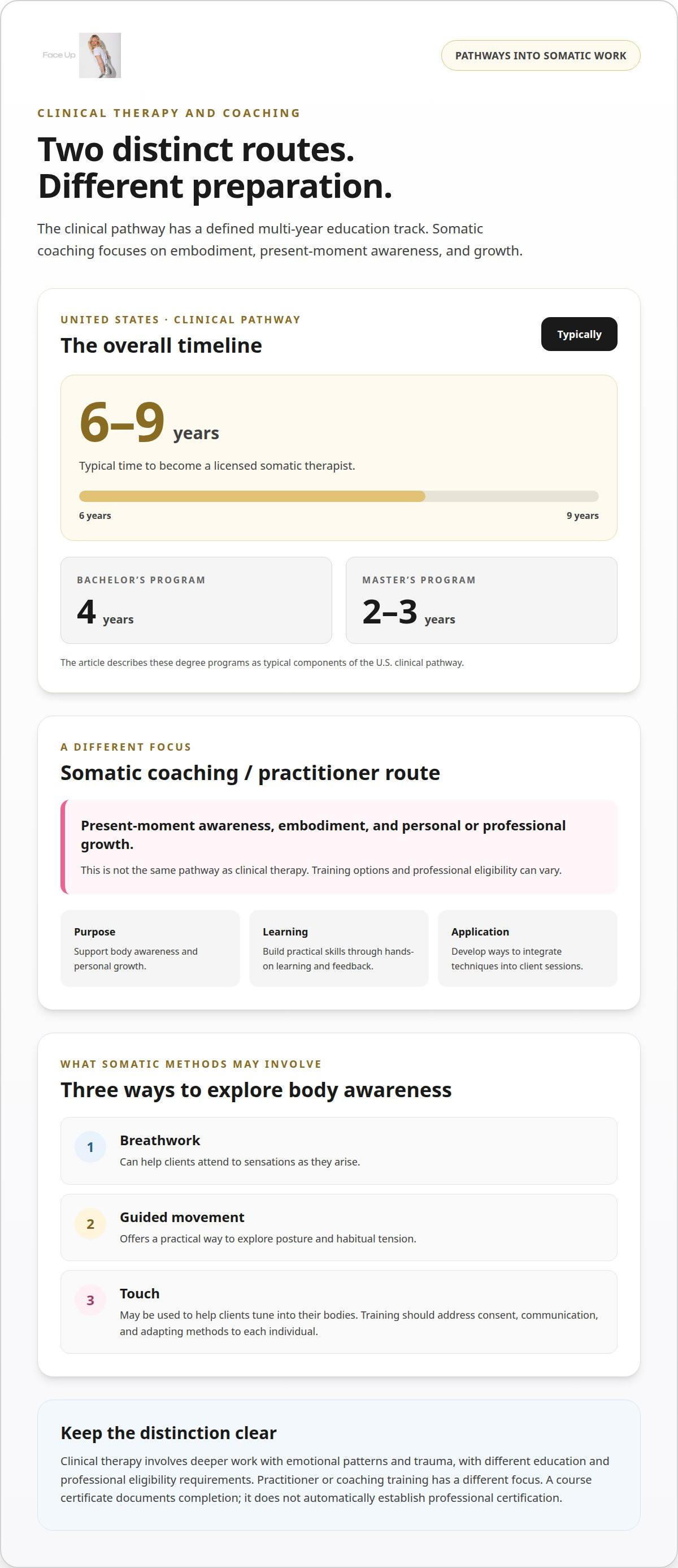
The clinical and coaching routes differ in purpose and preparation. In the United States, the clinical pathway typically includes a bachelor’s program lasting 4 years and a master’s program lasting 2 to 3 years. Becoming a licensed somatic therapist typically takes 6 to 9 years. Somatic coaching instead focuses on present-moment awareness, embodiment, and personal or professional growth; it isn’t the same pathway as clinical therapy.
For a coaching or practitioner program, prioritize hands-on learning and client integration. A useful sequence is to study foundational body-awareness techniques, practise them with feedback, then develop ways to apply them in client sessions. Breathing, yoga, and stretching can serve as purposeful movement practices. Certification options vary, so distinguish course completion from professional eligibility and the scope of work you intend to offer.
Recommended background courses and information sessions
Therapists, massage therapists, yoga teachers, and wellness practitioners may bring relevant foundations to somatic training. An information session can clarify how a course builds on those skills and what preparation it expects.
Eligible Professional Backgrounds
These backgrounds offer different starting points. A massage therapist may already understand touch and body mechanics; a yoga teacher may have experience guiding breath and movement. Therapists can bring familiarity with emotional reflection, while wellness practitioners may have experience with client-centred support. If you’re seeking a course, ask how its approach supports learners from each field and whether beginners should complete foundational study first.
Faculty experience matters, too. Review instructors’ professional backgrounds and teaching experience, then consider whether their methods match your intended practice. An information session is a practical place to ask how teachers demonstrate techniques, supervise practice, and explain the boundaries between bodywork, coaching, and clinical care. Their answers help you assess the program’s approach without assuming every course has the same scope.
Ethics, Consent, and Client Safety
Look for clear teaching on informed consent before movement or touch. For example, students should learn to explain an exercise, invite questions, and respect a client’s choice to pause or decline. A course should also address boundaries, privacy, and accurate descriptions of the practitioner’s role. These topics provide a professional foundation for body-based work.
Ask how training addresses discomfort, emotional responses, and changes during a session. For example, students can practise pausing an exercise when a participant signals discomfort, then offering a non-touch alternative. Teaching should also clarify when a client’s needs fall outside the practitioner’s training, rather than presenting somatic work as a universal healing approach.
Before enrolling, use an information session to map your next steps: identify any recommended background course, review the curriculum, and clarify how practice opportunities are structured. Ask what feedback students receive and how the program evaluates their developing skills. These details help you choose education that fits your experience and supports a considered journey into somatic practice.
Online, self-paced learning and course duration
Online study can make somatic concepts easier to revisit, but it doesn’t automatically replace guided practice. Use self-paced materials to build awareness of posture, breath, and nervous system responses. Then consider how the training develops practical skills through demonstration, feedback, and practice. That distinction matters if your career goal involves working directly with clients.
Course duration depends on the training level and location. In the United States, each Beginning and Intermediate training module consists of 4 days and 24 hours of course instruction. U.S. advanced training courses consist of 6 days and 36 hours of course instruction. Outside the United States, Beginning and Intermediate modules may last six days rather than four days.
Course instruction figures describe teaching time, not necessarily the full time needed to develop a practice. Allow for the study and experience involved in integrating techniques, reflecting on sessions, and strengthening client communication. For example, someone studying while working may spread independent learning across their available schedule, while a scheduled module requires setting aside its stated days.
Before choosing a format, map the learning you need. First, identify whether you’re exploring somatic work or preparing for client-facing practice. Next, separate material suited to independent study, such as concepts and reflection, from skills that need guided feedback. Finally, compare the course’s stated instruction hours and location format with your schedule. This helps you understand what the course duration includes, rather than treating it as the entire learning journey.
For a focused introduction to facial tension and body awareness, explore the Jaw Release Course as one learning option. Keep your wider plan informed by the difference between independent study and structured training. If you’re preparing to work as a therapist or practitioner, consider how each course supports practical application, not just content access. A clear learning sequence can help you build awareness while keeping hands-on skills central.
Face Up: Somatic Bodywork Session
Face Up’s Somatic Bodywork Session offers a practical next step if you want to experience somatic work before pursuing further study. The method focuses on releasing deep muscular and emotional tension in the face and neck without invasive procedures.
Consider a session if you’re exploring how body awareness and hands-on somatic work may fit your personal wellness goals. If your aim is professional training, Face Up Method Certification is the relevant educational path. A session is an experience, not a substitute for practitioner education.
For a personal introduction to somatic bodywork, contact Face Up about the Somatic Bodywork Session.
Choose a next step that fits your direction
If you’re deciding how to become a somatic bodyworker, let your next step reflect the work you want to do. You might first deepen your own body awareness or move toward structured practitioner education. Keep the distinction clear: personal study can support exploration, while professional practice calls for relevant training and an informed understanding of your scope.
Face Up offers several ways to continue exploring, including Face Up Method Certification, Face Up App Subscription, and Jaw Release Course. Consider which best fits your current focus: professional development, ongoing self-practice, or a guided introduction to jaw release. You don’t need to map every stage of your career at once. A deliberate next choice can give your learning direction while leaving room to refine your goals through experience.
Contact Face Up about training to discuss a learning path that fits your aims. Take the next step with curiosity and care.
Frequently Asked Questions
How does somatic healing address trauma and stress in the body?
Somatic approaches use body awareness to help people notice how stress appears physically, such as through shallow breathing, muscle tension, or guarded posture. A practitioner may invite a client to observe a sensation and choose a gentle movement or breathing exercise. This can support awareness and emotional processing, but it isn’t a guaranteed way to resolve trauma or a substitute for clinical care.
What training and certifications are required to become a somatic bodyworker in the United States?
There isn’t one universal somatic bodyworker credential for every role. Requirements depend on whether you intend to offer bodywork, coaching, or clinical therapy, and on your existing professional qualifications. For a clinical career, plan for formal education and licensing in the relevant field. Practitioner training may instead focus on somatic methods, assessment, and supervised application. Course completion alone doesn’t establish eligibility for every role.
How long does somatic bodywork training take, and how much does it cost?
Training time and tuition vary by program, format, level, and the instruction or practical assessment included. A short course may introduce a method, while a broader professional pathway requires additional study and practice. To compare options, separate scheduled teaching from independent study and supervised experience, then review the curriculum and payment terms. No single duration or cost applies across somatic training.
Do somatic bodyworkers need a massage therapy license in my state?
Whether a massage therapy license is required depends on your state and the services you perform. Relevant distinctions may include whether your work involves hands-on massage, how you describe the service, and whether you use a regulated professional title. Before offering sessions, identify the rules that apply to your location and planned activities. Somatic training by itself doesn’t determine state licensing requirements.
What steps are involved in starting a somatic bodywork practice?
Start by defining your client group and the somatic methods you’re trained to use. Then clarify your service description, session boundaries, consent process, and referral approach for needs outside your expertise. Build practical experience through supervised work or mentorship, and prepare clear client information before accepting bookings. For example, explain whether a session includes touch or guided movement so clients can make an informed choice.
How much do somatic bodyworkers earn in the United States?
Earnings depend on factors such as location, client volume, work schedule, experience, and whether you’re employed or self-employed. A practitioner with a steady private caseload may have a different income pattern from someone offering sessions alongside another wellness role. Consider operating expenses and unpaid administrative time when planning a career. Don’t treat a single salary estimate as representative of every somatic bodyworker.


