

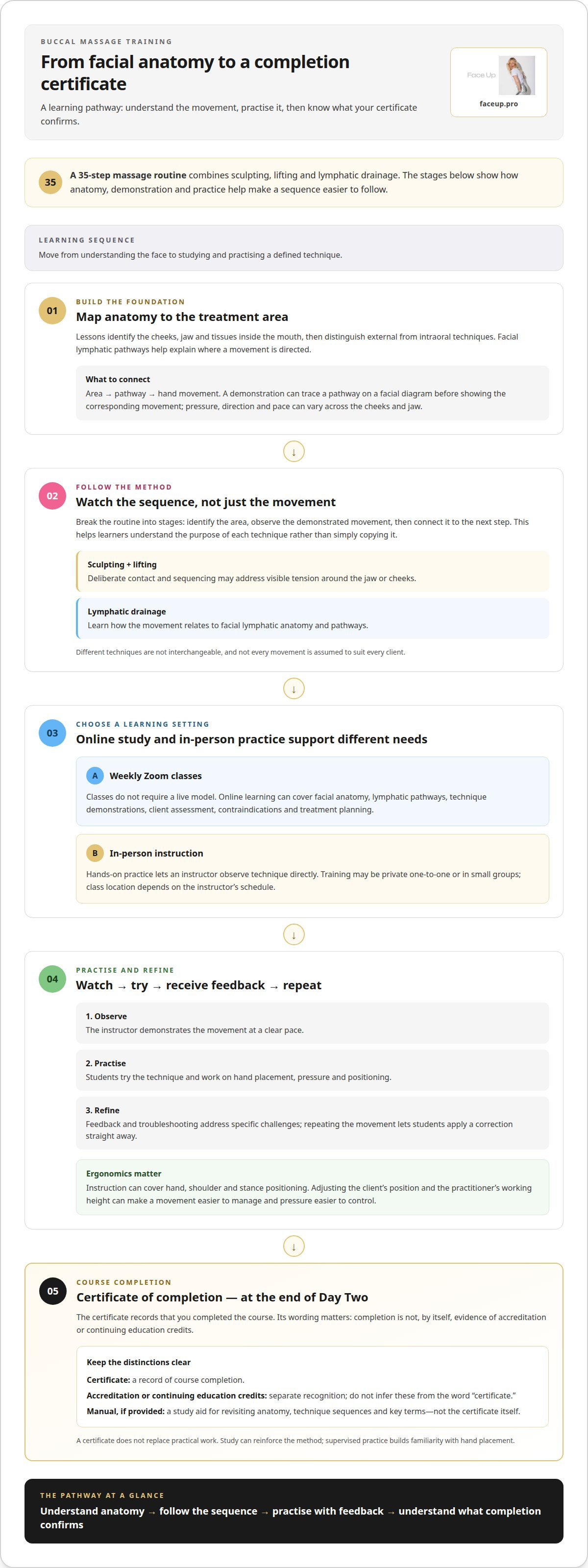
A certificate isn’t automatic across every course. In one buccal massage training format, participants receive a certificate of completion at the end of Day Two. Before enrolling, understand what the course teaches and what the certificate represents.
For massage therapists considering buccal massage training in Australia, online learning can offer a structured way to study facial anatomy, lymphatic pathways and technique demonstrations. Some weekly Zoom classes don’t require a live model, while training may also cover client assessment, contraindications and treatment planning.
It’s reasonable to want more than a certificate: you need to know how the technique is taught and whether online study supports confident practice. This article explains what certificate wording means, how instructors teach anatomy and buccal techniques, and what to look for in online learning. You’ll also see how a course may complement your massage work and where hands-on practice and feedback fit into your training.
Key Takeaways
- See how facial anatomy and lymphatic pathways help make buccal technique demonstrations easier to follow.
- Understand how instructor demonstrations, guided practice and feedback can support skill development.
- Learn when participants receive a certificate of completion and what to consider about the course’s recognition.
- Explore how online study can cover assessment, contraindications and treatment planning, and where Face Up Method Certification fits your learning goals.
Facial anatomy, physiology, and technique demonstrations
Effective buccal massage training connects each hand movement to facial anatomy and its intended treatment area. Lessons should identify the cheeks, jaw and tissues inside the mouth, then show how external and intraoral techniques differ. For example, an instructor can contrast gentle contact on the outside of the cheek with controlled pressure inside it. This context helps learners follow the sequence instead of copying movements without understanding them.
The lymphatic system is another important topic. Lymphatic and buccal facial massage training covers facial lymphatic anatomy and pathways, helping students understand lymphatic drainage techniques. A useful demonstration traces a pathway on a facial diagram before showing the corresponding hand movement. The instructor can explain how pressure, direction and pace vary across the cheeks and jaw, rather than treating the whole face as one surface.
A 35-step massage routine combines sculpting, lifting and lymphatic drainage. Breaking it into stages makes the protocol easier to follow: identify the area, observe the demonstrated movement, then connect that movement to the next step. Facial sculpting and lifting techniques may address visible tension around the jaw or cheeks through deliberate contact and sequencing. The point is to understand what each technique is designed to do, not to assume that every movement suits every client.
Instructor experience also matters. Polina has over 13 years of experience in facial anatomy and natural rejuvenation. For Australian students considering an international facial massage approach, clear explanations of terminology and technique help make demonstrations transferable across learning settings. NeoLifting facial massage and sculpting should likewise be taught through a defined sequence, with the instructor explaining how its approach relates to sculpting, lifting and buccal work. That distinction helps learners understand the method without treating different techniques as interchangeable.
Instructor demonstrations and hands-on practice
In-person buccal massage training takes place in the city hosting a scheduled class, so location depends on the instructor’s course schedule. The available details don’t identify particular Australian cities. Training is offered privately one-to-one or in small groups, formats that shape how much individual observation and feedback students receive.
A useful practice sequence moves from watching to trying, then refining. The instructor first demonstrates a movement at a clear pace. Students practise it, and the instructor gives feedback on hand placement, pressure and positioning. Troubleshooting can address specific challenges, such as maintaining a steady hold near the jaw while keeping the client comfortable. Repeating the movement after feedback lets students apply the correction straight away.
Good instruction also considers ergonomics. The instructor can demonstrate hand, shoulder and stance positioning before students practise sculpting movements. For example, leaning forward to reach a client’s cheek may strain the practitioner’s posture or make pressure harder to control. Adjusting the client’s position and the practitioner’s working height can make the movement easier to manage. These details matter when hands-on techniques are repeated throughout a career.
In-person training lets an instructor observe practice directly and respond to each student’s technique. In a small group, demonstration, practice and feedback can be distinct parts of the session. One-to-one teaching keeps attention on a single learner. Either way, the instructor can help students refine contact and sequencing instead of leaving them to interpret a demonstration alone.
Weekly Zoom classes don’t require a live model, while the training includes hands-on practice, troubleshooting and feedback. Each format serves a different learning need: online demonstrations support guided study, while face-to-face practice allows direct observation of technique. Before choosing a learning pathway, consider whether you need an instructor to assess your movements or mainly want to study demonstrations and principles.
Do I receive a Certificate after completing the course?
Yes. Participants receive a certificate of completion at the end of Day Two. That provides a clear record of course completion, but the wording matters. A completion certificate documents that you finished a course; on its own, it does not establish accreditation or continuing education credits. Those are separate forms of recognition and should not be inferred from the word “certificate.”
For a beauty or massage professional, this distinction helps set realistic expectations. A certificate can document study of a method, while continuing education credits refer to formal recognition under a separate system. The training awards a certificate of completion, not a stated credit. Treat the document as evidence that you completed the course, rather than assuming it changes a qualification or professional registration.
Check what the document identifies: the course, the issuing name and the completion status. “Certificate of completion,” for example, communicates a different outcome from a qualification title. A training manual, if provided, serves another purpose: it can help you revisit facial anatomy, technique sequences and key terms after instruction. The manual supports further study; it is not the certificate itself.
A certificate also doesn’t replace the practical work needed to develop skills. Connect anatomy with technique as you learn, then consider how each movement relates to a client’s needs. Reviewing a cheek technique in a manual can reinforce the method, while supervised practice builds familiarity with hand placement. Keeping these roles distinct makes the certificate useful without overstating what it proves.
For anyone comparing buccal massage training in Australia, the direct answer is that participants receive a certificate of completion at the end of Day Two. Consider the wording alongside the course content and learning format. This gives you a grounded view of what you completed, the skills you studied and whether separate credit recognition matters to your professional plans.
Online buccal massage training for massage therapists
Online study can help a therapist build knowledge of buccal techniques within a wider wellness practice. Look at how a course teaches assessment, responsible decision-making and treatment planning.
Online Course Format
Weekly Zoom classes provide instructor-led learning without requiring a live model. The training covers client assessment, contraindications and treatment planning, so online study can address more than facial movement sequences. For example, a therapist can connect an assessment lesson with decisions about whether a planned treatment suits a client. This format works best as structured learning, not as a substitute for every kind of supervised practice.
Course Curriculum Comparisons
Course curricula vary in their balance of anatomy, technique demonstrations and client-care topics. Compare the teaching sequence: does it cover assessment, contraindications and treatment planning? These topics are included in the training described here. A course focused mainly on demonstrations offers a different learning experience from one that also develops decision-making. For a massage therapist, a strong fit connects practical technique with client assessment and treatment planning.
Enrolment Qualifications and Prerequisites
There is no single prerequisite for every buccal massage course. Each course sets its own entry requirements, while a massage therapist’s prior training shapes how new facial techniques fit their existing knowledge. Before choosing, distinguish enrolment criteria from curriculum. Knowing whether a course is designed for working therapists or a broader group of learners helps you judge its relevance to your practice.
Regulations and Scope of Practice
In Australia, distinguish course completion from the scope of your professional practice. A training certificate records learning; it does not, by itself, define which services a therapist may provide. Scope depends on the practitioner’s underlying qualifications and the requirements that apply to their work. Learning an intraoral technique, for example, doesn’t replace sound client assessment or responsible treatment planning. Keep those decisions grounded in your professional role and the client’s needs.
Face Up
Face Up can be a next step for practitioners exploring facial techniques and continued learning. Its offerings include Face Up Method Certification, Face Up App Subscription and Jaw Release Course, alongside Face Up Sculpting Treatment. Each serves a different purpose, from developing method-based skills to experiencing a facial treatment.
If you’re deciding how to build on buccal massage study, consider whether your next priority is professional training, ongoing self-practice or bodywork experience. Matching your goal to the right kind of support helps you move forward without treating a course certificate as a substitute for practical judgement.
For a considered next step, contact Face Up to discuss which offering best fits your learning or treatment goals.
Take your next learning step with intention
Connect your learning goals with the work you want to do. Consider which skills you want to strengthen, how facial techniques fit your existing practice and what learning format helps you apply new knowledge. This makes buccal massage training in Australia a considered professional development decision, not just a course choice.
Focus on what you want to carry into practice: clearer technique, a more deliberate approach to client care or a pathway for continued learning. Choose a next step that supports your professional direction rather than simply adding another item to your credentials.
Face Up offers options for practitioners interested in developing their facial practice. Discuss your training goals with Face Up and choose a next step that feels aligned with your work.
Frequently Asked Questions
What is buccal massage training and what techniques are taught?
Buccal massage training teaches practitioners to work with facial tissues using external and intraoral techniques. A course can combine demonstrations with client assessment and treatment planning, helping learners understand how to choose an approach. For example, training may show how a practitioner considers a client’s needs before deciding whether buccal work belongs in a treatment plan.
Where can I take buccal massage training courses in Australia?
Australian learners can take part in online weekly Zoom classes, while in-person locations depend on the scheduled course delivery. The available course details don’t identify specific Australian cities, so there’s no reliable city list to provide. For location flexibility, online study offers a way to attend classes without travelling to an in-person venue.
What are the course fees and duration for buccal massage training in Australia?
Fees and duration vary with the course format, curriculum, practice opportunities and instructor support. A focused online course and an in-person program with guided practice may structure learning differently. Compare what the fee covers and how lessons are delivered, then consider whether the schedule allows enough time to understand the techniques and apply them thoughtfully.
Are there online buccal massage certification courses available to Australians?
Yes, Australians can access online buccal massage training, including weekly Zoom classes that don’t require a live model. Online learning can cover client assessment, contraindications and treatment planning alongside technique instruction. It suits therapists seeking structured remote study, while the certificate and practical components depend on the course design.
Is buccal massage training accredited or recognised in Australia?
A certificate of course completion and formal accreditation are different. The certificate documents that a participant completed the training, while recognition or continuing education credit depends on the relevant professional or accrediting framework. If you need a course to meet a particular professional requirement, identify that requirement first and assess the course against it, rather than relying on the word “certification” alone.
What safety, hygiene, contraindications and risks are covered in buccal massage training?
Training covers client assessment, contraindications and treatment planning, helping practitioners consider whether a technique is appropriate. Hygiene also matters before intraoral practice, including clear procedures for hand hygiene and barriers. Consider how the course teaches practitioners to recognise situations where treatment should be adapted or avoided, and how it supports responsible decisions during client care.


