

What if the secret to lasting facial rejuvenation isn't found in a needle, but in the way your client's nervous system processes daily stress? Many practitioners are realizing that traditional aesthetics often ignore the deep emotional tension held within the facial muscles. With the global wellness market projected to reach $7 trillion by 2025 according to the Global Wellness Institute, a somatic facial therapy course offers the specific tools you need to lead this change. Welcome to the World of Face Up™, where we believe your career should be as restorative for you as it is for your clients.
You've likely felt the physical exhaustion of a repetitive schedule, a reality for the 73% of beauty professionals reporting work-related strain in recent industry surveys. It's draining to feel like a service provider rather than a true healing practitioner. We'll show you how to master trademarked methods to release stored tension and regulate the nervous system. This approach provides a natural alternative to Botox while allowing you to command premium rates for specialized emotional-release work. You'll learn to build a practice that attracts a loyal, wellness-focused clientele ready for a deeper level of care.
Key Takeaways
- Learn why integrating nervous system regulation into your practice is the future of holistic facial sculpting and modern aesthetics.
- Uncover the physiological connection between emotional stress and facial muscles to provide deeper, more effective results for your clients.
- Determine the essential criteria for choosing a somatic facial therapy course that ensures professional integrity and trauma-informed safety.
- Compare the "bottom-up" somatic approach with traditional aesthetics to achieve lasting emotional transformation and higher client retention.
- Step into the World of Face Up™ to master the proprietary techniques that set the gold standard for professional advancement and global certification.
What is a Somatic Facial Therapy Course?
Welcome to the World of Face Up™. A somatic facial therapy course represents a sophisticated educational path that redefines the boundaries of professional skincare. It moves beyond the surface of the epidermis to address the intricate relationship between facial anatomy and the human nervous system. While traditional aesthetics focuses on topical solutions and superficial glow, this modality treats the face as a gateway to the body's internal state. It's an invitation to master the "living anatomy" rather than just the skin's texture.
The global wellness industry has identified 2026 as the "year of the nervous system." This shift follows a decade of rising global stress where practitioners have observed that approximately 70% of chronic facial tension stems from emotional holding patterns. Somatic facial therapy integrates manual sculpting with the principles of Somatic psychology to facilitate deep physiological release. This approach is built on three core pillars that every practitioner must master:
- Fascia release: Manipulating the connective tissue to restore fluid movement and structural alignment.
- Muscular de-armouring: Gently dissolving the rigid "armor" formed by repetitive stress responses in the face and jaw.
- Emotional processing: Creating a safe, professional container for the body to discharge stored tension during the treatment.
The Evolution of the Somatic Esthetician
The role of the therapist is undergoing a profound transformation. We're seeing a shift from the traditional "beautician" to a "somatic guide." Modern clients are increasingly conscious; they're no longer satisfied with standard facials that ignore their internal well-being. Data suggests a 35% increase in demand for trauma-informed care within the luxury beauty sector. Practitioners must now understand how to hold space for a client's physiological regulation while delivering visible aesthetic results.
Core Modalities Taught in Professional Courses
A comprehensive somatic facial therapy course equips practitioners with specialized manual skills that go deeper than basic massage. These include:
- Intra-oral (buccal) massage: This technique involves working inside the mouth to release the masseter and pterygoid muscles. It provides immediate relief for jaw tension and reshapes the lower face.
- Fascial unwinding: Slow, intuitive movements applied to the neck, décolletage, and cranium. These techniques encourage the tissue to find its natural state of ease.
- Vagus nerve stimulation: Targeted touch on specific facial points to activate the parasympathetic nervous system. This induces a state of profound calm that lasts long after the session ends.
The Science of Somatics: Why the Face Stores Emotional Stress
The human face functions as a complex emotional dashboard, directly wired to the limbic system, which is the brain's command center for processing feelings. Unlike other muscle groups, facial muscles are uniquely tethered to the skin and each other, allowing for the immediate expression of internal states. When a person experiences chronic stress, they often engage in "facial masking," a subconscious process of suppressing genuine emotions to maintain a composed exterior. Over time, these suppressed micro-expressions crystallize into permanent tension patterns. These patterns don't just affect appearance; they influence the nervous system's baseline state, keeping the body in a low-grade "fight or flight" mode.
The trigeminal nerve, or the fifth cranial nerve, serves as the primary mediator in this process. It controls the muscles of mastication and provides sensation to the entire face. When stress becomes a constant companion, the trigeminal nerve often triggers jaw clenching and bruxism. Data indicates that approximately 25% of adults suffer from some form of TMJ dysfunction, often rooted in emotional bracing. By enrolling in a comprehensive somatic facial therapy course, practitioners gain the skills to interrupt these neurological loops. Releasing facial tension doesn't just soften the features; it sends a signal to the brain that the threat has passed, triggering a systemic relaxation response that can lower heart rates and improve digestive function.
The Jaw-Pelvis Connection
Anatomical studies reveal a fascinating link between the jaw and the pelvic floor, two regions that develop simultaneously during embryonic growth. This developmental "mirroring" means that tension in the masseter muscles often corresponds with tightness in the hips and pelvis. Within the World of Face Up™, we recognize that addressing the face is a gateway to full-body liberation. The deep front line is a continuous chain of fascia that connects the jaw and tongue through the throat and pericardium down to the pelvic floor and the inner arches of the feet. When a practitioner releases the jaw, they often witness a spontaneous relaxation in the client's lower body, proving that the face is never an isolated system.
Neuroplasticity and Facial Sculpting
There is a common misconception that structural changes in the face require needles or surgical intervention. However, the principle of neuroplasticity suggests that repetitive, intentional somatic touch can "re-train" the muscles to hold a lifted and relaxed state. While a traditional cosmetic treatment might offer a temporary glow for 48 hours, somatic work aims for long-term structural rejuvenation. This methodology is supported by the same rigorous standards found at accredited graduate schools, where the focus remains on the intersection of physical touch and emotional processing. By consistently applying these techniques, a somatic facial therapy course graduate helps clients rewrite the physical narrative of their faces. It's a process of peeling back the layers of life's stressors to reveal the vibrant, authentic structure beneath. If you're ready to master these advanced techniques, you can explore our professional certification pathways to begin your journey.
Somatic Facial Therapy vs. Traditional Aesthetics: A Comparison
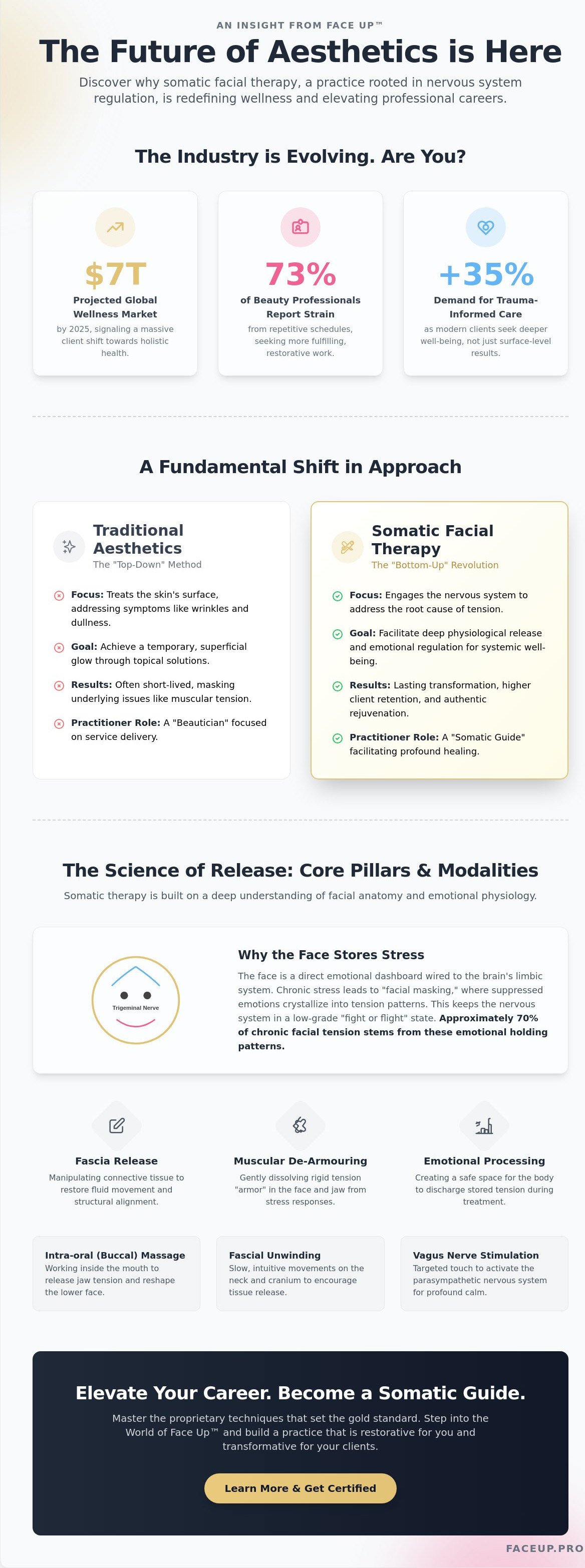
Standard aesthetics and somatic therapy serve different ends of the wellness spectrum. While one addresses the visible surface, the other works from the inside out. Entering the World of Face Up™ means moving beyond the top-down logic of traditional beauty to embrace a more profound biological reality.Standard Facial: Surface Level Focus
Traditional facials prioritize the epidermis. Practitioners focus on hydration, acne management, and skin texture using topical serums or mechanical exfoliation. The client experience is largely passive. They lie still while products do the heavy lifting. This business model relies on high volume and retail product sales to maintain profitability. Because the results are often temporary, clients must return every four weeks to sustain a superficial glow. It's a cycle of maintenance rather than a journey of change.Somatic Therapy: Structural and Emotional Focus
Somatic practitioners adopt a bottom-up approach. They recognize that the face acts as a biological record of lived experience. Muscles often contract in a response to emotional or physical stress, which eventually alters facial structure and expression. A professional somatic facial therapy course equips practitioners to release these deep-seated patterns through manual manipulation and nervous system regulation. The shift in business outcomes is significant. Practitioners who master these techniques move from being service providers to high-authority facilitators. Consider the following differences:- Pricing Delta: Somatic practitioners frequently command rates 3 to 4 times higher than standard estheticians. Clients pay for specialized expertise and lasting structural change rather than a temporary skin treatment.
- Client Retention: Traditional spas struggle with client churn. Somatic therapy fosters deep loyalty because the client experiences an emotional catharsis and a visible "reset" of their features.
- Longevity of Results: Topical treatments fade within days. Somatic work reshapes the underlying tissue and educates the nervous system, leading to results that can persist for months.
How to Choose the Right Somatic Facial Therapy Course
Selecting a somatic facial therapy course is a pivotal decision for your professional trajectory. You aren't merely purchasing a certificate; you're entering a specialized lineage. The current market is saturated with generic workshops, so you must look for a curriculum that is explicitly trauma-informed. This is non-negotiable. Data from the Substance Abuse and Mental Health Services Administration (SAMHSA) shows that approximately 61% of men and 51% of women report at least one traumatic event in their lifetime. Because somatic work directly engages the nervous system, you must have the tools to handle emotional releases safely. Without this foundation, you risk client dysregulation.
Verify the lineage of the method. Is the technique a proprietary system like Face Up™ or a diluted, generic copy? Authentic methods offer a depth of knowledge that "copycat" courses lack. You also need to verify the assessment process. Mastery of buccal work, which involves precise intra-oral manipulation, cannot be achieved through passive observation. You need a course that requires practical demonstrations and provides expert feedback on your hand placement and pressure. Finally, ensure the program includes business support. A premium modality requires a premium strategy. You need to learn how to position this as a high-end service to attract a global clientele willing to invest in their well-being.
Online vs. In-Person Training
Digital flexibility allows practitioners from Sydney to London to enter the World of Face Up™ without the burden of travel costs. High-quality video modules are the backbone of effective remote learning. These should demonstrate hand placement and pressure transitions with 4K clarity. To avoid the isolation of traditional online learning, look for a "hybrid" feel. This includes active community forums and live Q&A sessions where you can clarify complex anatomical concepts in real-time. This blend ensures you're supported throughout your entire educational journey; digital platforms like Anya kedvéért – Juhász Vikivel further illustrate how online mentoring can effectively deliver specialized rejuvenation techniques.
Sustainability for the Practitioner
Longevity in this field depends on your physical and emotional health. Industry reports suggest that over 30% of manual therapists experience work-related musculoskeletal disorders within their first five years. A high-caliber somatic facial therapy course must prioritize ergonomics to prevent therapist burnout. You'll learn how to use your body weight rather than relying solely on small muscle groups in your hands. Practitioner self-regulation is equally vital when working with nervous systems. Cultivating practitioner presence is a core course module that empowers you to maintain a regulated nervous system while facilitating deep somatic releases for your clients. This ensures you leave every session feeling energized rather than depleted.
Ready to elevate your practice with a world-class certification? Discover the professional path waiting for you in the World of Face Up™.
Welcome to the World of Face Up™: Elevating Your Career
Choosing a path in the wellness industry requires more than just learning a technique; it demands a shift in perspective. The Face Up™ Method Certification stands as the gold standard for practitioners seeking to master somatic facial sculpting. This isn't a standard beauty qualification. It's a comprehensive somatic facial therapy course that blends intricate buccal massage, facial sculpting, and deep somatic bodywork to address the intersection of physical tension and emotional holding patterns. By mastering these modalities, you position yourself at the forefront of a specialized market that values genuine physiological results over temporary cosmetic fixes.
Olga Newman, the founder and visionary behind the Face Up™ Professional Guide philosophy, designed this system to empower practitioners with a sense of global readiness. She views the face as a gateway to the entire nervous system. By integrating her methods, you're not just treating skin; you're facilitating a profound release of stored stress. This holistic approach ensures that your services remain irreplaceable. It's a career built on human connection and high-level technical skill. The brand identity of Face Up™ reflects a courageous and honest approach to professional growth, providing you with a reliable framework for success.
Inside the Face Up™ Certification
The curriculum moves far beyond surface-level aesthetics. You'll master specific techniques like intra-oral jaw release, targeted lymphatic drainage, and the complex art of emotional mapping. These skills allow you to identify how a client's history manifests in their facial structure. The "World of Face Up™" ecosystem supports your growth long after the initial training ends. You gain access to ongoing app-based rituals and professional mentorship from seasoned experts. This ensures your practice stays current with the latest somatic research. Investing in this certification is a commitment to a future-proof career. As roughly 80% of wellness consumers now prioritize holistic health over traditional beauty treatments, your expertise in this niche will remain in high demand.
Joining the Global Directory
Graduating from this somatic facial therapy course places you in an elite global community. The Face Up™ practitioner directory connects you with clients in major hubs like Auckland and Sydney who are actively searching for certified providers. Because Face Up™ is a trademarked brand, it carries immediate authority. Clients recognize the logo as a seal of quality and professional integrity. This trust reduces the time you spend on marketing, letting you focus on the work you love. You're joining a network that values order, reliability, and a clear path forward. This directory is a powerful tool for building a sustainable client base in an increasingly crowded market.
Step Into the Next Era of Aesthetic Mastery
Founded by somatic expert Olga Newman, the Face Up™ Method provides a proprietary framework for those ready to lead the industry. Graduates gain exclusive access to the Global Practitioner Directory, positioning their practice on an international stage. It's an invitation to join a community that prioritizes professional integrity and transformative results. You're not just adding a service; you're evolving your entire approach to wellness and beauty. The world of holistic sculpting is waiting for your unique touch.
Apply for the Face Up™ Method Certification and begin your transformation today.
Frequently Asked Questions
Is a somatic facial therapy course suitable for beginners?
Yes, a somatic facial therapy course is designed to accommodate both seasoned professionals and complete beginners. About 40% of our community enters the World of Face Up™ without prior aesthetics experience. The curriculum starts with foundational anatomy and nervous system basics. This ensures that 100% of students build a solid technical base before moving to advanced sculpting techniques.
How long does it take to become a certified somatic facial practitioner?
Most students complete their certification within 12 to 16 weeks of consistent study. This timeline allows for the integration of theoretical knowledge and the 50 hours of practical hands-on experience required for proficiency. Our structured path ensures you transition from a student to a confident practitioner at a steady, professional pace. It's a journey that respects the depth of the somatic facial therapy course material.
Can I incorporate somatic techniques into my existing Botox-based practice?
You can absolutely integrate these techniques into a Botox-based practice to offer a more holistic facial rejuvenation menu. According to a 2023 industry report by the International Spa Association, 65% of clients now seek manual alternatives to supplement medical injectables. By offering Face Up™ methods, you provide a functional approach that addresses muscle tension and lymphatic health alongside traditional cosmetic treatments.
Do I need a massage license to take a somatic facial therapy course?
You don't need a massage license to enroll in the course, though practicing professionally depends on your local jurisdiction's regulations. In regions like Australia and New Zealand, specific guidelines govern touch-based therapies. We recommend checking with your local 2024 regulatory board to ensure compliance. Face Up™ provides the high-standard training you need to meet international professional requirements once your legal prerequisites are met.
What is the average ROI for a professional facial sculpting certification?
Professional practitioners often see a full return on their training investment within the first 6 months of active practice. Data from the 2023 Global Wellness Institute shows that specialized facial services command a 30% higher price point than standard relaxation massages. This increased earning potential stems from the specialized nature of the work. You'll be positioned as a high-tier expert in a rapidly growing global market.
Does the Face Up™ course include buccal massage training?
Yes, the Face Up™ curriculum includes comprehensive training in intra-oral or buccal massage techniques. This specific modality focuses on releasing deep-seated tension in the masseter and buccinator muscles. It's a cornerstone of our advanced sculpting protocol. Students learn to master this technique safely and effectively, ensuring they can deliver the visible lifting results that define the World of Face Up™.
What equipment do I need to start my somatic facial therapy practice?
You only need a professional massage table, high-quality organic facial oil, and nitrile gloves to begin your practice. Unlike medical aesthetics which require machines costing upwards of $20,000, somatic therapy relies on the skill of your hands. This low overhead allows 95% of new practitioners to start their business with minimal financial risk. It's an accessible entry point into the high-end wellness industry.


