
What if the most effective way to future-proof your career in 2026 isn't another high-tech device, but a deeper understanding of the somatic connection between the face and the nervous system? As the global non-invasive aesthetic market continues its rapid expansion, you might find yourself wondering: is facial sculpting certification worth it when the industry feels so saturated? It's a valid concern, especially when you're balancing the physical demands of traditional bodywork with the urgent need to stand out among local competitors.
We understand that you're looking for more than just a new skill; you're seeking a sustainable way to increase your revenue and provide transformative results. This guide will reveal the financial, professional, and therapeutic ROI of advanced certification, helping you determine if this is the right strategic move for your practice. We'll explore how moving beyond surface-level aesthetics to address emotional tension and somatic release can create a unique selling proposition that turns a standard service into a premium, high-demand experience.
Key Takeaways
- Understand why the 2026 aesthetic market is shifting toward conscious aging and how this transition creates a high-value niche for natural rejuvenation.
- Learn how to evaluate the financial return on your investment and determine if a facial sculpting certification is worth it based on projected hourly rates and client retention.
- Explore the therapeutic depth of the Face Up Method™, which integrates somatic bodywork and buccal techniques to address emotional tension rather than just surface-level aesthetics.
- Discover a two-step framework for auditing training programs to ensure the curriculum provides genuine medical and somatic depth; this helps you avoid low-value, generic courses.
- Identify the ergonomic advantages of somatic techniques that prevent practitioner burnout while gaining access to a global directory for lead generation.
The Rising Demand for Natural Rejuvenation in 2026
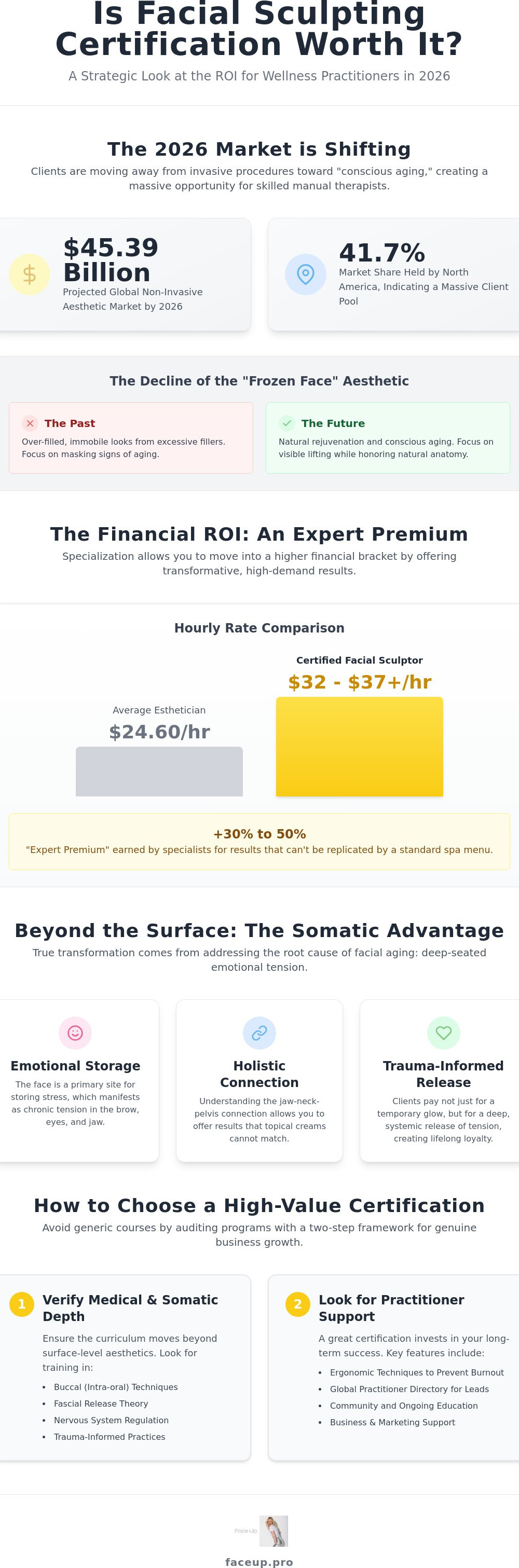
The aesthetics industry is undergoing a profound transformation as we move through 2026. While medical interventions remain popular, a significant segment of the market is shifting toward "conscious aging." Clients are increasingly wary of the "frozen" look associated with excessive fillers. They're searching for alternatives that honor their natural anatomy while providing visible lifting and contouring. With the global non-invasive aesthetic market projected to reach $45.39 billion in 2026, the demand for specialized manual expertise is at an all-time high. North America currently holds 41.7% of this market share, indicating a massive pool of clients who value longevity over a quick fix.
The Decline of the "Frozen Face" Aesthetic
The era of the over-filled, immobile face is ending. It's becoming obsolete. In 2025, US facial procedures grew by an estimated 19%, driven largely by a desire for non-invasive, high-performance manual techniques. Clients now prioritize the human touch. They want the precision of a practitioner who understands facial architecture. Traditional methods like Gua sha and sculptural massage have moved from niche wellness circles into the mainstream beauty spotlight. When you evaluate whether a facial sculpting certification aligns with your goals, consider how these skills position you as a specialist in this "natural-first" economy. You aren't just offering a facial; you're offering a sustainable alternative to the needle.
A significant "holistic gap" currently exists between traditional esthetics and standard massage therapy. Estheticians often focus exclusively on the skin's surface, while massage therapists frequently stop their work at the collarbone. This leaves the complex musculature of the face largely unaddressed. Facial sculpting fills this void by treating the face as a structural whole. It addresses both aesthetic goals and nervous system regulation in a single session.
The Somatic Revolution in Professional Wellness
Somatic work has become the modern gold standard for high-end practitioners. We've learned that the face is a primary site for emotional storage. Stress often manifests as chronic tension in the brow, eyes, and jaw. A practitioner who understands the jaw-neck-pelvis connection can offer results that a topical cream simply cannot match. This trauma-informed approach to beauty addresses the root cause of facial aging by releasing deep-seated tension in the fascia.
Professionals often ask: is facial sculpting certification worth it when the market feels crowded? The answer lies in the depth of your training. If your certification includes somatic theory and buccal techniques, you aren't just another service provider. You're a facilitator of holistic well-being. This specialized knowledge allows you to command higher rates while providing the deep, emotional results that modern clients are actively seeking. They aren't just paying for a glow; they're paying for a release.
Evaluating the ROI: Is Facial Sculpting Certification Worth It?
Deciding whether is facial sculpting certification worth it requires a shift in perspective. You have to move from viewing education as an expense to seeing it as a strategic business investment. While the average esthetician salary in the United States is approximately $24.60 per hour as of July 2026, specialized practitioners often operate in an entirely different financial bracket. By moving beyond basic services, you unlock the "Expert Premium." This is a pricing model where certified specialists command 30% to 50% more than generalists because they offer results that cannot be replicated by a standard spa menu.
Specialization doesn't just increase your per-session rate; it transforms your client retention. When a client experiences the profound emotional and physical release of a somatic facial treatment, they don't just see a temporary glow. They feel a systemic shift. This deep, therapeutic value creates lifelong loyalty. It reduces the constant, exhausting need for new client acquisition that plagues many general beauty businesses. Instead, you build a practice based on high-ticket, signature treatments that clients view as essential wellness rather than optional luxury.
Revenue Projections for Specialized Practitioners
The math of specialization is compelling. Compare the revenue of a standard 60-minute facial to a 90-minute somatic sculpting session. The latter allows for a much higher margin because it requires a level of manual skill and anatomical knowledge that machines cannot replace. If an industry-standard advanced course requires an initial investment, you only need to upgrade a handful of existing clients to these premium sessions to break even. Most dedicated practitioners achieve a full return on their training investment within three to four months of integrating these signature treatments into their menu.
Market Differentiation and Competitive Edge
Standing out in a saturated market is difficult if your services look exactly like the spa down the street. A proprietary method gives you a unique selling proposition that competitors lack. When you complete a somatic facial therapy course, you're gaining the ability to address complex issues like TMJ tension and nervous system dysregulation. This attracts a higher-tier clientele who are looking for holistic solutions rather than just surface-level skincare.
Your certification serves as a powerful marketing engine. It provides the social proof and authority needed to justify higher rates on social media and your booking site. Joining a global practitioner directory listing can also act as a direct lead-generation tool, placing your name in front of clients who are already searching for the specific benefits of somatic facial work. You aren't just gaining a certificate; you're gaining a professional identity that commands respect in the 2026 wellness market.
Beyond the Surface: Why Somatic Training is the Modern Gold Standard
Somatic facial sculpting is the practice of releasing deep-seated tension through the nervous system. It's a paradigm shift for the beauty industry. While traditional esthetics might focus on product penetration, somatic training prioritizes the fascial network and the cranial nerves. This is why the Face Up Method™ is so effective. It integrates buccal, lymphatic, and somatic bodywork into a single, cohesive system that addresses the structural foundation of the face. You aren't just moving skin; you're communicating with the body's internal architecture.
Attempting to learn these techniques through unregulated "YouTube learning" is risky. Facial anatomy is dense with nerves and delicate vessels. Improper pressure or incorrect vectors in deep tissue work can cause lasting discomfort or even nerve irritation. This professional risk is a key reason why is facial sculpting certification worth it; it provides the safety protocols and anatomical depth that free tutorials simply cannot offer. True mastery requires a guided environment where the science of fascial release is explained in detail. When you understand how fascia acts as a sensory organ, you can achieve a "somatic glow" that looks like it came from within, because it did.
The Power of Buccal Massage Training Online
Buccal, or intra-oral massage, has become the most requested "secret" technique of 2026. It allows you to access the musculature from both the inside and outside, providing a level of lifting that external massage alone can't achieve. Accessing high-quality buccal massage training online ensures you master the release of hidden muscles, such as the buccinator and internal pterygoids, safely and effectively. These muscles are often the culprits behind a heavy lower face or chronic jaw tension. Releasing them provides immediate, visible results that clients can see in the mirror and feel in their bodies.
Emotional Release: The Practitioner’s New Toolkit
Practitioners often see "emotional armor" in a client's facial expression. It's the set jaw, the tight lips, or the furrowed brow that never quite relaxes, even during sleep. This is where the therapeutic value of facial sculpting truly shines. Releasing the masseter and temporalis muscles does more than sharpen a jawline; it often triggers a profound emotional shift.
Consider the impact on a client who carries years of stress in their jaw. By using somatic techniques to calm the nervous system, you facilitate a release that transforms both their appearance and their well-being. They leave the table looking years younger, not because of a chemical, but because their facial muscles have finally let go of chronic stress patterns. This level of results turns a one-time client into a lifelong advocate for your practice.
How to Choose a Certification that Actually Grows Your Business
Selecting the right training program is a pivotal moment in your professional journey. It's the bridge between being a generalist and becoming a sought-after specialist. When you ask yourself, is facial sculpting certification worth it, the answer depends entirely on the depth of the curriculum you select. A high-quality program doesn't just teach you where to put your hands; it provides a comprehensive understanding of anatomy, technique, and somatic theory. You need to ensure the method you learn is proprietary and trademarked. This protects your unique selling proposition and ensures you aren't just offering a generic service that can be found at any local spa.
A rigorous audit of your potential program is essential. Start by verifying the instructor's real-world experience. Have they successfully built a practice using these techniques? Next, evaluate the balance between digital flexibility and practical assessment. While online learning offers convenience, a reputable certification must include a way to verify your manual skill. Finally, check for post-certification support. A program that offers a practitioner directory listing provides immediate lead-generation value, helping you connect with a global community of professionals and local clients alike.
Red Flags in Facial Sculpting Courses
Be wary of "weekend workshops" that promise total mastery in 48 hours. Mastering the complexities of the facial fascial network and the nervous system takes time. A lack of anatomical depth is a major red flag; it leads to mediocre results and, more importantly, compromises client safety. Your methodology should evolve with 2026 research. If a course hasn't updated its somatic theory or safety protocols in years, it won't help you stand out in a modern market. You want a program that pushes the boundaries of what manual therapy can achieve.
The Value of Global Recognition
Being part of an international community like Face Up elevates your brand's authority. It signals to your clients that you adhere to high-standard, global readiness. This global recognition isn't just about a certificate on the wall; it's about the resources you can access. Leveraging a global directory allows you to find local clients in your city who are specifically looking for the Face Up Method™. Continuous education is the only way to maintain your professional edge. As new research emerges regarding emotional release and facial structure, staying connected to a high-standard partner ensures you remain at the forefront of the industry.
Step Into Your Future as a Certified Face Up Method™ Practitioner
The transition into becoming a Face Up Method™ practitioner is as much a personal evolution as it is a professional one. While the previous sections of this guide detailed the financial logic and market demand, the intrinsic value of this journey lies in the daily experience of your work. You move from the repetitive strain of surface-level treatments to a rhythmic, intentional practice that honors both your client's anatomy and your own energy. This is the ultimate answer to why is facial sculpting certification worth it; it provides a career path that deepens with time rather than depleting your physical resources.
Ergonomics are often overlooked in the beauty industry, yet they are the foundation of professional longevity. Traditional deep-tissue work often relies on aggressive manual force, which contributes to high burnout rates and chronic wrist injuries. In contrast, somatic techniques utilize the body’s own neurological pathways to achieve results. By learning to communicate with the facial fascia through specific vectors and light, intentional contact, you achieve superior lifting and contouring without the physical toll. You aren't just saving your hands; you're refining your touch into a high-value, sustainable tool that allows you to practice for decades to come.
The Face Up Community Advantage
Joining this movement connects you to a proprietary ecosystem designed for global readiness. The Face Up App serves as your digital anchor, offering a dedicated space for ritual refinement and continuous learning long after your initial training is complete. You aren't navigating the complexities of the 2026 wellness market alone. Instead, you're networking with a global network of somatic beauty professionals who share a commitment to integrity and non-invasive excellence. This community reflects Olga Newman’s vision: a world where practitioners are empowered to grow independent, high-standard businesses that prioritize genuine human connection and verified quality.
Ready to Elevate Your Practice?
High-end somatic facial therapy thrives in a studio space that mirrors the calm efficiency of the method itself. Consider how your lighting, soundscape, and client intake process can reflect a trauma-informed, holistic approach. If your professional evolution involves a physical expansion or renovation, you can check out Counterly to help with the technical details of your studio's countertop layouts. We provide the proprietary framework, the digital tools, and the community support necessary to ensure your practice remains at the forefront of the industry.
When you are ready to move beyond the transactional nature of traditional esthetics, the path forward is clear. Apply for the Face Up Method™ Certification today and begin the process of verifying your standing as a leader in the somatic revolution. This is your invitation to enter a specialized professional landscape where your expertise is recognized on a global scale. Step into a future where your work transforms lives, starting with your own.
Redefining Your Professional Potential
The aesthetic landscape of 2026 demands a deeper level of care than surface-level treatments can provide. By integrating somatic bodywork and emotional release into your practice, you bridge the gap between beauty and true wellness. You've seen how the market is pivoting toward natural rejuvenation and how specialized expertise allows you to command premium rates while protecting your own physical health. Ultimately, determining is facial sculpting certification worth it depends on your desire to lead in this evolving industry rather than just keep pace with it.
As you look to lead in your field, you can discover Discovering DeShandra Solutions for faith-based mentorship and coaching programs designed to empower women in their professional evolution.
Your journey into advanced facial sculpting is supported by a proprietary ecosystem designed for your success. It's a path that leads to joining a global directory of certified practitioners and mastering techniques for deep emotional and muscular release under the guidance of somatic expert Olga Newman. This is your opportunity to offer results that are as transformative for the spirit as they are for the face. Master the Face Up Method™: Explore Our Professional Certification today and step into a community that values your growth as much as your craft. We look forward to welcoming you into our global network.
Frequently Asked Questions
Is facial sculpting certification worth it for beginners?
Yes, a is facial sculpting certification worth it for beginners because it allows you to bypass the saturated generalist market from day one. Instead of competing on price for basic services, you enter the industry as a specialist in somatic release. This sets a high-standard foundation for your career and attracts a clientele that values specialized knowledge over generic options.
How much can I charge for a certified facial sculpting session in 2026?
Certified specialists command a premium that reflects their advanced anatomical knowledge and somatic expertise. In the 2026 market, practitioners often see a 30% to 50% increase in their earning potential compared to generalist rates. While exact figures depend on your local jurisdiction and experience level, specializing in high-demand manual techniques naturally justifies a higher-tier pricing structure.
Do I need a background in esthetics to take a somatic facial therapy course?
It's not always mandatory. While an esthetics background is helpful, many successful practitioners come from massage therapy or holistic bodywork backgrounds. These courses focus on the nervous system and fascial network, which are universal to all bodywork professionals. You should always verify your local regulations to ensure you're practicing within your professional scope.
What is the difference between buccal massage and facial sculpting?
Buccal massage is a specific intra-oral technique used to release deep muscles from the inside of the mouth. Facial sculpting is a more comprehensive methodology that integrates buccal work with lymphatic drainage and fascial release. Sculpting addresses the entire structural architecture of the face, whereas buccal massage is one specialized tool within that broader system.
Can I learn facial sculpting online effectively?
Yes, you can learn effectively online if the program utilizes high-quality demonstrations and structured practical assessments. Modern digital platforms allow you to revisit complex anatomical lessons as often as needed for mastery. The key is choosing a program that offers professional feedback and a verified path to certification rather than just passive video consumption.
How long does it take to become a certified Face Up Method™ practitioner?
The timeline depends on your previous experience and the intensity of the curriculum. Most practitioners find they can complete the core theoretical and practical modules within a few months of dedicated study. True mastery involves ongoing practice and ritual refinement as you integrate these somatic techniques into your unique professional identity and daily practice.
Will this certification help me with clients suffering from TMJ or jaw tension?
Absolutely, as this is one of the primary therapeutic benefits of the training. Somatic facial sculpting specifically targets the masseter and temporalis muscles, which are central to TMJ discomfort. By addressing the nervous system’s role in chronic tension, you can provide deep relief for clients who have found little success with traditional treatments.
What tools do I need for a professional facial sculpting practice?
Your primary tools are your hands and a deep understanding of facial anatomy. For buccal techniques, you'll need high-quality, powder-free gloves to ensure safety and hygiene. While some practitioners incorporate manual tools like Gua sha, the focus of a somatic practice is on the intuitive, human touch and the ability to read and release fascial tension.


