

Somatic Experiencing isn’t another name for somatic therapy as a whole. It’s one specific approach within a broader field that may also include dance therapy and yoga therapy. Learning how to choose a somatic therapist starts with understanding that distinction and considering what kind of support feels right for you. Safety matters: sessions should move at a pace that supports awareness and choice, and touch should never be assumed or used without your ongoing consent.
If you’re unsure what to expect, that’s understandable. Practitioners use different methods, and a good fit depends on more than the name of a therapy. You deserve to feel respected, comfortable asking questions, and in control of your boundaries.
This guide explains how somatic therapy differs from Somatic Experiencing, what to look for in training and trauma-informed practice, and how to assess your comfort with a therapist’s approach. It also offers practical ways to consider pacing, consent, and personal fit before deciding whether to begin.
Key Takeaways
- Somatic therapy is a broad category; Somatic Experiencing is one specific approach. Understanding the difference can help you identify what kind of support you’re looking for.
- Look for a process that prioritizes pacing, choice, and clear consent, especially when sessions involve touch or trauma-related experiences.
- Assess a practitioner’s relevant training and professional credentials in light of the support you need, and distinguish somatic training from mental-health licensure.
- Use conversations about approach, boundaries, and personal fit to decide whether a therapist feels right for you, then explore Face Up Method Certification if you’re interested in learning Face Up’s method.
2. Initial assessment, safety, and stabilization
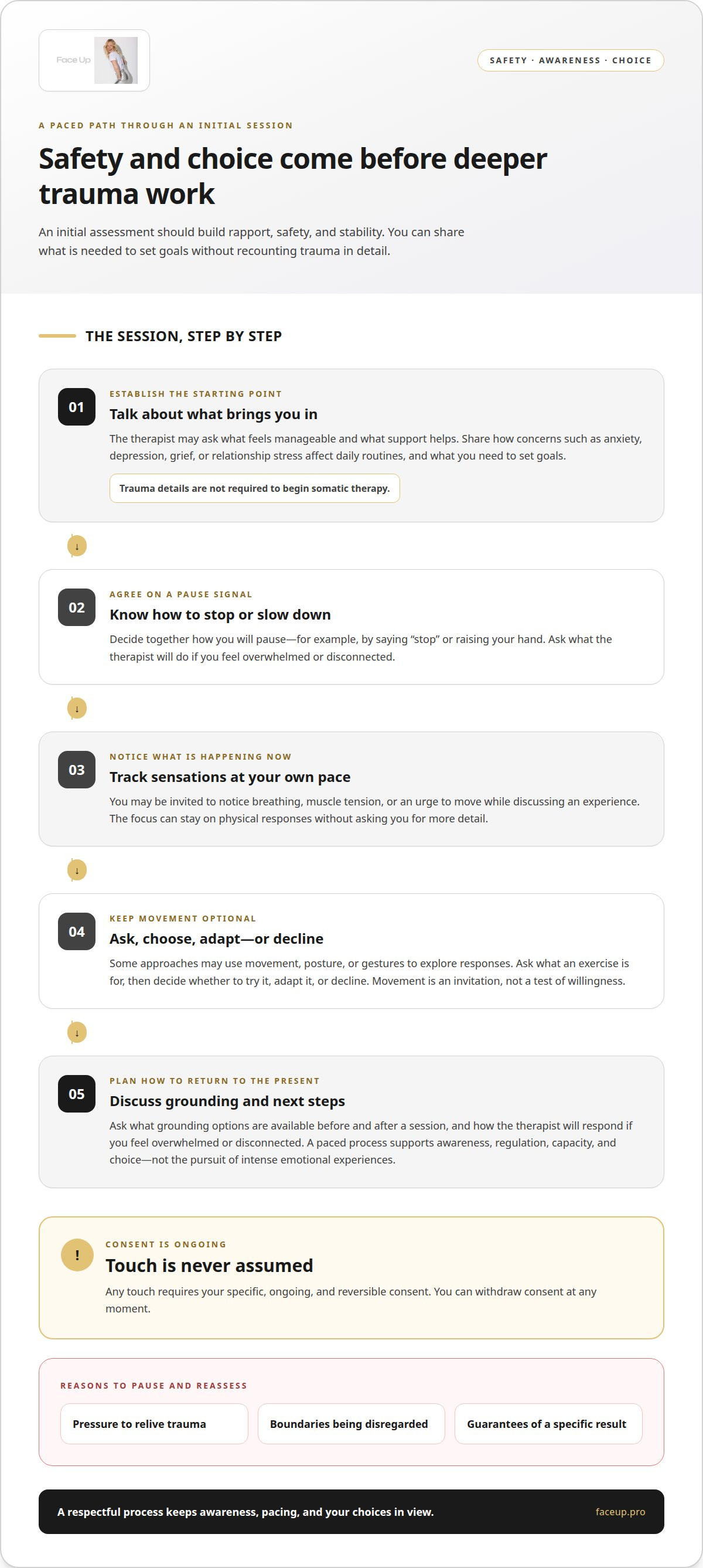
An initial assessment should establish rapport, safety, stability, and relevant history before trauma processing begins. The therapist may ask what brings you to treatment, what feels manageable, and what support helps. For example, describe whether anxiety, depression, grief, or relationship stress affects your daily routines. Share the details needed to set goals; somatic therapy doesn’t require you to recount trauma in detail.
Agree on a way to pause, such as saying “stop” or raising your hand. Then notice what’s happening in the moment: your breathing, muscle tension, or urge to move. A therapist may invite you to track physical responses while discussing an experience, without asking for more detail. Grounding exercises before and after a session can help bring your attention back to the present.
Movement should be an invitation, not a test of willingness. In Somatic Experiencing, a practitioner may guide movements intended to help you soothe yourself while you stay attentive to present sensations. Sensorimotor Psychotherapy may also use movement, posture, and gestures to explore emotional responses. Ask what an exercise is for, then choose whether to try it, adapt it, or decline.
What are the risks or warning signs when choosing a somatic therapist? Pressure to relive trauma, disregard for your boundaries, or claims that treatment guarantees a specific result are reasons to pause. Touch should never be assumed: it requires your specific, ongoing, and reversible consent. You can withdraw consent at any moment.
Before trauma work deepens, discuss how the therapist will respond if you feel overwhelmed or disconnected. Ask how to signal a pause and what grounding options are available. A paced approach supports awareness, regulation, capacity, and choice rather than pursuing intense emotional experiences. These steps help you assess whether the process respects your safety and autonomy.
4. Choosing a therapist based on fit
Fit depends on whether a therapist’s approach matches your needs, preferences, and sense of safety. When considering how to choose a somatic therapist, compare the practitioner’s methods with the support you want. You may prefer psychotherapy that includes body awareness, while someone else may want less conversation and more movement. Ask how sessions balance these elements and what can change if the format doesn’t suit you.
Before booking, ask which modality the therapist practices, what a typical session involves, and how they adapt it to your goals. You could also ask how they respond when distress rises and how you can adjust an exercise. Specific answers help you understand whether the approach is collaborative or follows a set plan. As you weigh how to choose a somatic therapist, consider whether the explanation makes sense to you, not just whether the method sounds appealing.
Fit can also involve identity and lived experience. If your gender, sexual orientation, or relationship structure affects your comfort, ask how the therapist approaches those topics. For instance, explain that a relationship pattern concerns you and notice whether the response feels respectful and relevant. Consider whether you’d feel able to disagree or request a different approach.
What questions should I ask a somatic therapist before booking? Ask about their modality, what sessions involve, how the work relates to your goals, and how you can pause or adapt an exercise. Their answers can help you assess whether the practitioner’s approach feels compatible before you begin.
If you’re interested in hands-on work for facial and neck tension, a Somatic Bodywork Session is a bodywork option to consider alongside your goals. It’s distinct from psychotherapy, so choose the kind of support that fits what you’re seeking.
4. What training and credentials should a somatic therapist have?
“Somatic therapist” can describe a licensed psychotherapist, bodyworker, coach, or wellness practitioner. Training and scope of practice vary, so match credentials to the support you need. For mental-health concerns, a licensed psychotherapist is trained to assess and treat them within their professional scope. Licensed psychotherapists, including those accruing postgraduate hours, have at least a master’s degree.
Somatic training is a separate question from professional licensure. Ask which recognized somatic program the practitioner completed, what methods it covered, and how they apply trauma-informed care. Some professional trainings run across 6-8 modules, with modules lasting 4 to 6 days and spaced over 2½ to 3 years. Some include a minimum of 18 hours of continuing education in specific somatic topics. These examples describe possible training structures, not a universal credential.
- For psychotherapy: Clarify the person’s mental-health license, somatic training, and experience with your concern.
- For dance therapy: A dance therapist needs a master’s degree and two years of supervised clinical work before certification.
- For bodywork or coaching: Ask what their training qualifies them to do, and distinguish that scope from psychotherapy.
Experience matters alongside coursework. Consider a practitioner with several years of somatic therapy experience, especially if trauma is part of your history. Ask how their training informs sessions, how they recognize distress, and when they refer someone for mental-health care beyond their scope. A confident answer should explain the methods they use, not rely on a broad label alone.
Consider the answers together: credentials establish professional preparation, while relevant somatic training and trauma-informed practice show how that preparation applies to body-based work. No single title tells you everything. Compare the practitioner’s training, scope, and experience with the kind of care you’re seeking.
4. How can I verify a somatic therapist’s license in my state?
Start with the practitioner’s exact professional title and the state where you’ll receive care. “Somatic therapist” describes varied roles, not one universal mental-health license. Somatic therapy has no governing board, so a somatic training certificate alone doesn’t establish psychotherapy credentials. Identify whether the person presents as a psychotherapist, bodyworker, coach, or another professional.
For a licensed psychotherapist, use your state’s licensing board to find the relevant credential and check the official record. Match the practitioner’s full name and license type. A similar name or a somatic training credential isn’t enough to establish that the license belongs to the person you’re considering.
- Find the exact title used in the practitioner’s profile, such as psychotherapist or bodyworker.
- Search the relevant state licensing board’s records using the practitioner’s name and credential type.
- Compare the record with the practitioner’s stated role and the service they plan to provide.
Professional requirements can depend on the practitioner’s role, so check the credentials relevant to the service offered. Check the credential tied to the practitioner’s professional role instead of searching for a single “somatic therapist” license. For psychotherapy, ask how the person’s mental-health license and somatic training relate to your goals.
Location matters for online sessions. Confirm that a therapist is permitted to provide care where you’ll physically be during the appointment. A license in the therapist’s own state doesn’t by itself establish permission to work with you across state lines.
Licensed psychotherapists must follow state-specific confidentiality rules and their profession’s code of ethics. Ask how those protections apply to your sessions and what the therapist’s professional scope covers. If you’re seeking bodywork rather than psychotherapy, explore a Somatic Bodywork Session as a distinct option, not a substitute for licensed mental-health care.
Face Up: Face Up Method Certification
Face Up Method Certification offers practitioners a way to learn Face Up’s approach to facial sculpting and somatic bodywork. It may suit professionals seeking to develop skills in this specific method. It is distinct from psychotherapy training and doesn’t replace mental-health licensure or trauma-focused clinical preparation. If your goal is personal practice rather than practitioner training, the Face Up App Subscription or Jaw Release Course may be more relevant. For hands-on facial work, Face Up Sculpting Treatment is another option. Consider how each offering aligns with your goals, and keep clinical trauma care separate from bodywork when that is the support you need. To explore Face Up Method Certification, visit faceup.pro.
Choose a Next Step That Matches Your Intention
Before committing, write down what you want support to look like in daily life. That intention can help you decide how to choose a somatic therapist whose approach feels aligned, or whether you’re exploring a different kind of body-based practice. Make your next step specific: personal self-practice, learning a method professionally, or focused facial and jaw work are distinct aims.
Face Up offers Face Up Method Certification for practitioners, the Face Up App Subscription and Jaw Release Course for self-practice, and Face Up Sculpting Treatment for facial work. Choose the path that reflects your intention, without expecting a bodywork or learning option to replace trauma-focused mental-health care when that’s what you need.
If you’d like to explore which Face Up option fits your goals, contact Face Up to discuss your needs. Take the next step at a pace that feels right for you.
Frequently Asked Questions
Do I have to retell my trauma in detail?
No. You can start with effects you notice now, such as tension before sleep or avoiding a place, rather than recounting events. Share only what helps clarify the support you want. If a question feels too close, say so and return to what feels useful today. You can also tell the therapist which topics you’d prefer to leave aside for now.
Do I have to talk about my body the whole time?
No. Sessions don’t have to focus continuously on body sensations. You might briefly notice whether your jaw feels tight, then return to a conversation about a work conflict. If turning your attention inward feels uncomfortable, say so and discuss another way to engage. The balance between talking and body-focused attention can reflect your preferences rather than follow a fixed script.
How many consults is it reasonable to have before deciding?
Speaking with a few practitioners is a reasonable way to compare approaches, without treating a particular count as a rule. A free 15-minute initial consultation can help you hear how each person describes their method and answers your questions. Afterward, note whose explanations were clear and whose approach felt compatible with your goals. You can decide without committing during the call.
What is somatic therapy and what conditions can it help?
Somatic therapy combines conversation with attention to the body and body-centered practices. People seek it for concerns such as anxiety, panic, chronic stress, grief, emotional numbness, hypervigilance, dissociation, or difficulty feeling grounded. It may also address distress that shows up physically. The approach and goals depend on the practitioner’s training and whether the work fits the concern you want help with.
What types of somatic therapy are there, and how do they differ?
Somatic therapy is an umbrella term, not a single method. Somatic Experiencing emphasizes present-moment sensations and movements intended to support self-soothing. Sensorimotor Psychotherapy combines movement, mindfulness, and talk therapy, including attention to posture and gestures. Somatic EMDR brings body awareness into memory processing. Dance therapy and yoga therapy are other body-centered approaches, each with a different focus.
What should I expect in a first somatic therapy session?
Expect to discuss what brings you in and what you hope will change, along with relevant personal history. To make the conversation easier, jot down your main concern, questions about the practitioner’s method, and anything you want to keep private for now. The therapist can use that information to shape an initial direction. You can leave with a clearer understanding of the proposed approach and next steps.


