

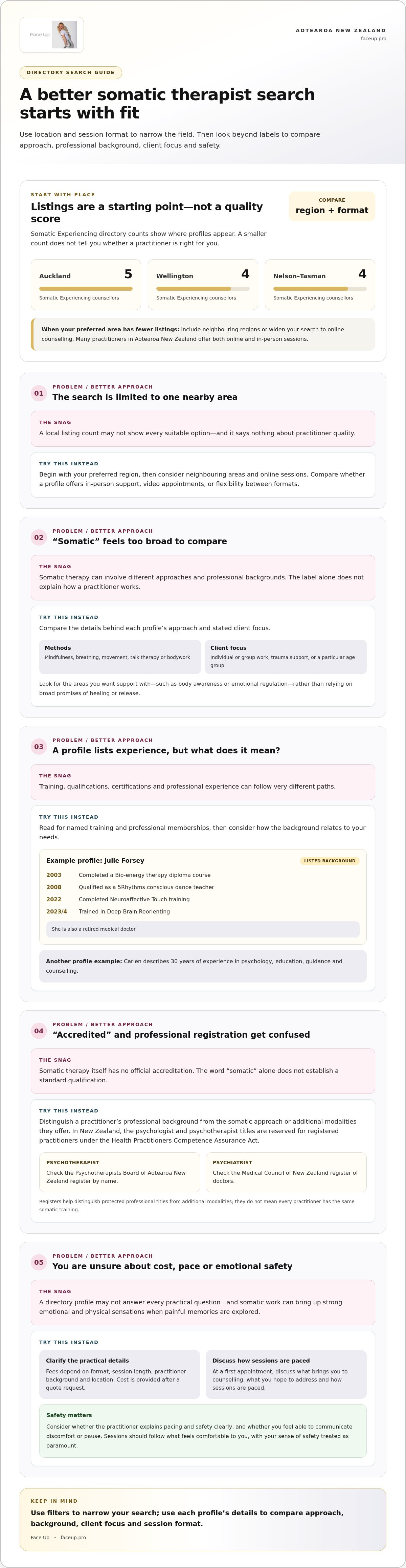
A useful somatic therapist directory search starts with fit, not just a nearby name. For Somatic Experiencing, listings include 5 counsellors in Auckland and 4 in Wellington, while many practitioners in Aotearoa New Zealand offer both online and in-person sessions. You can narrow your search by region, approach, practitioner background, client type and session format.
Finding a directory is a useful first step, but comparing profiles takes care: “somatic therapy” covers different approaches and professional backgrounds. This guide explains how to search a somatic therapist directory in New Zealand, what to look for in a practitioner’s profile, and what a listing can and can’t tell you. You’ll also learn how location and online-session details can help you focus your search.
Key Takeaways
- Filter by region and session format first, then compare approaches and the types of clients each practitioner works with.
- Read profiles for training, qualifications and additional modalities, and distinguish professional background from the somatic approach offered.
- Use directory filters to narrow your search, but treat a listing as a starting point rather than proof of suitability or a guaranteed outcome.
- If you’re a practitioner looking to deepen your facial sculpting and somatic bodywork practice, explore whether Face Up Method Certification fits your goals.
Location and online-session search options
A somatic therapist directory in New Zealand can help you compare practitioners by region and session format. Start with the area where you’d prefer to attend, then consider online options. Many practitioners in Aotearoa New Zealand offer both, so you can weigh face-to-face support against a wider remote search.
Use regional listings as a guide to where profiles appear, not as a measure of practitioner quality. The directory lists 5 Somatic Experiencing counsellors in Auckland and 4 in Wellington. If your preferred area has fewer listings, include neighbouring regions or online counselling in your search. Then compare each profile’s approach, client groups and session format.
Online sessions can connect you with practitioners beyond your immediate region. When using a somatic therapist directory in New Zealand, consider whether you prefer video appointments, in-person support, or flexibility between the two. This helps narrow your search to profiles that suit your access needs and schedule. A practitioner’s description can also clarify how they work with trauma, emotional responses and body awareness, rather than relying on broad labels such as psychology or neuroscience.
For a somatic therapy session in New Zealand, fees depend on the format, session length, practitioner’s background and location. The cost is provided after a quote request.
At a first appointment, expect to discuss what brings you to counselling, what you hope to address and how sessions are paced. You can describe your goals and ask how the practitioner works with bodily sensations and supports clients in regulating emotional responses.
Somatic therapy can bring up strong emotional and physical sensations when working through painful memories. Before starting, consider whether the practitioner explains pacing and safety clearly, and whether you feel able to communicate discomfort or pause. Sessions should follow what feels comfortable to you, with your sense of safety treated as paramount.
Practitioner professional backgrounds and additional modalities
Somatic therapy can sit alongside counselling, psychotherapy or other practices, so practitioners may have varied training. In Aotearoa New Zealand, compare their stated background, relevant registration and methods, rather than relying on the word “somatic” alone.
Qualifications and Professional Memberships
Somatic therapy has no official accreditation, so the term alone doesn’t establish a standard qualification. Practitioners in the Aotearoa New Zealand directory are responsible for the information they provide about training, qualifications, certifications and opinions. Look for named training and professional memberships, then consider how each relates to your needs.
Profiles can show distinct pathways. Julie Forsey completed a Bio-energy therapy diploma course in 2003, qualified as a 5Rhythms conscious dance teacher in 2008, completed Neuroaffective Touch training in 2022, and trained in Deep Brain Reorienting in 2023/4. She is also a retired medical doctor. Another listed practitioner, Carien, describes 30 years of experience in psychology, education, guidance and counselling.
Somatic sessions may also include mindfulness, breathing, meditation, yoga, dance, talk therapy or bodywork. Consider which methods support your wellbeing, connection and sense of safety. Attachment-focused work, for example, may suit someone interested in how relationships affect the nervous system.
Checking Professional Registers
Are somatic therapists in New Zealand registered or accredited, and by which organisations? Somatic therapy itself has no official accreditation. The Health Practitioners Competence Assurance Act reserves the psychologist and psychotherapist titles for registered practitioners.
To check a psychotherapist, search the Psychotherapists Board of Aotearoa New Zealand register by name. Psychiatrists can be checked on the Medical Council of New Zealand register of doctors. These registers help distinguish protected professional titles from additional modalities, but they don’t establish that every practitioner has the same somatic training.
Use directory details to guide your next step: compare a practitioner’s background, approach and listed methods, then consider what kind of professional connection feels appropriate. Practitioners seeking a profile can explore a practitioner directory listing.
Directory filters for modalities, client types, and regions
Use filters to narrow a broad search by approach, client group or region. Then compare the details behind each label: the modality, clinical background and people a practitioner works with.
Start with the approach. Somatic work can include mindfulness, breathing, movement, talk therapy or bodywork, and practitioners may combine methods. A profile describing anxiety support, for example, can help you judge whether its approach and client focus align with your goals. Consider what you want to develop, such as body awareness or emotional regulation, rather than relying on broad promises of healing or release.
Next, apply a regional filter. The directory lists 4 Somatic Experiencing counsellors in Nelson-Tasman. Compare that region with other areas relevant to you, then review each profile’s session format and client groups. A counsellor, psychologist or bodywork practitioner can have different professional training and service focuses, even when profiles mention similar somatic modalities.
Client groups matter, too. Look for descriptions that match your circumstances, such as individual or group therapy, trauma support, or work with a particular age group. Somatic therapy can be offered individually or in groups. Read the practitioner’s stated focus alongside their modalities, rather than assuming a method suits every client.
ACC-related support is another distinct consideration. In New Zealand, ACC funds support at no cost for anyone who has experienced sexual abuse or assault, and support starts before the claim is assessed. A directory profile’s modality or client-group filters don’t establish ACC registration or current availability for new clients. Treat these as separate practical details when comparing options.
To make a focused shortlist, use this sequence:
- Select a region or online format that works for you.
- Filter by modality and the client group relevant to your situation.
- Compare practitioner background, session type and stated focus.
- Keep ACC support and current intake separate from directory search filters.
Directory limitations and disclaimers
A directory can help you discover Somatic Experiencing, coaching or movement-based practices, but a profile is not a clinical assessment. Treat the listed information as a starting point for understanding each practitioner’s stated techniques and mental health focus.
Practitioners are responsible for information they provide about training, qualifications, certifications and opinions. Directory administrators can’t guarantee the accuracy or completeness of profile details, linked articles or websites, or that a listed practitioner will suit your needs or achieve specific results. A detailed profile can still help you identify methods, such as movement or bodywork, to explore further.
Read each entry carefully and distinguish the practitioner’s own description from a directory endorsement. The administrators don’t endorse or recommend practitioners. A listing that mentions trauma support, anxiety or Somatic Experiencing describes the practitioner’s stated work; it doesn’t establish that their approach suits every person or situation.
Directory terms also set limits on what happens after an introduction. Clients and practitioners are responsible for resolving concerns or disputes directly with each other, and administrators can’t mediate or resolve them. Keep this in mind when using profile details to make decisions about mental health support.
Use a profile to shortlist relevant techniques, then discuss your goals and preferences with the practitioner. For example, note whether you’re seeking counselling, coaching or movement-based work, and whether the stated approach addresses your concerns. This turns search filters into a clearer conversation about fit.
Practitioners who want a profile presence can explore a Practitioner Directory Listing as a way to share their background and practice information.
Face Up: Face Up Method Certification
Face Up Method Certification is for practitioners interested in facial sculpting and somatic bodywork. It’s a relevant next step if your professional focus is facial and neck tension, rather than finding a counsellor through a directory. Face Up’s method centres on natural rejuvenation by releasing deep muscular and emotional tension without invasive procedures.
For personal practice, the Jaw Release Course and Face Up App Subscription offer different learning formats. The course focuses on jaw release, while the app supports daily self-practice rituals. These options are distinct from a directory search for mental health support or a registered therapist.
If professional development in facial sculpting and somatic bodywork aligns with your goals, visit Face Up to explore the available options.
Choose a next step that fits your focus
The most useful next step depends on what you want to develop: support for personal wellbeing, or skills in facial sculpting and somatic bodywork. A somatic therapist directory in New Zealand helps you explore practitioner profiles; it serves a different purpose from training or guided self-practice.
For professional learning, Face Up offers Face Up Method Certification. For personal practice, the Face Up App Subscription and Jaw Release Course provide other ways to engage with facial tension and body awareness. These are distinct options, not substitutes for counselling or mental health care. Before choosing, write down what you hope to learn or practise, then let that goal guide your next step.
If you’d like to explore Face Up’s options and decide what aligns with your interests, contact Face Up to explore support. Take your time, stay guided by your needs, and move forward with confidence.
Frequently Asked Questions
What directories list somatic therapists in New Zealand?
The Aotearoa New Zealand directory is a starting point for finding practitioners who include Somatic Experiencing in therapeutic, counselling or coaching services. Use profiles to identify practitioners by their stated work, then consider which details matter to your needs. A listing helps you discover options, but it doesn’t independently establish a practitioner’s suitability or verify every profile claim.
How can I find a somatic therapist near me in New Zealand?
Search by town or region, then widen the search to nearby areas if you find few suitable profiles. If travel is difficult, include online sessions in your criteria. For example, someone in a smaller community can look beyond their immediate area and compare practitioners who offer remote appointments, rather than limiting the search to a local clinic.
Which somatic therapy approaches are offered by New Zealand practitioners?
Approaches and session methods vary. Profiles may refer to Somatic Experiencing, sensorimotor therapy, attachment-focused work or somatic bodywork. Sessions can also include mindfulness, breathing, movement, yoga, meditation or talk therapy. These terms describe different methods, not interchangeable labels. If one approach interests you, note its name and look for a profile explaining how the practitioner uses it.
What qualifications should I look for when choosing a somatic therapist in New Zealand?
Look for named training, relevant qualifications and professional memberships, then distinguish somatic-method training from registration in another profession. Somatic therapy itself has no official accreditation. In New Zealand, the psychologist and psychotherapist titles are reserved for registered practitioners. For a psychotherapist, use the Psychotherapists Board of Aotearoa New Zealand register; for a psychiatrist, use the Medical Council of New Zealand register.
Can I find online somatic therapy sessions with New Zealand practitioners?
Yes, practitioners in Aotearoa New Zealand offer online sessions as well as in-person appointments. When comparing profiles, look for the session format and the practitioner’s description of their approach. Online appointments can make it possible to consider practitioners beyond your local area. Before narrowing your options, consider whether the format suits your preference for conversation, guided awareness or movement-based practices.
How do I compare somatic therapists and check their experience and specialties?
Compare profiles using the same details: professional background, named training, modalities, client groups and stated areas of focus. For example, one profile may describe trauma-related work, while another combines somatic practice with mindfulness or bodywork. Practitioners provide their own listing information, and directory administrators don’t guarantee its completeness. Use profile details to form a shortlist, not as an endorsement or promise of outcomes.


