

Have you ever wondered why your face feels like a mask of tension you simply cannot remove? For many, the weight of daily stress doesn't just vanish. It settles into the jaw, the brow, and the delicate tissues around the eyes. If you struggle with chronic jaw clenching or feel that you look perpetually tired despite a rigorous skincare routine, you aren't alone. These physical markers are often the body's way of storing emotional history. By utilizing somatic facial release techniques, you can begin to address the intersection of physical rigidity and nervous system health.
It's absolutely possible to release emotional history through facial work because the face is directly linked to the brain's emotional centers. When we soften the "muscular armoring" in the brow or jaw, we often trigger a discharge of stored stress or trauma. This emotional release is a natural part of the somatic process. It helps clear the "stress mask" and allows your face to reflect a genuine sense of internal safety and authenticity; to explore specialized support for this emotional unwinding, you can find out more about Somatic Signature Intensive and Signal Mapping Sessions.
We understand that true rejuvenation requires more than a topical solution. It requires a deeper connection to how your body processes trauma and stress. This guide will help you discover how to release deep-seated emotional and physical tension through expert somatic methods. You'll learn how to regulate your nervous system through targeted facial movements, leading to a more relaxed and youthful expression. We will explore the science behind these practices and provide you with the tools needed to find lasting relief and a renewed sense of calm within our professional community.
Key Takeaways
- Understand how somatic facial release techniques communicate directly with the nervous system to unlock tension that traditional massage often misses.
- Discover the "face-brain" connection and how the amygdala influences the muscular armoring that affects your daily facial expressions.
- Learn why the "less is more" principle is essential for effective somatic work, prioritizing breath and presence over aggressive physical pressure.
- Identify the tangible benefits of facial release, ranging from reduced jaw clenching and headaches to a naturally rejuvenated, glowing complexion.
- Explore how the Face Up Method™ provides a professional framework for integrating somatic bodywork into your personal or practitioner routine.
What are Somatic Facial Release Techniques?
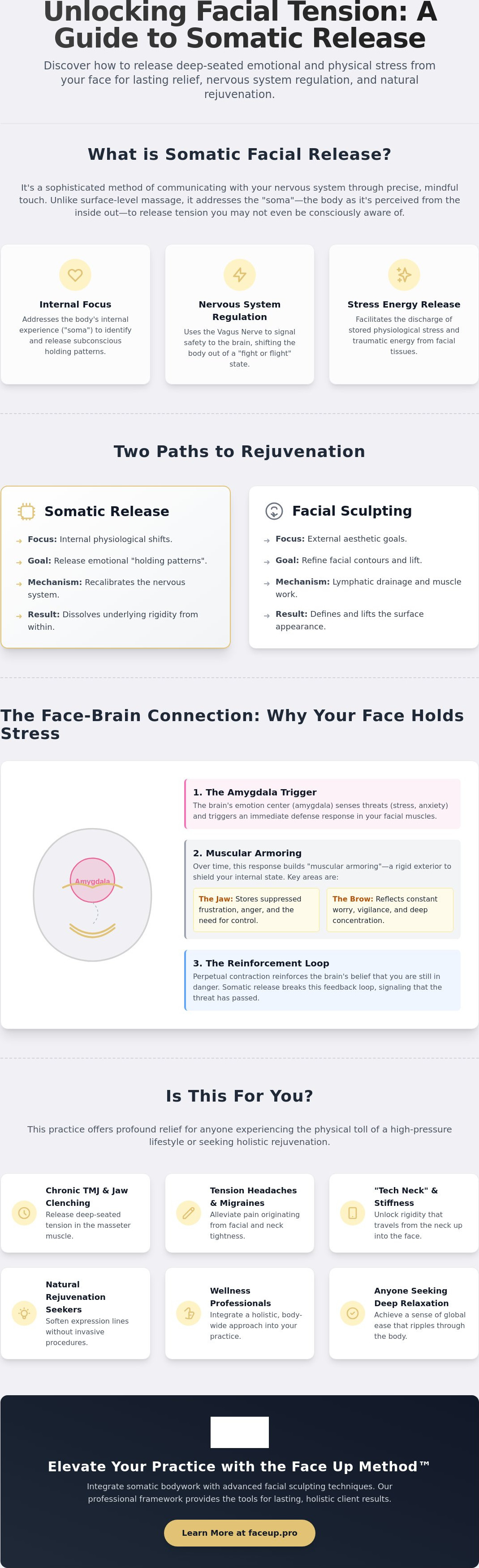
Somatic facial release techniques represent a sophisticated methodology for communicating with the nervous system through the medium of touch. While a traditional facial massage often prioritizes the skin's surface or aesthetic glow, somatic work looks much deeper. It addresses the "soma," a term that describes the body as it's perceived and experienced from the inside out. This internal perspective is vital for identifying where we hold tension that we might not even be consciously aware of. By focusing on the internal experience, we move beyond simple relaxation into a space of true physiological change.
The core of this practice involves the Vagus Nerve, which serves as the primary highway for the parasympathetic nervous system. When we apply specific, mindful pressure to the face, we send direct signals to this nerve that the body is safe to move out of a "fight or flight" state. This process is closely aligned with the foundational theories of Somatic Experiencing, which explores how our tissues store and eventually release the energy of past stressors. Somatic facial release is a therapeutic methodology that utilizes precise touch to recalibrate the nervous system, facilitating the discharge of stored physiological stress from the facial tissues.
The Difference Between Facial Sculpting and Somatic Release
It's helpful to distinguish between external aesthetic goals and internal physiological shifts. Facial sculpting typically aims to refine the external contour of the face through lymphatic drainage and muscle lifting. In contrast, somatic release targets the internal emotional "holding patterns" that have become etched into the musculature over years of stress. These two approaches don't have to be mutually exclusive. Within the Face Up Method™, we integrate both to ensure that the physical lift is supported by a genuinely relaxed nervous system. This creates a result that looks natural because the underlying rigidity has been dissolved from the inside.
Who Can Benefit from These Techniques?
These somatic facial release techniques provide significant relief for anyone experiencing the physical tolls of a high-pressure lifestyle. If you suffer from chronic TMJ, frequent tension headaches, or the neck stiffness often called "tech neck," somatic work offers a clear path to physical comfort. It's also an excellent natural alternative for individuals who want to soften expression lines without relying on invasive procedures or injections. For professionals, incorporating these methods into somatic massage therapy allows for a more holistic approach to client care. By addressing the face, practitioners can unlock deep-seated relaxation that ripples throughout the entire body, creating a sense of global readiness and ease.
Why the Face Stores Emotional and Physical Tension
The human face is a complex map of our internal state. It's directly connected to the amygdala, the part of the brain that processes emotions like fear and anxiety. When the amygdala senses a threat, it triggers an immediate response in the facial muscles. This isn't just about big, explosive reactions. It's about the micro-traumas of daily life that accumulate over time. Eventually, these responses lead to what is known as muscular armoring. This concept describes how we use our facial muscles as a shield against the world, creating a rigid exterior to protect our internal vulnerability.
The jaw and the brow are the primary sites for this emotional storage. The jaw is often where we "bite back" words or suppress frustration. The masseter muscle is one of the strongest in the body, and it's a primary site for storing unprocessed anger or the need for control. Similarly, the brow reflects constant vigilance, worry, or deep concentration. When these areas remain perpetually contracted, they don't just cause physical discomfort; they actually reinforce the brain's belief that we are still in danger. Using somatic facial release techniques helps break this feedback loop by signaling to the brain that the perceived threat has passed.
Many people assume their facial lines and rigidity are simply a result of getting older. While time certainly plays a role, the depth and placement of these lines are often determined by the emotional holding patterns we've maintained for years. It's not just an aging issue; it's a structural manifestation of your history. Somatic work allows us to address the root cause of these patterns, offering a path to rejuvenation that is both physical and emotional.
The Vagus Nerve and Facial Expression
Our facial expressions are governed by cranial nerves that are part of the social engagement system. When we feel safe, our faces are naturally mobile and expressive. However, chronic stress can lead to a state of dorsal vagal shutdown. This often manifests as a "frozen" or flat facial expression that feels heavy and unresponsive. By consciously releasing the tension in the face, we send signals of safety back to the brain through the Vagus Nerve. If you're interested in exploring these connections further, you might find the resources in the Face Up ecosystem helpful for your journey toward nervous system regulation.
Fascia: The Web of Emotional Memory
Fascia is more than just connective tissue; it's a sophisticated sensory organ that "remembers" stress. In the face, the superficial fascia is uniquely intertwined with the muscles. When we repeat the same stressed expressions, the fascia thickens and loses its elasticity, creating permanent creases in the connective tissue. Keeping this tissue supple requires more than just topical treatments. It requires the intentional movement and presence found in somatic facial release techniques to ensure the fascia remains a fluid, responsive web rather than a rigid cage.
4 Essential Somatic Facial Release Techniques to Try
To begin your practice of somatic facial release techniques, you must first establish a foundation of presence. Unlike traditional massage where you might passively receive treatment, somatic work is an active dialogue between your awareness and your tissues. Before you start, find a quiet, safe environment where your nervous system can begin to down-regulate. Your breath serves as the bridge here; deep, diaphragmatic breathing signals to the brain that it's safe to let go of the "muscular armoring" we discussed previously. In this practice, we follow the "less is more" principle. Aggressive pressure often causes the body to guard itself further, so keep your touch gentle and invitational.
Your own hands are the most sophisticated tmj massage tool you possess. They provide immediate sensory feedback, allowing you to feel the subtle "melting" of fascia that tools sometimes miss. As you move through these techniques, stay curious about the sensations that arise, as these are the signals your body uses to process stored stress.
1. The Jaw Unwinding Technique
Locate your masseter muscle by gently clenching your teeth; it's the thick band of muscle just in front of your ear. Place your fingertips or the heels of your hands here and apply light, steady compression. Instead of rubbing, use "micro-movements"—tiny, almost invisible shifts of the jaw from side to side or slightly open. This allows the jaw to find its natural resting place. Many people experience a sudden sigh or a sense of emotional lightness as this primary site of control finally softens.
2. Intra-oral (Buccal) Release
Reaching the muscles from the inside is often more effective because it allows you to address the buccinator and pterygoid muscles from both sides. Using a clean thumb inside the cheek and fingers on the outside, gently knead the tissue. This "inside-out" approach is a hallmark of professional somatic bodywork. It releases deep-seated tension that external massage can't reach, creating a global softening effect across the entire lower face and neck.
3. Brow and Frontalis Softening
Place your fingertips at the center of your forehead and imagine the tension "melting" away from the midline. As you slowly slide your fingers toward your temples, visualize the forehead fascia unfurling like a piece of silk. This technique doesn't just soften "worry lines"; it's deeply connected to the relaxation of the scalp and the occiput at the base of the skull. By releasing the frontalis, you often find that the entire "helmet" of tension around your head begins to dissolve.
4. The Auricular (Ear) Reset
The fascia around the ears acts as a structural anchor for facial lifting. Gently grasp the outer edges of your ears and apply very light traction, pulling outward and slightly back. This stimulates the auricular branch of the Vagus nerve, which can create an immediate sense of calm and "openness" in the chest and throat. It's a powerful tool for shifting out of a stressed state and into a place of global readiness and ease.
The Benefits: From Pain Relief to Natural Rejuvenation
The results of consistent practice go far beyond the immediate relief of a tight jaw. While many individuals begin exploring somatic facial release techniques to address specific pain points, they often discover a wide range of secondary benefits that transform their physical appearance and mental state. Physical relief often manifests as a significant reduction in tension headaches and the cessation of audible jaw clicking. Better sleep quality is another frequently reported outcome, as the body is no longer fighting against nocturnal bruxism or facial guarding. When the facial muscles finally rest, the entire system follows suit.
Releasing the "Stress Mask"
Chronic tension creates what many practitioners call a "stress mask." Over time, the constant contraction of the depressor muscles pulls the features downward, leading to a heavy or drooping appearance that skincare alone cannot fix. Somatic release acts as a natural lifting tool by relaxing these downward-pulling muscles, allowing the lifting muscles to function without opposition. Unlike Botox, which achieves smoothness by paralyzing the muscle, somatic work achieves it through deep relaxation. This ensures your face remains expressive and alive while preventing the formation of deep-set expression lines. For those ready to experience this transformation firsthand, booking a Somatic Bodywork Session can provide the professional guidance needed to unlock these results.
Improving Lymphatic Flow and Detoxification
The relationship between tight muscles and stagnant lymph is direct. When facial muscles are rigid, they act like a bottleneck, preventing the lymphatic system from efficiently draining waste and excess fluid. This often results in morning puffiness and chronic inflammation. By utilizing somatic facial release techniques, you clear these pathways. Myofascial softening allows the lymph to flow freely once again, which naturally reduces swelling and enhances the contours of the face. This internal detoxification process supports long-term skin health and resilience against environmental stressors.
Ultimately, somatic facial release offers a rare synergy where the pursuit of physiological health naturally results in a more youthful and radiant aesthetic.
Elevating Your Practice with the Face Up Method™
Mastering the art of facial tension release requires more than just occasional practice; it demands a structured approach that integrates deep physiological understanding with refined manual skill. Olga Newman's unique methodology represents this evolution, blending advanced facial sculpting with the core principles of somatic bodywork. By moving beyond surface-level aesthetics, the Face Up Method™ offers a professional-grade system for those who seek deeper healing and long-term results. It's an invitation to transition from simple self-care into a state of true mastery over your own nervous system and physical presence.
This approach isn't just a set of movements; it's a proprietary ecosystem designed to facilitate global readiness and professional excellence. Whether you're an individual looking to reclaim your facial vitality or a professional aiming to provide high-standard care, these somatic facial release techniques serve as the foundation for a life lived with greater ease and integrity. Within this community, we value proactive management of stress, positioning ourselves as reliable partners in your journey toward holistic rejuvenation.
Professional Certification for Practitioners
For those in the wellness and beauty industries, adding a specialized modality is a strategic move toward professional advancement. The Face Up Method Certification is specifically designed for massage therapists, estheticians, and somatic coaches who want to offer more than just traditional treatments. By mastering these high-ticket, specialized techniques, you can address the root causes of facial tension in your clients, providing relief for chronic jaw pain and emotional "armoring." This training allows you to join a global network of practitioners who are setting new standards in holistic facial health, ensuring you remain a leader in a rapidly evolving professional landscape.
The Face Up App: Your Daily Somatic Companion
Maintaining the results of professional bodywork requires consistency and the right tools. The Face Up app serves as your daily somatic companion, offering guided rituals that fit seamlessly into a modern lifestyle. These expert-led sessions focus on everything from jaw release to comprehensive facial sculpting, allowing you to regulate your nervous system from the comfort of home. You aren't just following a routine; you're joining a global movement of women who choose natural, somatic rejuvenation over invasive procedures. The app provides the rhythmic "gateway" needed to keep your facial fascia supple and your mind calm, ensuring that your "Somatic Glow" remains a permanent part of your daily expression. Explore our ecosystem today to begin your journey toward a more relaxed, authentic self.
Embracing a Future of Facial Vitality and Ease
Reclaiming your facial expression is a profound journey toward nervous system regulation and physical freedom. We've explored how the face serves as a mirror for our internal emotional state and how targeted movements can dissolve the "muscular armoring" that often accompanies chronic stress. By integrating somatic facial release techniques into your routine, you're doing more than pursuing a youthful appearance; you're cultivating a state of internal safety that ripples throughout your entire body.
To deepen your practice, we invite you to explore the Face Up ecosystem. Founded by Olga Newman, a world-renowned specialist in somatic bodywork, our methodology is a proprietary system used by professionals globally to achieve high-standard results. Whether you utilize the daily rituals available via the Face Up App for consistent, long-term maintenance or seek a deeper professional path, you're joining a specialized community dedicated to integrity and proactive health management.
Master the Face Up Method™ and transform your practice today. Your path to a more relaxed, authentic, and radiant self begins with a single, mindful breath.
Frequently Asked Questions
Is somatic facial release the same as a regular face massage?
No, somatic facial release techniques differ from traditional massage by prioritizing nervous system communication over superficial muscle manipulation. While a standard facial targets the skin and lymphatic flow, somatic work addresses the "soma," or the body as it's perceived from within. This method focuses on identifying and dissolving deep-seated holding patterns that the brain maintains as a protective response. It's a more intentional, internal process that aims for physiological recalibration rather than just external relaxation.
How often should I practice somatic facial release techniques?
Consistency is the most important factor in achieving lasting results with somatic facial release techniques. Most practitioners recommend daily practice, even if it's only for five to ten minutes. Short, frequent sessions are more effective at teaching the nervous system that it's safe to let go of tension. Over time, these small rituals accumulate to create a significant shift in your baseline level of facial relaxation and global readiness.
Can these techniques help with chronic TMJ and jaw pain?
Yes, these techniques are highly effective for managing chronic TMJ and jaw pain by addressing the root cause of muscular constriction. By targeting the masseter and pterygoid muscles through gentle unwinding and intra-oral work, you can interrupt the cycle of clenching and grinding. This process doesn't just treat the symptom; it helps the jaw find its natural resting place, providing relief from the physical rigidity that leads to clicking and discomfort.
Do I need any special tools for somatic facial release?
No special equipment is required because your hands are the most sophisticated tools for this work. They provide immediate sensory feedback, allowing you to feel exactly where the fascia is "melting" or where a muscle is still guarding itself. While some individuals choose to incorporate specific props later in their journey, the foundational practice relies entirely on your own presence and the invitational touch of your fingertips to guide the nervous system.
Can I do somatic facial release if I have Botox or fillers?
You can certainly practice somatic release if you have injectables, provided you wait for the initial healing period. Most professionals suggest waiting at least two weeks after receiving Botox or fillers before applying pressure to the treated areas. Somatic work actually complements these treatments by ensuring the surrounding tissues remain supple and healthy. It focuses on the muscles and fascia that injectables don't reach, creating a more balanced and natural appearance.
How long does it take to see results from somatic facial work?
You'll likely feel an immediate sense of physical relief and mental calm after your very first session. However, structural changes and aesthetic improvements, such as a more "lifted" or rejuvenated look, typically become visible after four to six weeks of consistent daily practice. This timeframe allows the fascia to reorganize and the nervous system to adopt new, more relaxed patterns of expression, leading to a sustainable, healthy glow.
Is it possible to release emotional trauma through the face?
It's absolutely possible to release emotional history through facial work because the face is directly linked to the brain's emotional centers. When we soften the "muscular armoring" in the brow or jaw, we often trigger a discharge of stored stress or trauma. This emotional release is a natural part of the somatic process. It helps clear the "stress mask" and allows your face to reflect a genuine sense of internal safety and authenticity.
What is the best time of day to perform these rituals?
The best time of day depends on your personal goals and daily rhythm. Performing these rituals in the evening is highly beneficial for down-regulating the nervous system before sleep, which can prevent nighttime jaw clenching. Alternatively, a morning practice can help you start the day from a place of calm efficiency. The key is to find a quiet window where you can focus entirely on your internal experience without being rushed or interrupted.


