

What if the persistent tension in your jaw isn't a muscular failure, but a survival signal your nervous system has forgotten how to switch off? For those navigating the daily burden of TMJ disorders, the experience often extends beyond simple discomfort to include chronic headaches and a visible widening of the jawline due to masseter hypertrophy. It's frustrating to feel stuck in a perpetual stress response, but it's important to recognize that your body is simply trying to protect you in a specialized professional landscape that often demands constant readiness.
Discovering somatic exercises for TMJ relief offers a sophisticated, nervous-system-led path toward reclaiming your jaw's natural freedom and facial symmetry. By shifting from traditional stretching to a proprietary, bottom-up approach, you can finally release the emotional stress stored in your tissues. This article explores how the Face Up Method helps you transition from chronic clenching to a state of calm efficiency, providing you with practical tools to achieve pain-free movement and a more balanced, sculpted appearance.
Key Takeaways
- Shift your perspective from treating isolated muscles to regulating the nervous system to address the root cause of chronic jaw clenching.
- Discover the science of pandiculation and how this natural reset mechanism provides more sustainable results than traditional passive stretching.
- Learn five foundational somatic exercises for TMJ relief designed to retrain lateral joint movement and release stored emotional stress.
- Understand the "Bottom-Up" approach to healing, which ensures the body feels safe enough to permanently let go of chronic facial tension.
- Explore how guided daily rituals through the Face Up App can elevate your self-care practice into a comprehensive facial wellness journey.
Understanding the Somatic Root of TMJ Tension
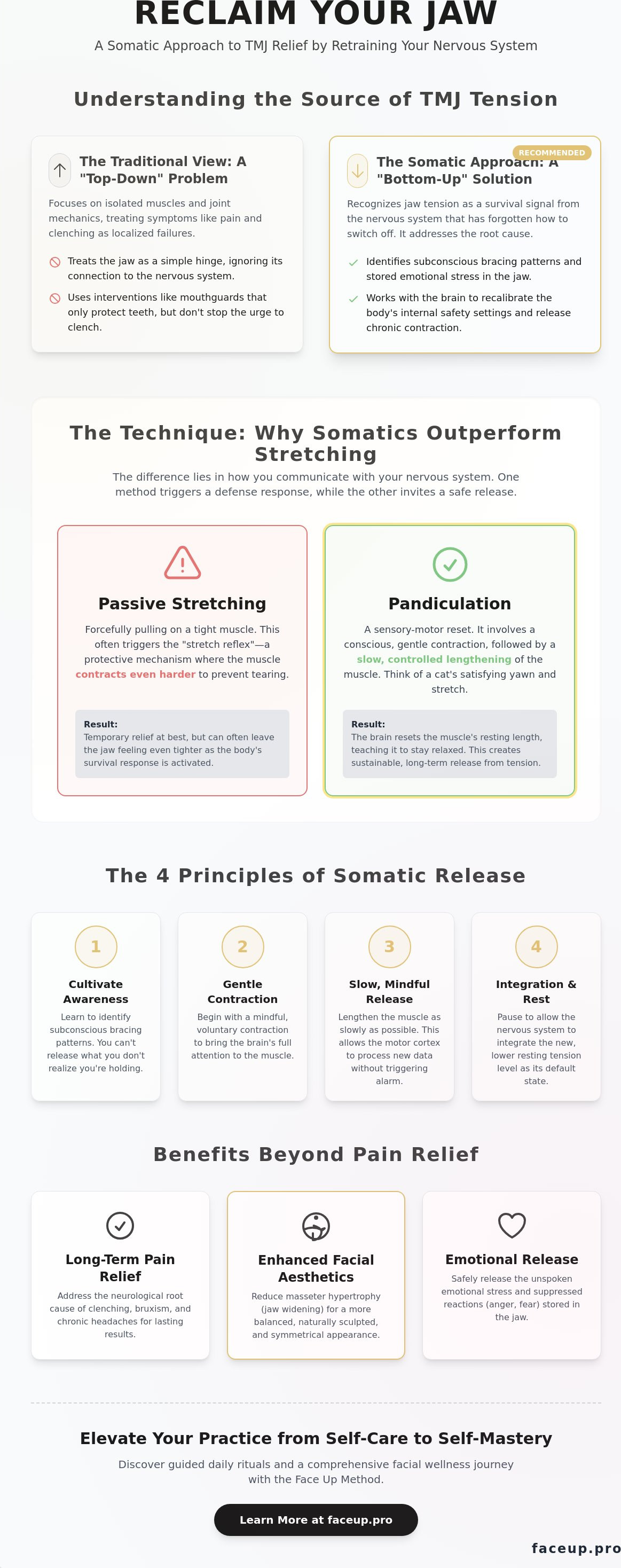
The temporomandibular joint acts as a sophisticated hinge connecting your jawbone to your skull, facilitating essential movements for communication and nourishment. When this system is compromised, many individuals experience symptoms of Temporomandibular Joint Dysfunction, which frequently originates from neurological habits rather than structural failure. A primary cause is Sensory Motor Amnesia (SMA), a condition where the brain loses the ability to voluntarily relax the masseter muscles due to chronic contraction. By integrating somatic exercises for TMJ relief, you begin the process of identifying these subconscious bracing patterns and reminding the nervous system that it's safe to release the hold.
The jaw often functions as a primary container for unspoken emotional stress. Because the masseter is one of the strongest muscles in the body relative to its size, it becomes the default site for "holding" energy when we suppress reactions like anger or fear. This physical bracing creates a feedback loop where the body remains in a high alert state, even when the immediate stressor has passed. Recognizing this somatic root is the first step toward moving beyond temporary fixes toward a state of professional and physical integrity.
The Emotional Connection: Why We Hold Stress in the Jaw
In somatic theory, we observe a profound mirroring between the jaw and the pelvic floor. These two regions often reflect each other's tension; if you're clenching in one, the other is likely bracing as well. This connection is frequently reinforced by the habit of "holding your tongue" during professional or personal conflicts, which physically manifests as a rigid, protective shield. The emotional jaw is a primitive survival mechanism that locks down our primary source of expression to protect our internal vulnerability.
Signs Your TMJ Pain is a Somatic Issue
It's vital to differentiate between structural joint damage and functional muscle tension driven by the autonomic nervous system. If you find that traditional mouthguards only protect your teeth without stopping the urge to clench, you're likely dealing with a functional somatic issue. Chronic bruxism is often a signal that the body's internal safety settings need recalibration. Incorporating somatic exercises for TMJ relief allows you to address this neurological command at its source, offering a more sophisticated and long term solution than surface level dental interventions.
The Science of Somatic Movement: Retraining Your Nervous System
Pandiculation is the biological key to unlocking chronic tension. It's the same yawning and stretching behavior you see in cats or dogs after they wake from a nap. While it looks like a simple stretch, it's actually a sensory-motor reset. According to the National Institute of Dental and Craniofacial Research, TMD involves complex interactions between the muscles and the joints. Traditional approaches often focus on the joint itself, but somatic movement focuses on the brain's control of those muscles. By engaging in somatic exercises for TMJ relief, you aren't just pulling on tight tissue; you're updating the neurological software that governs your jaw's resting state.
Proprioception is your internal sense of where your body is in space and how much tension it's holding. When you lose this awareness in your jaw, you don't realize you're clenching until the pain starts. Somatic movement restores this internal radar. You begin to catch the tension at its source, releasing it before it manifests as a migraine or a locked jaw. This heightened awareness is the foundation of long-term freedom from pain.
Pandiculation vs. Stretching: Why One Works and the Other Fails
Passive stretching often triggers the stretch reflex. This is a protective mechanism where the muscle actually contracts to prevent tearing when it's pulled too far. This is why your jaw might feel even tighter after a vigorous stretch. Pandiculation works differently. You start with a conscious, gentle contraction of the muscle, followed by an extremely slow, controlled lengthening. This deliberate movement tells the brain to reset the resting length of the muscle. In the world of nervous system regulation, slow is fast because it allows the motor cortex to process new information without triggering a survival response.
Facial Sculpting Benefits of a Relaxed Jaw
Chronic clenching doesn't just cause pain. It changes your appearance. The masseter muscles, when overworked, undergo hypertrophy. This results in a heavy, squared lower face that can obscure your natural bone structure. By incorporating somatic exercises for TMJ relief, you allow these muscles to return to their optimal, relaxed state. This process is a form of natural rejuvenation. When combined with specialized tmj massage therapy, somatic release helps restore the youthful V-shape of the jawline. You're not just seeking pain relief; you're engaging in a holistic sculpting process. If you want to integrate these techniques into a daily ritual, exploring the Face Up App Subscription provides a structured path toward both physical comfort and aesthetic balance.
Why Somatic Exercises Outperform Traditional TMJ Stretches
Traditional physical therapy protocols for jaw pain frequently emphasize strengthening or passive stretching. While these methods offer a momentary reprieve, they often fail to address why the tension returns once you leave the clinic. The longevity of somatic exercises for TMJ relief comes from their "bottom-up" methodology. Instead of forcing a muscle to lengthen, which can trigger a protective contraction, you're teaching the nervous system that it's safe to let go. As noted by Johns Hopkins Medicine on TMD, the condition involves complex muscular and neurological interactions that require more than just a surface-level fix.
Many professionals hesitate to start a new regimen because they don't have time for a dedicated workout. Somatic practice isn't an exercise in the traditional sense; it's a shift in how you inhabit your body. These movements are designed to be integrated into your existing daily rituals. You can perform a subtle jaw glide during a morning commute or a conscious yawn before a high-stakes meeting. It's about micro-interventions that prevent tension from accumulating in the first place. By focusing on quality of movement rather than quantity, you achieve results that last far longer than a standard stretch.
Somatic Release vs. Botox for TMJ
The Role of Awareness in Lasting Relief
Lasting freedom from jaw pain requires breaking the habit of unconscious daytime clenching. Somatic check-ins allow you to monitor your tension levels in real time. By developing this internal awareness, you can catch the first signs of bracing and release them instantly. To assist in this process, many find that a specialized tmj massage tool serves as an excellent tactile reminder to soften the masseters. This combination of mental check-ins and somatic tools ensures that you aren't just managing pain, but actively creating a more resilient, relaxed facial structure that supports your overall professional presence.
5 Essential Somatic Exercises for Daily TMJ Relief
Moving from the biological theory of nervous system regulation into physical practice requires a structured approach. These somatic exercises for TMJ relief focus on quality of sensation rather than quantity of movement. By prioritizing the internal experience of the masseter muscles, you bypass the protective bracing patterns that usually hinder progress. The goal is to provide your brain with new, safe data regarding the state of your jaw.
- Step 1: The Conscious Yawn. This movement activates the natural pandiculation reflex. Gently contract your jaw as if starting a yawn, then slowly and consciously allow the jaw to open and lengthen. The key is the slow, controlled release.
- Step 2: Jaw Gliding. Many individuals lose the ability to move the joint laterally without clicking. Retrain this movement by shifting your lower jaw slightly to the right, then back to center, then to the left. Focus on the smoothness of the track.
- Step 3: The Soft Palette Release. Close your eyes and bring your awareness to the back of your throat. Imagine the soft palette lifting and the back of your tongue dropping. This internal shift creates immediate space in the joint.
- Step 4: Neck and Jaw Integration. The sternocleidomastoid (SCM) muscle often pulls on the jaw. Gently turn your head while keeping your jaw soft, noticing the connection between the neck's rotation and the jaw's tension levels.
- Step 5: The Face Up "Jaw Drop" Ritual. This is a two-minute daily grounding practice. Simply let your lips touch while your teeth stay apart. Allow gravity to take the weight of your lower jaw. It serves as a neurological anchor for your day.
How to Practice for Maximum Results
Set yourself up for success by choosing a quiet environment where you can close your eyes. This minimizes external stimuli, allowing your motor cortex to focus entirely on proprioceptive feedback. Never push into pain. If you feel a sharp sensation or a click, reduce the range of motion until the movement is fluid. Consistency is the primary driver of change. To deepen your practice with guided video instruction, explore the Face Up App Subscription, which integrates these movements into a manageable daily flow.
Common Mistakes to Avoid
The most frequent error is moving too fast or using excessive force. Speed triggers the stretch reflex, which is exactly what we want to avoid. If you find yourself holding your breath, stop and reset. Your breath is the primary indicator of your nervous system's state. Focus on the sensation of the movement rather than achieving a specific "result" like a wider opening. When you prioritize the process, the physical release follows naturally.
Elevating Your Practice: From Self-Care to Professional Mastery
For those ready to deepen their practice, the Jaw Release Course offers a comprehensive curriculum designed for profound, long-term healing. It moves beyond basic movements into advanced somatic explorations that address the deepest layers of stored tension. If you prefer a guided daily experience, the Face Up App Subscription provides a structured environment with rituals that fit seamlessly into a busy schedule. These resources ensure that your progress remains steady and well-governed, allowing you to inhabit your body with newfound ease and confidence.
The Face Up Method™: A Proprietary Approach to Somatics
The Face Up Method™ represents a sophisticated blend of professional authority and welcoming accessibility. Developed by Olga Newman, this proprietary approach bridges the gap between clinical bodywork and aesthetic rejuvenation. It's built on the belief that true beauty and wellness are inseparable from a regulated nervous system. Practitioners across the globe are increasingly drawn to this method because it offers a sustainable, high-standard alternative to invasive treatments. By addressing the somatic root of tension, the method ensures that facial sculpting results are supported by genuine muscular relaxation rather than temporary fixes.
Professionals looking to integrate these transformative techniques into their own practice can pursue the facial sculpting certification. This program provides the specialized training needed to master the Face Up Method™ and join a community of experts dedicated to high-level professional advancement. It's a path toward becoming a reliable partner in the global wellness landscape, offering clients a clear way forward through the power of somatic exercises for TMJ relief and advanced bodywork.
Next Steps for Your Journey
Your progression toward a tension-free life is supported by a robust ecosystem of tools and community support. We invite you to take the next step in your professional or personal development through these curated pathways:
- Download the Face Up App to begin a 7-day jaw release trial and experience guided somatic rituals firsthand.
- Consult the Practitioner Directory Listing to find a certified professional who can provide personalized Somatic Bodywork Sessions or Face Up Sculpting Treatments.
- Join our community of forward-thinking professionals who are redefining the standards of beauty and wellness through nervous system health.
Embrace a Future of Lasting Jaw Freedom
True relief from TMJ isn't found in temporary fixes or aggressive stretching; it's found in the quiet dialogue between your brain and your body. You've learned that your jaw often acts as a container for survival stress and that retraining your nervous system is the only sustainable path to comfort. By prioritizing somatic exercises for TMJ relief, you address both chronic pain and the aesthetic concerns of masseter hypertrophy, leading to a more balanced and rejuvenated appearance.
This holistic journey is guided by the expertise of somatic bodywork expert Olga Newman and the proprietary Face Up Method™, a system trusted by certified professionals worldwide. Whether you're seeking to resolve years of tension or move toward professional mastery, you don't have to navigate this path alone. You're invited to enter a specialized community where professional authority meets welcoming accessibility.
Begin your journey to a tension-free jaw with the Face Up App
Your path to a calmer nervous system and improved facial symmetry starts with a single, conscious breath. We're here to provide the structured guidance you need to move forward with confidence and grace.
Frequently Asked Questions
How often should I do somatic exercises for TMJ?
You should practice somatic exercises for TMJ relief daily to achieve the best results. Consistency is vital because you're retraining the motor cortex of the brain rather than just stretching a muscle. A dedicated session of five to ten minutes each morning or evening helps establish a new neurological baseline. This frequency ensures that your nervous system recognizes the "relaxed" state as its new default setting.
Can somatic exercises help with teeth grinding at night?
Somatic movement is highly effective for reducing teeth grinding at night. Bruxism is usually a physical manifestation of a nervous system that remains in a "high alert" state even during sleep. By practicing these techniques during the day, you lower your overall autonomic arousal. This reduces the brain's impulse to clench the jaw as a survival response while you're unconscious, leading to deeper and more restorative sleep.
How long does it take to see results from somatic jaw release?
Most individuals experience a sensory shift after their very first session, but permanent structural changes typically require three to four weeks of consistent practice. Neurological retraining is a cumulative process. While the immediate "jaw drop" feels wonderful, the brain needs repeated successful repetitions to overwrite years of clenching habits. By the end of a month, you'll likely notice improved facial symmetry and a reduction in tension related headaches.
Are somatic exercises safe if I have a clicking or popping jaw?
It's entirely safe to perform these movements if your jaw clicks or pops, provided you stay within a pain free range of motion. Clicking often indicates that the joint is slightly misaligned or the muscles are pulling unevenly. Retraining the lateral and vertical paths of the jaw through somatic exercises for TMJ relief helps the joint move more fluidly. If you encounter a click, simply reduce the size of the movement until it feels smooth.
Can I do these exercises if I have dental implants or braces?
You can safely practice somatic movement if you have dental implants, braces, or other orthodontic work. These exercises focus on the brain's control over the muscles rather than applying external pressure or force to the teeth or joint. Because you aren't pulling or pushing on the jaw, there is no risk to dental hardware. It's actually a beneficial way to manage the tension that often accompanies orthodontic adjustments.
What is the difference between jaw yoga and somatic exercises?
Jaw yoga typically focuses on stretching and strengthening, while somatic movement focuses on pandiculation and nervous system regulation. Yoga often involves holding a stretch to lengthen a muscle, which can sometimes trigger a protective contraction. Somatic movement uses slow, conscious contraction followed by even slower lengthening to reset the muscle's resting length. This approach ensures the brain feels safe throughout the entire process, leading to more sustainable results.
Do I need any special tools to perform these exercises?
You don't need any special equipment to begin your practice, as the movements rely entirely on internal awareness and slow motor control. While the exercises are effective on their own, some individuals choose to integrate a specialized TMJ massage tool to enhance their sensory feedback. These tools can help you pinpoint specific areas of tension, but the primary work always happens within your own nervous system through focused, intentional movement.
Can somatic movement help reduce the appearance of a double chin or heavy jaw?
Somatic movement can significantly improve the appearance of a heavy jawline by addressing masseter hypertrophy. When the jaw muscles are constantly clenched, they grow larger and create a squared, heavy look. By teaching these muscles to relax, you allow them to return to their natural, leaner state. This process helps restore the face's youthful V shape and can even improve the appearance of the neck area through better postural alignment.


