

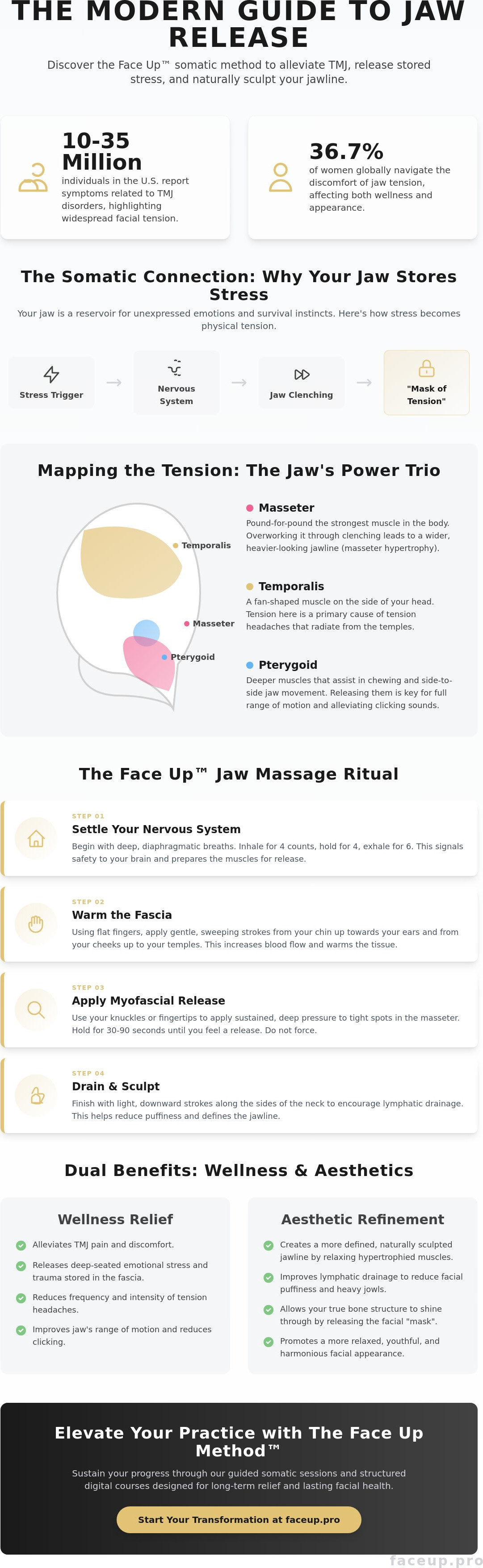
Did you know that between 10 and 35 million individuals in the United States report symptoms related to TMJ disorders? It's a staggering figure that highlights how much stress we physically store in our facial muscles. If you frequently wake up with a tight jaw or feel that your profile looks heavy due to tension, you're likely among the 36.7% of women globally navigating this discomfort. Learning a proper jaw massage is more than a beauty trend; it's a somatic gateway to releasing emotional weight and restoring your natural facial structure.
Welcome to the World of Face Up™, where we provide a professional path to both physical relief and aesthetic refinement. In this guide, you'll discover how to master techniques that release deep-seated emotional stress, alleviate TMJ pain, and naturally define your jawline. We'll explore the science-informed Face Up Method™ to help you understand the root of your clenching while providing a clear roadmap to a more sculpted, youthful appearance. You'll gain the tools to transform your daily tension into a ritual of calm efficiency and lasting facial health.
Key Takeaways
- Understand how the jaw stores survival instincts and unexpressed emotions, and why somatic release is essential for true facial harmony.
- Identify the "Power Trio" of muscles-the masseter, temporalis, and pterygoid-to accurately map and address your physical tension.
- Learn the step-by-step Face Up™ jaw massage ritual, including specific breathing techniques needed to settle your nervous system.
- Uncover the aesthetic benefits of releasing facial fascia, from improved lymphatic drainage to a more defined, naturally sculpted jawline.
- Discover how to sustain your progress through guided somatic sessions and structured digital courses designed for long-term relief.
The World of Jaw Massage: Why Somatic Release is the Key to Facial Harmony
Welcome to the World of Face Up™. In 2026, the approach to facial wellness has moved far beyond surface level treatments. We've entered an era where daily self care rituals have replaced occasional clinical interventions for many. A daily jaw massage ritual isn't just a physical manipulation of the temporomandibular joint; it's a science informed somatic practice that bridges the gap between your nervous system and your physical appearance. While traditional methods often treat jaw issues as purely mechanical failures, the Face Up™ perspective views the jaw as a reservoir for unexpressed emotions and survival instincts. By addressing this tension, we don't just find relief; we unlock a natural form of facial sculpting that allows your true bone structure to shine through.
The Somatic Connection: Why Your Jaw Stores Stress
Why does your jaw feel like it's made of stone after a long day? When you encounter stress, your brain triggers a fight-or-flight response that sends immediate signals to your cranial nerves. The masseter is often the first muscle to contract in anticipation of conflict or hard work. Over time, this chronic clenching creates a mask of tension that affects your entire nervous system. This isn't just a physical habit; it's a physiological state. Releasing this through targeted jaw massage allows for emotional trauma release, helping you shed the weight of stress that has become stuck in your fascia. It's about more than just comfort. It's about reclaiming the fluidity and ease that tension has stolen from your face.
Signs You Need a Jaw Release Ritual
It's not always about sharp pain. Many people don't realize they're clenching until they see the physical results in the mirror or feel the secondary effects in their body. Common signs include clicking sounds when you open your mouth, a limited range of motion, or persistent facial puffiness. With approximately 10 to 35 million people in the United States reporting TMJ-related symptoms, this is a widespread concern that affects both health and aesthetics. Chronic tension inhibits lymphatic drainage, which often leads to heavy jowls or a saggy jawline that doesn't respond to traditional skincare.
Understanding The Anatomy of Your Jaw Muscles is the first step in identifying these patterns. Try a self-check mirror exercise: clench your teeth and feel the sides of your jaw. If the muscles feel bulky and hard, you're likely experiencing masseter hypertrophy. This means your face is working overtime, even when you're asleep. This constant work often triggers tension headaches and neck stiffness, creating a cycle of discomfort that only a dedicated release ritual can break.
Mapping the Tension: The Anatomy of Your Jaw Muscles
To master the art of jaw massage, we must first understand the landscape we're working with. In the World of Face Up™, we don't just see a joint; we see a sophisticated network of muscles that dictate both your comfort and your silhouette. This network is led by what we call the "Power Trio": the masseter, the temporalis, and the pterygoid muscles. Together, these tissues facilitate every word you speak and every bite you take. However, when they're trapped in a cycle of chronic contraction, they don't just cause pain. They physically alter the contours of your face. Utilizing professional techniques like myofascial release allows us to address these layers with precision, ensuring that we're treating the source rather than just the symptom.
It's also essential to recognize the suboccipital link. Often, the tension you feel in your jaw actually originates at the base of your skull. The muscles connecting your neck to your head work in tandem with your jaw. If your neck is stiff, your jaw will likely follow. This interconnectedness is why a holistic approach is so vital. If you're looking for a Step-by-Step Guide to Jaw Massage, you'll find that addressing the neck and skull base is just as important as the jaw itself. Understanding this map is the first step toward lasting relief and professional-grade results.
The Masseter: The Strongest Muscle and Its Aesthetic Impact
The masseter is pound-for-pound the strongest muscle in the human body. Located at the back of the cheeks, it's responsible for the heavy lifting of chewing. When this muscle is overworked through stress-induced clenching, it undergoes masseter hypertrophy. Masseter hypertrophy is the physical enlargement of the muscle tissue due to chronic overactivity, often resulting in a "square" or bulky lower face. By incorporating regular release work, you can soften these contours and return your face to its intended shape. For those ready to begin this journey, our Jaw Release Course offers a structured path to professional recovery.
The Temporalis and Pterygoids: The Hidden Culprits
While the masseter gets most of the attention, the temporalis and pterygoids are the silent partners in tension. The temporalis fans out across the sides of your head; it's the primary culprit behind those nagging tension headaches that wrap around your temples. Meanwhile, the lateral and medial pterygoids sit deeper within the skull. These internal muscles require specialized attention because they control the side-to-side movement of the jaw. If these aren't addressed, you might find that your relief is only temporary. You can dive deeper into these specific mechanics in our ultimate guide to TMJ massage therapy, which explores how to restore balance to these hidden layers.
A Step-by-Step Guide to the Face Up™ Jaw Massage Ritual
Welcome to the World of Face Up™. To achieve lasting somatic release, we must treat our practice as a sacred ritual rather than a mechanical task. Before your fingers even touch your skin, your environment must be prepared to support a parasympathetic shift. Start with clean hands and a calm space where you won't be interrupted. While your hands are your most intuitive instruments, incorporating the right tmj massage tool can provide the specific leverage needed to reach deeper fascial layers. Integrating a daily jaw massage into your routine allows you to move from a state of survival into a state of restoration.
We begin every session with the Face Up™ breathing technique. Inhale deeply through your nose for four counts, then exhale slowly through slightly parted lips for six counts. This simple shift signals to your nervous system that it's safe to let go. As you move through this five minute flow, remember two critical safety rules: always avoid the carotid artery located on the side of your neck, and never force your jaw joint to "pop" or "click." We work with the body's natural rhythm, not against it.
External Techniques for Daily Tension Release
Our daily flow starts with warming the tissues from the outside. Begin with the "Z" Knead. Use your knuckles to apply firm but gentle pressure to the masseter muscle, moving in a zigzag motion from the cheekbone down to the jaw angle. This increases blood flow and breaks up initial adhesions. Next, perform the Temple Sweep. Place your fingertips on your temples and use slow, upward circular motions to release the temporalis. This doesn't just soothe the mind; it creates a subtle lift in the brow area. Finally, use the Jawline Slide. Create a "V" shape with your index and middle fingers, sliding them firmly along the jawbone from the chin toward the ears. This encourages lymphatic drainage and immediately begins to define the bone structure.
Advanced Intraoral (Buccal) Techniques for Deep Sculpting
To reach the pterygoids and the deepest layers of facial fascia, we must work from the inside out. Intraoral, or buccal, techniques are the hallmark of the Face Up Method™. Start with the "Hook and Hold." Place your thumb inside your cheek and your fingers on the outside, gripping the masseter muscle. Gently knead the tissue between your thumb and fingers, looking for "trigger points" or areas of high density. Once found, hold the pressure for 30 seconds while maintaining your rhythmic breathing. Follow this with a buccal stretch. Use your thumb to gently sweep the inside of your cheek in a downward and outward motion. This releases the deep fascia of the lower face, providing a level of sculpting that external jaw massage alone cannot achieve.
Aesthetic and Wellness Benefits: Why Jaw Massage is the Ultimate Natural Facelift
Welcome back to the World of Face Up™. We've mapped the muscles and mastered the ritual; now, let's look at the "why" behind the results. In our community, we believe beauty and health are inseparable. While many seek jaw massage for pain relief, the aesthetic transformation is often what surprises people most. Chronic tension acts as a physical barrier to your body's natural waste removal system. When your jaw muscles are perpetually tight, they compress the lymphatic vessels. This leads to that "heavy" or puffy morning face many of us recognize. By systematically releasing these blockages, we don't just feel better; we reveal the sharp, defined bone structure that tension has been hiding.
This isn't just about reducing swelling. It's a natural facelift. When the jaw is released, the surrounding tissues can settle back into their intended positions. You'll notice your cheekbones appearing higher and your eyes looking more open. This long-term practice allows you to age gracefully, maintaining facial volume and contour without ever needing to rely on fillers or invasive procedures. Beyond the mirror, this release significantly lowers cortisol levels. When you aren't physically clenching, your brain produces fewer stress hormones. This shift often leads to improved sleep quality, as your body isn't fighting a physical "stress mask" throughout the night, allowing for deeper restorative cycles.
Sculpting the Jawline and Reducing Puffiness
The relationship between muscle density and fluid retention is direct. A tight masseter muscle creates a "dam" effect, trapping interstitial fluid in the lower face and contributing to a saggy appearance. Our Face Up™ rituals use specific vectors to move this fluid toward the lymph nodes behind the ears and down the neck. This promotes a more V-shaped, contoured look naturally by debulking the lower third of the face. Lymphatic drainage is accelerated when the masseter is relaxed. By maintaining this flow, you ensure your facial contours remain crisp and well-defined day after day.
Resetting the Nervous System for Total Body Wellness
The jaw is a primary gateway to the Vagus Nerve. Relaxing this area sends an immediate signal to your brain that you're safe, triggering a total body "reset." This creates a powerful "Face-Body" loop. When your facial muscles soften, your shoulders naturally drop and your cervical spine finds better alignment. We encourage you to view jaw massage as a vital mental health tool rather than just a beauty hack. It's a way to proactively manage your nervous system. When you release your jaw, you release the physical grip of anxiety that often manifests as chronic tension in the upper body. Ready to experience these benefits for yourself? Explore our Face Up™ Sculpting Treatment to begin your transformation.
Elevating Your Practice with the Face Up Method™
Welcome to the final stage of your journey into the World of Face Up™. You've seen how a targeted jaw massage can redefine your profile and settle your nervous system. However, true transformation requires consistency and a deeper understanding of somatic principles. Our brand stands as a leader in non-invasive, holistic rejuvenation, offering a path that moves beyond occasional self-treatment toward professional-level mastery. For those seeking a deeper, structured transformation, our Jaw Release Course provides the comprehensive tools needed to address chronic tension at its root. Whether you're looking to refine your personal routine or expand your professional toolkit, the Face Up Method™ provides the structure needed for lasting change.
Guided Rituals via the Face Up™ App
Consistency is the primary challenge in any wellness practice. The Face Up™ App serves as your daily companion, providing expert-led video rituals that you can follow on the go. It's designed to fit into a busy lifestyle, ensuring that your somatic practice doesn't fall by the wayside. Features like "Daily Reminders" are specifically built to help you break the subconscious habit of daytime clenching, which we previously identified as a major contributor to masseter hypertrophy. By joining this digital space, you become part of the "World of Face Up™" community, a global network of individuals dedicated to conscious facial health and proactive management of their well-being.
Professional Path: Becoming a Certified Practitioner
The global Somatic Therapy Market is projected to reach USD 12.55 billion by 2033, growing at a compound annual rate of 17.7%. This surge reflects a massive shift in consumer demand toward holistic and non-invasive therapies. If you feel called to help others achieve the physical and aesthetic results you've experienced through jaw massage, our facial sculpting certification offers a rigorous, science-informed training program. Becoming a certified practitioner allows you to enter this thriving market as a recognized expert in facial fascia and nervous system regulation. It's a chance to turn your passion for somatic beauty into a professional career that aligns with global standards of excellence. Explore our professional certification programmes to take your first step toward professional mastery and global readiness.
Step Into Your Most Aligned Self
You've explored how the jaw acts as a physical archive for stress and how targeted release work can restore your natural profile. By understanding the anatomy of the masseter and implementing a daily ritual, you shift from managing symptoms to achieving professional grade rejuvenation. This isn't just about aesthetics; it's about a fundamental reset of your nervous system that ripples through your entire body. The trademarked Face Up Method™, founded by somatic expert Olga Newman, offers a verified path to this transformation. It's time to move beyond temporary relief and join our global community of certified practitioners who prioritize long term facial health and integrity.
Integrating a regular jaw massage into your lifestyle ensures you age with clarity and ease while maintaining the sharp contours of a healthy face. Our system provides the organized, confident guidance you need to navigate this journey with professional support. Whether you're seeking to alleviate chronic clenching or want to define your jawline naturally, the tools for your progression are ready. Start your journey to a tension-free life with the Face Up™ Jaw Release Course today and experience the power of somatic mastery. We're here to guide you toward a more vibrant, sculpted future.
Frequently Asked Questions
How often should I perform a jaw massage for the best results?
For optimal results, you should perform a jaw massage daily for approximately 5 to 10 minutes. Consistency allows the masseter muscle to transition from a state of chronic contraction to one of functional relaxation. If you're managing acute tension, a shorter 2 minute ritual performed three times a day can help break the subconscious habit of daytime clenching before it leads to masseter hypertrophy.
Can jaw massage really change the shape of my face or jawline?
Yes, regular practice can visibly refine your jawline by reducing muscle bulk and accelerating lymphatic drainage. When you release the 30 pounds of pressure often held in the jaw, the lower face appears less "square" and more contoured. This natural sculpting effect reveals your true bone structure, helping you achieve a more V-shaped profile without the need for invasive clinical interventions.
Is it normal to feel emotional or 'teary' during a deep jaw release?
It's completely normal to feel emotional or even teary during a deep somatic release. The jaw is a primary reservoir for the "fight or flight" response and unexpressed survival instincts. Releasing this physical tension often triggers a corresponding emotional discharge, which is a clear sign that your nervous system is finally letting go of stored stress and moving toward a state of safety.
What is the difference between a regular face massage and a somatic jaw release?
A regular face massage typically focuses on skin surface circulation and product absorption. In contrast, a somatic jaw massage targets deep fascial layers and nervous system regulation. It uses specific vectors to release the "Power Trio" of muscles, aiming for long term functional relief and structural change rather than just a temporary glow or surface level relaxation.
Should I use oil or cream when massaging my jaw at home?
You should use a small amount of oil or cream to provide enough "slip" to protect your skin from dragging. However, it's important not to use too much, as you need a firm grip to perform deep myofascial work or intraoral techniques effectively. The goal is to maintain professional control over the underlying muscle tissue without sliding off the skin's surface.
What are the 'red flags' that mean I should see a professional instead of self-massaging?
You should consult a medical professional or a certified practitioner if you experience sharp, shooting pain, a completely locked jaw, or persistent swelling that doesn't subside after 48 hours. While self-massage is safe for most, these symptoms may indicate underlying structural issues that require a clinical diagnosis. Our practitioner directory can help you find a specialist trained in the Face Up Method™ for expert guidance.
Can jaw massage help with chronic migraines or tension headaches?
Yes, releasing the jaw can significantly reduce the frequency of tension headaches and migraines. Because the temporalis and suboccipital muscles are closely linked, jaw tension often radiates upward into the skull. Softening these areas reduces the physical pressure on cranial nerves, providing a non-medicinal path to relief that addresses the root cause of the pain rather than just masking it.
Is intraoral (buccal) massage safe to do on myself?
Intraoral, or buccal, massage is safe to perform on yourself when you follow a structured guide like the Face Up Method™. It's essential to use clean hands and move with a "hook and hold" technique rather than aggressive pulling. This internal approach is the most effective way to reach the pterygoid muscles, providing a level of deep sculpting that external techniques alone cannot achieve.


