

What if the most profound emotional breakthroughs don't happen on a therapist's couch, but through the release of physical tension in the body? As of January 1, 2026, California state law officially recognizes CAMTC-certified professionals as health care providers, proving that the industry is finally embracing the medicinal power of touch. If you've felt unfulfilled by surface-level wellness treatments, obtaining a somatic bodywork practitioner certification is your gateway to a career with deeper purpose and higher professional standing. You aren't alone in feeling overwhelmed by the maze of training costs, which can range from $297 for introductory courses to over $20,000 for comprehensive academy programs.
We understand that the path to a high-ticket holistic practice can feel confusing when you're balancing clinical theory with hands-on technique. This guide simplifies your journey by providing the exact steps to transition into somatic therapy with confidence. You'll learn how to distinguish between various modalities, navigate the 2026 regulatory changes in states like Alabama and California, and master the art of body-based emotional release. From specialized modalities like the Face Up Method™ to foundational somatic principles, you'll gain a clear professional roadmap to turn your passion for healing into a thriving, globally recognized career.
Key Takeaways
- Understand the fundamental shift from traditional talk therapy to "bottom-up" somatic healing to address stress at its physiological root.
- Identify the specific criteria for selecting a somatic bodywork practitioner certification that aligns with your professional background and career goals.
- Master the core pillars of the practice, including nervous system regulation and the role of the Vagus nerve in establishing a client's window of tolerance.
- Follow a structured five-step roadmap from foundational anatomy education to advanced specialization in high-demand somatic modalities.
- Discover why focusing on facial anatomy and the Face Up Method™ serves as a unique, effective gateway to the nervous system and professional mastery.
What is a Somatic Therapist in 2026?
Defining a somatic therapist in 2026 requires looking beyond the skin and into the complex architecture of the nervous system. At its core, somatic therapy is a body-centric approach to processing stress, tension, and lingering trauma. It operates on a fundamental philosophy: the body remembers what the mind forgets. While traditional methods often prioritize cognitive understanding, somatic work focuses on the physiological experience. This evolution is rooted in Somatic psychology, which posits that our biological responses to life events are just as significant as our psychological ones.
The wellness economy in 2026 is experiencing a massive surge in demand for these specialized practitioners. This isn't just a trend; it's a structural shift in healthcare. On January 1, 2026, California state law officially reclassified CAMTC-certified professionals as health care providers. This legislative change acknowledges that bodywork is a vital health service rather than a mere personal luxury. As the average salary for somatic coaches in the U.S. reaches approximately $68,000 per year, professionals are finding that a somatic bodywork practitioner certification offers both financial stability and deep vocational fulfillment.
Somatic Bodywork vs. Traditional Talk Therapy
Traditional therapy is a "top-down" approach, meaning it starts with the mind to influence the body. Somatic practitioners flip this script using "bottom-up" healing. Instead of focusing only on a client's narrative, you'll learn to work with the "felt sense"-the internal physical sensations that signal emotional states. Your role is to facilitate nervous system completion. When a stress response is triggered but never finished, it stays trapped in the muscles and fascia. Clients today are increasingly seeking physical release for these emotional burdens because they've realized that talking about a problem doesn't always move it out of their tissues.
The Scope of Practice: What You Can and Cannot Do
It's essential to distinguish between different professional paths. A Somatic Experiencing professional typically focuses on verbal cues and guided awareness to track trauma, often in a clinical setting. In contrast, earning a somatic bodywork practitioner certification prepares you for hands-on or specialized manual application. You'll need to navigate a changing legal landscape, such as Alabama's transition to a new massage therapy licensing board in 2026. Maintaining trauma-informed boundaries is the hallmark of a high-standard practice. You aren't there to "fix" the client, but to create a safe, regulated environment where their own body can find its way back to equilibrium through professional, ethical touch.
The Core Pillars of Somatic Practitioner Training
The foundation of any high-standard somatic practice lies in understanding the biological language of the body. When you pursue a somatic bodywork practitioner certification, you aren't just learning massage techniques; you're studying the intricate mechanics of the human nervous system. A primary focus of this education is the Vagus nerve, the long highway of the parasympathetic system that dictates whether a client feels safe or threatened. Practitioners must identify a client's "window of tolerance," which is the specific zone where they can process emotions without becoming overwhelmed or shutting down. This physiological awareness is what separates professional somatic work from standard wellness treatments.
This training often mirrors the academic rigor found in programs like the Certificate in Somatic Studies, emphasizing that healing is a physical event rather than a purely mental one. As you work toward your somatic bodywork practitioner certification, you'll master tools like titration, which involves breaking down intense physical sensations into manageable pieces, and pendulation, the process of gently shifting focus between a place of safety and a place of tension. These methods help clients develop interoception, the ability to sense internal bodily signals, and proprioception, the awareness of their body in space. These skills are often lost during periods of chronic stress or trauma.
Understanding Nervous System States
Recognizing a client's state in real-time is a critical skill for any modern facilitator. You'll learn to distinguish between the Ventral Vagal state, where social connection and calm are possible, and the Dorsal Dive, a state of immobilization or "freeze." Guiding a client back to safety requires more than just words; it involves co-regulation, where your own regulated nervous system acts as a steady anchor for theirs. Through rhythmic breath and intentional touch, you create a proprietary environment of calm efficiency that allows the client's system to reset at a measured pace.
Embodiment and the Facial-Emotional Link
Modern research highlights the face and jaw as primary storage sites for emotional history. The jaw, in particular, acts as a physical record of suppressed expression and survival instincts. Releasing this area can trigger a profound full-body somatic release, often bypassing the mental resistance found in traditional therapy. This is why a specialized somatic facial therapy course is becoming an essential asset for practitioners who want to offer more than surface-level care. Fascia, the connective tissue wrapping every muscle, holds these emotional patterns in place. By addressing the facial-cranial connection, you open a "secret door" to the nervous system that other bodywork might miss. If you're ready to deepen your impact, consider exploring how the Face Up Method integrates these pillars into a professional sculpting practice.
Choosing the Right Somatic Bodywork Practitioner Certification
Selecting a somatic bodywork practitioner certification isn't merely an administrative task; it's a strategic investment in your professional identity. The 2026 market offers a diverse range of pathways. Choosing the right one depends heavily on your existing background and your ultimate career goals. If you're a mental health professional, a multi-year clinical route might be appropriate. However, for wellness practitioners, estheticians, or massage therapists, a holistic bodywork path provides the manual tools needed to facilitate physical release. Organizations like the United States Association for Body Psychotherapy serve as vital resources for understanding these professional standards and finding accredited pathways.
Many prospective students wonder if they can truly master these skills through digital platforms. While the 'felt sense' is deeply personal, modern educational technology has made it possible to learn complex manual techniques with precision. As practitioners increasingly rely on digital solutions, learning to leverage modern tools through the AI Made Easy Academy can help streamline the administrative side of a growing practice. High-quality programs now utilize high-definition video, interactive anatomy models, and remote supervision to ensure students meet global standards. Choosing a program that includes a Practitioner Directory listing is also a crucial business move. It ensures that once you've achieved your somatic bodywork practitioner certification, you're immediately visible to a global community seeking specialized, high-ticket services.
Clinical Somatic Experiencing vs. Holistic Bodywork
Clinical certifications often require a multi-year commitment and significant financial investment. For instance, some comprehensive programs in 2026 can cost upwards of $20,000. While these provide deep theoretical knowledge, they often focus less on the direct manual manipulation of tissue. For those seeking to integrate somatic release into a beauty or wellness practice, specialized methods like buccal massage training online offer a more streamlined and practical approach. These targeted certifications allow you to master the "secret door" of the jaw and facial fascia in a fraction of the time, focusing on the immediate physical application of somatic principles.
What to Look for in a 2026 Curriculum
A credible curriculum must go beyond basic theory. Look for programs that mandate supervised practice hours and encourage personal sessions to ensure you've embodied the work yourself. In 2026, the most effective trainings integrate modern tools like biofeedback or specialized manual techniques for intraoral and cranial release. A high-standard program will also teach you how to manage the emotional weight of a session while maintaining professional decorum and trauma-informed boundaries. Ensure the curriculum includes clear client intake protocols and business ethics to set you up for long-term success.
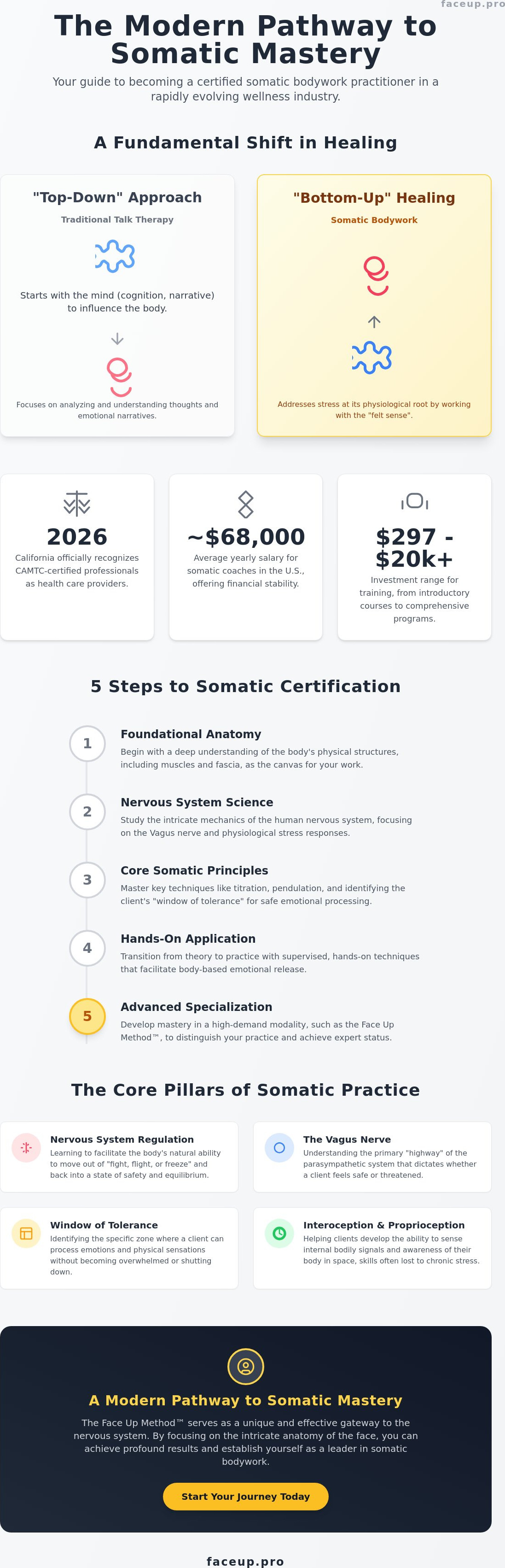
5 Steps to Becoming a Certified Somatic Therapist
Transitioning into the field of somatic therapy requires a structured approach that balances academic knowledge with intuitive physical mastery. While the journey is deeply personal, the professional requirements for a somatic bodywork practitioner certification in 2026 have become more standardized to ensure global readiness and client safety. Following this roadmap allows you to build a practice that is both ethically sound and financially sustainable; to help you navigate this transition, check out The Jenny Lane Blog for specialized business coaching.
- Step 1: Foundational Education in Anatomy and Physiology. You must first understand the physical structures you'll be influencing. This includes a deep dive into the musculoskeletal system and the nervous system's role in stress responses.
- Step 2: Selecting a Specialised Somatic Modality. General knowledge is rarely enough for a high-ticket practice. Choosing a niche, such as facial sculpting or intraoral release, allows you to offer specialized solutions for complex issues like chronic jaw tension.
- Step 3: Completing Supervised Practicum and Case Studies. Theory alone doesn't build touch sensitivity. You'll need to document specific sessions and receive feedback from senior mentors to refine your "bottom-up" facilitation skills.
- Step 4: Obtaining Professional Liability Insurance and Certification. With states like California reclassifying practitioners as health care providers as of January 2026, proper credentials and insurance are non-negotiable for professional standing.
- Step 5: Launching Your Practice and Building a Referral Network. Establish your presence through practitioner directories and local wellness communities to ensure a steady flow of clients who value holistic, body-based healing.
Developing the Practitioner's Presence
Your own nervous system is the most important tool in your treatment room. Before you can guide others through emotional release, you must commit to your own somatic healing journey. This self-work ensures you don't absorb a client's stress or become dysregulated during intense sessions. Therapeutic presence is the unwavering, non-judgmental state of grounded awareness that provides the safety required for a client's nervous system to shift into a healing state. Maintaining this presence allows you to act as a steady anchor, facilitating a proprietary environment of calm efficiency even during profound emotional shifts.
Building Your Professional Toolkit
The environment you create for your sessions dictates the depth of the work possible. Whether you choose a dedicated studio, a mobile service, or a hybrid online model, your space must reflect high-standard professionalism. Integrating specific equipment, such as a high-quality tmj massage tool, can significantly enhance your workflow when addressing cranial tension. Your client intake process should be just as precise, helping you identify somatic readiness and screen for contraindications. If you're ready to start this journey with a proven system, explore the Face Up Method Certification to master the art of facial-emotional release.
The Face Up Method™: A Modern Pathway to Somatic Mastery
The Face Up Method™ represents a specialized evolution within the broader landscape of somatic work. While a foundational somatic bodywork practitioner certification provides the essential physiological framework, this proprietary method offers a targeted application for the face and cranial structures. The face is often called the "secret door" to the nervous system because of its direct connection to the cranial nerves, specifically those governing the social engagement system. By focusing on these high-density receptor areas, practitioners can facilitate a deep state of regulation that radiates throughout the entire body. This isn't just a facial. It's a precise neurological reset.
This approach offers a distinct business advantage in the 2026 wellness market. Clients are increasingly moving away from invasive procedures, seeking high-value, non-invasive rejuvenation that addresses both their aesthetic goals and their emotional wellbeing. Holding a somatic facial bodywork certification positions you as a leader in this shifting landscape. You aren't just providing a treatment; you're offering a transformative experience that helps clients shed the physical weight of chronic stress at a measured and professional pace.
Why the Face Up Method is Unique
The Face Up Method™ moves far beyond the superficial scope of standard facial courses near me. While traditional facials focus on the skin's surface, this method utilizes intraoral and deep tissue techniques to address the root of tension. The "Jaw Release" connection is a primary example. By addressing TMJ issues through a somatic lens, you help clients release years of suppressed expression and survival-based bracing. This combination of aesthetic sculpting and profound emotional release creates a unique value proposition that justifies premium pricing and fosters deep client loyalty within our global community.
Next Steps for Aspiring Practitioners
Applying for the Face Up Professional Training program is the first step toward entering this global ecosystem of high-standard facilitators. The certification process is rigorous yet supportive, designed to ensure you embody the principles of the method before you ever treat a client. You'll move through a structured curriculum that covers advanced facial anatomy, psychosomatics, and the proprietary sculpting techniques that define the method. Upon completion, you'll gain access to our Practitioner Directory, connecting you with a global audience ready for your expertise. Explore the Face Up Method Professional Certification to begin your transition into a career of somatic mastery and professional advancement.
Step Into the Future of Holistic Healing
The evolution of the wellness landscape in 2026 has made it clear that "bottom-up" healing is no longer a niche preference but a professional standard. You've seen how reclassifying practitioners as health care providers in states like California has raised the bar for entry and solidified the industry's integrity. Successfully obtaining your somatic bodywork practitioner certification is the first step toward building a practice that addresses the physiological roots of stress. By focusing on specialized areas like the face and jaw, you bridge the gap between aesthetic rejuvenation and deep emotional release, providing a service that is both physically restorative and emotionally transformative.
Your path to mastery doesn't have to be a solitary climb. By joining our proprietary ecosystem, you gain access to proprietary somatic sculpting techniques and specialized TMJ and jaw release training that set your practice apart in a competitive global market. We invite you to Start Your Journey: Become a Certified Face Up Practitioner and benefit from our Global Practitioner Directory Access. This is your opportunity to lead with order, reliability, and a clear path forward in the burgeoning field of somatic therapy. We're ready to welcome you into a community that values your professional advancement as much as your clients' profound wellbeing.
Frequently Asked Questions
Do I need a medical degree to become a somatic therapist?
No, you don't need a medical degree to practice somatic therapy, though a background in nursing, massage therapy, or psychology is often beneficial. Most practitioners enter the field through specialized vocational programs that focus on nervous system regulation and body-based emotional release. It's essential to verify your local state regulations, as some jurisdictions require specific licenses for hands-on bodywork.
How long does it typically take to get a somatic bodywork practitioner certification?
The timeline for a somatic bodywork practitioner certification varies depending on the depth of the curriculum you choose. Intensive specialized trainings like the Face Up Method™ can be completed in five days, while comprehensive clinical programs, such as those at the Strozzi Institute, typically require 14 months of study. Most high-standard certifications involve a mix of classroom hours and supervised case studies to ensure professional readiness.
What is the average salary for a certified somatic practitioner in 2026?
Current 2026 market data indicates that somatic coaches in the United States earn an average salary of approximately $68,000 per year. Practitioners in Canada often see higher averages, reaching around $84,000 annually. For those running private practices, hourly rates for specialized sessions generally range between $100 and $250, depending on the practitioner's level of expertise and geographic location.
Can somatic therapy be performed effectively online?
Somatic therapy is highly effective through digital platforms when the focus is on guided interoception and nervous system regulation. While manual bodywork requires physical presence, practitioners use online sessions to teach clients how to track internal sensations and complete stress responses. This hybrid model allows you to maintain a global practice while offering a proprietary environment of calm efficiency to clients regardless of their physical location.
What is the difference between Somatic Experiencing and Somatic Bodywork?
Somatic Experiencing is primarily a verbal modality that tracks internal physical sensations to resolve trauma without necessarily using touch. In contrast, a somatic bodywork practitioner certification focuses on manual techniques to physically release tension stored in the muscles and fascia. While both approaches aim to regulate the nervous system, bodywork utilizes direct physical contact to facilitate emotional breakthroughs and structural alignment.
Is somatic therapy covered by insurance for clients?
Coverage depends entirely on your professional credentials and the specific laws of your jurisdiction. As of January 1, 2026, California reclassified CAMTC-certified professionals as health care providers, which has simplified the process for some clients to seek reimbursement. You should always encourage clients to verify their benefits, especially if your practice integrates with health savings accounts or specific wellness insurance riders.
How do I choose between a facial-focused or full-body somatic course?
Your choice should align with your business goals and the specific client pains you wish to address. Full-body courses provide a broad foundation for general tension, while facial-focused programs offer a specialized "secret door" to the nervous system via the cranial nerves. Many professionals find that starting with a specialized niche like the jaw and face allows them to establish a high-ticket practice more quickly than generalists.
What are the prerequisites for the Face Up Method™ certification?
The Face Up Method™ is designed for dedicated beauty and wellness professionals who are ready to move beyond surface-level treatments. While prior experience in massage therapy or esthetics is helpful, the most important prerequisite is a commitment to the somatic healing journey. The program acts as a rhythmic gateway, providing the specialized tools and directory access needed to transition into a career of professional mastery and global readiness.


