

What if the most powerful tool in your skincare suite wasn't a clinical serum or a high-tech laser, but your ability to regulate a client's nervous system? Many estheticians today feel like "product pushers" in a $129 billion market that often prioritizes surface-level fixes over genuine, deep-seated healing. You likely recognize that chronic tension and emotional stress manifest in the skin, yet you might lack the specific framework to address these somatic layers. If you're wondering how to become a holistic facialist who offers more than just a temporary glow, you're ready to step into a more meaningful professional ecosystem.
This 2026 guide provides a clear, structured roadmap for transitioning from traditional aesthetics to the high-impact world of somatic beauty and holistic rejuvenation. We'll demystify the current certification landscape, from state licensing hours to specialized advanced training. You'll discover how to master techniques like buccal massage and integrated sculpting to create a career that feels like a calling. By the end of this article, you'll have the global perspective and practical steps needed to become a confident facilitator of both skin health and emotional well-being.
Key Takeaways
- Understand why modern clients are moving away from invasive fillers toward somatic bodywork that addresses the root causes of facial tension.
- Learn the essential roadmap for how to become a holistic facialist, including how to navigate licensing requirements and choose high-standard certifications in 2026.
- Explore the science of emotional release and how mastering the Face Up Method™ allows you to treat the face as a gateway to the nervous system.
- Gain practical insights into launching your practice, from securing professional insurance to joining a global practitioner directory for increased visibility.
- Discover the difference between basic massage and advanced sculpting techniques that re-educate facial patterns and release chronic jaw tension.
Redefining the Role: What Does a Holistic Facialist Actually Do?
The profession of facialism is undergoing a profound transformation. In the past, an esthetician's primary goal was to treat the skin's surface with topical applications and chemical interventions. Today, the role has evolved into a specialized discipline that merges biology, psychology, and advanced manual therapy. If you are exploring how to become a holistic facialist, you are entering a field where the face is viewed as a gateway to the entire human system. You aren't just a technician; you are a facilitator of deep, systemic change.
By 2026, the global skincare market is projected to reach $129.11 billion, yet the fastest-growing sectors are those focused on organic ingredients and "neuroglow" experiences. Clients are increasingly moving away from the "frozen" aesthetics of Botox and dermal fillers. They're seeking practitioners who can deliver visible rejuvenation without compromising their natural expressions or long-term facial health. This shift isn't just about avoiding needles. It's about a desire for authenticity and internal regulation that traditional clinical treatments simply cannot provide.
The Shift from Esthetics to Somatic Beauty
The modern practitioner understands that a wrinkle is rarely just a sign of age. Often, it's a physical record of the nervous system's history. While the "clean beauty" movement focused on removing toxins from products, somatic beauty focuses on removing tension from the tissue. Integrating somatic approaches into your practice means you aren't just rubbing the skin; you're communicating with the brain through the fascia. This requires a deep understanding of how emotional tension is stored in the face and how to safely facilitate its release. In this proprietary ecosystem of care, the practitioner acts as a professional mentor for the client's skin and spirit.
Beyond the Surface: Treating the Whole Person
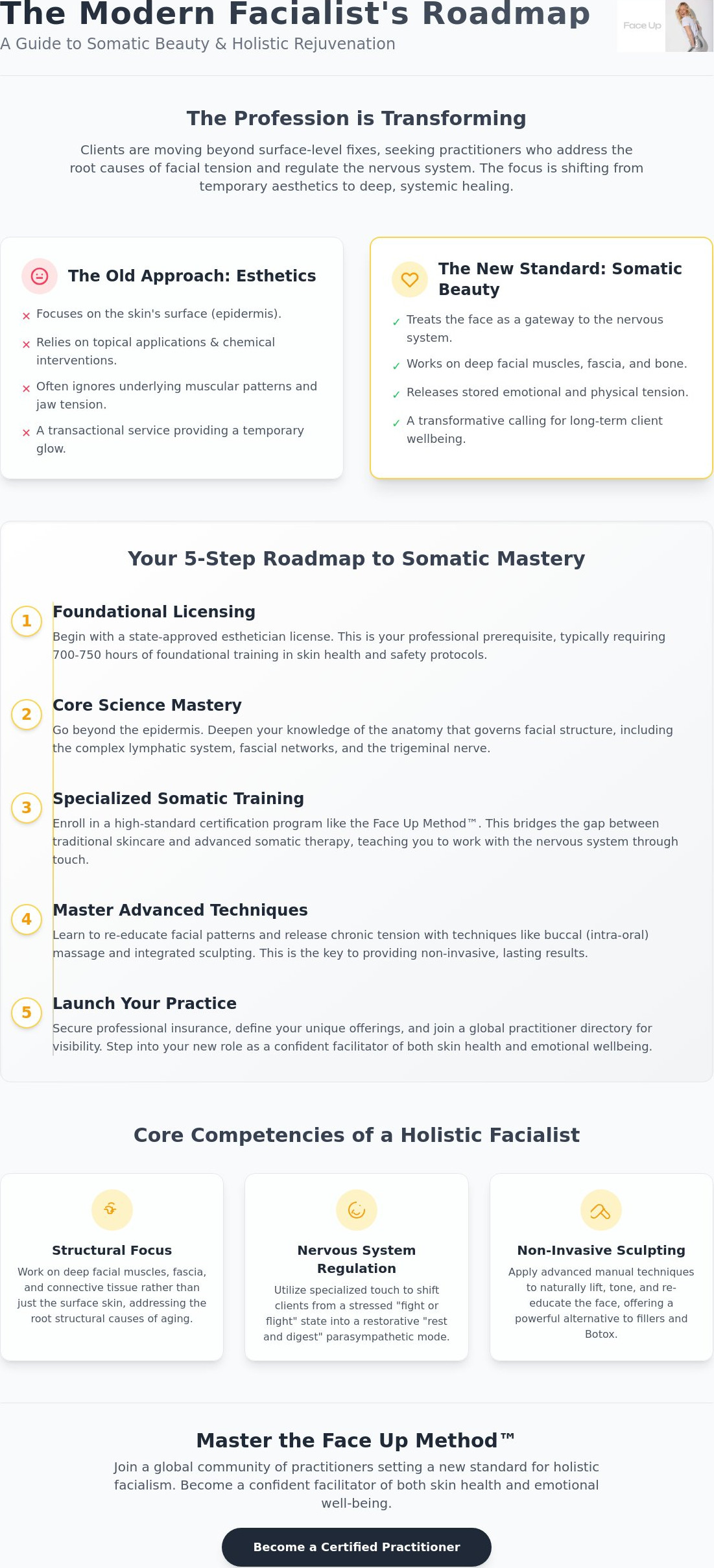
A holistic facialist looks at the face as a reflection of lifestyle, posture, and emotional state. Chronic jaw tension, for example, can lead to facial sagging and lymphatic congestion. A traditional treatment might ignore the jaw entirely, focusing instead on a firming cream. A somatic facialist addresses the underlying muscular patterns. Key differences in this 2026 standard include:
- Structural Focus: Working on deep facial muscles and fascia rather than just the epidermis.
- Nervous System Regulation: Using touch to shift a client from a "fight or flight" state into a restorative "rest and digest" mode.
- Non-Invasive Sculpting: Utilizing manual techniques to lift and tone the face naturally, providing an alternative to medical-grade fillers.
This approach transforms a simple facial into a profound wellness ritual. It moves the career from a transactional service to a transformative professional calling. By mastering these advanced techniques, you position yourself as a reliable, high-standard partner in your client's long-term health journey.
The Educational Path: Certifications and Core Competencies
Mapping your journey requires a clear understanding of your current professional standing. If you are wondering how to become a holistic facialist, your starting point depends on whether you are pivoting from a different industry or upskilling as a licensed esthetician. In most jurisdictions, a foundational esthetician license is the prerequisite. Once this foundation is established, the transition to holistic mastery involves a deeper dive into the interconnected systems of the body, including the nervous system and fascial networks.
A structured approach ensures your transition is both legally compliant and professionally sound. Follow this 5-step roadmap to build your practice:
- Foundational Licensing: Research your local requirements. For example, Texas mandates 750 training hours and a $50 application fee, while Indiana requires 700 hours.
- Core Science Mastery: Move beyond surface aesthetics to study the complex lymphatic system and fascial networks that govern facial structure.
- Specialized Training: Enroll in a program that bridges the gap between traditional skin care and advanced somatic therapy.
- Practical Assessment: Ensure your training includes rigorous hands-on evaluation to verify your manual sculpting techniques.
- Professional Credentialing: Secure the necessary insurance and global recognition to build authority with a discerning 2026 clientele.
Choosing the Right Certification Program
Selecting a program requires looking past marketing buzzwords. A high-standard curriculum must address the nervous system and its role in facial tension. The Face Up Method™ Certification serves as a benchmark here, focusing on proprietary techniques that integrate theory with rigorous practical application. This ensures you aren't just memorizing steps, but understanding the "why" behind every movement. Hands-on assessments are non-negotiable for practitioners who wish to command high-ticket rates in a competitive global market.
Essential Skills for the Modern Practitioner
The modern practitioner must develop a "somatic touch." This involves more than manual dexterity; it's the ability to remain professionally present and create a safe environment for emotional release. You'll learn to "read" the face for signs of stagnation, such as chronic jaw tension or deep brow furrows, which are often physical markers of cortisol effects and stored stress. Mastering these skills allows you to move away from being a service provider to becoming a trusted facilitator of rejuvenation. Joining an established network through a professional practitioner directory can significantly ease the administrative transition into your new career.
The Somatic Connection: Why Emotional Release is the Future of Facialism
A common misconception among those learning how to become a holistic facialist is that the work is merely a "natural" version of a standard spa treatment. It isn't. While a traditional facial might offer temporary relaxation, somatic facial therapy functions as a deep physiological intervention. It targets the structural and emotional layers that topical creams simply cannot reach. By treating the face as a living map of the client's internal state, you provide results that are both aesthetic and restorative.
Mastering these somatic skills is the defining factor in how to become a holistic facialist who commands authority in a crowded market. You aren't just selling a glow; you're facilitating a release of the physical markers of stress. When you address the root cause of facial stagnation, the aesthetic "lift" becomes a byproduct of internal health rather than a forced external change.
The Science of Facial Tension and the Nervous System
The face is densely populated with nerves that connect directly to the brain's emotional centers. When you apply specialized touch, you are engaging with the Vagus nerve, the primary component of the parasympathetic nervous system. This engagement signals the body to move out of a high-cortisol "stress mode" and into a state of repair. Fascia, the connective tissue that wraps around every muscle, acts as a physical storage site for these emotional and physical stressors. Somatic facial therapy is the bridge between bodywork and beauty. By releasing the fascia, you don't just smooth a wrinkle; you release the structural memory of the stress that created it.
Buccal Massage and Deep Tissue Sculpting
By 2026, intra-oral or buccal massage has moved from a niche specialty to a mandatory skill for high-level practitioners. This technique involves working on the facial muscles from both the inside and outside of the mouth. It's particularly effective for releasing the masseter muscle, which often stores immense tension from chronic jaw clenching. These techniques provide a natural alternative to invasive jaw procedures or fillers by restoring the face's natural architecture. The results include:
- Improved Facial Symmetry: Releasing unilateral tension that pulls the features out of alignment.
- Enhanced Lymphatic Drainage: Clearing the pathways that allow for natural detoxification and reduced puffiness.
- Structural Lifting: Re-educating muscles to sit in a more lifted, youthful position without the need for synthetic paralyzing agents.
Creating a "safe container" is the final, most critical component of this work. As a practitioner, your professional presence allows clients to experience and process emotional shifts that often arise during deep tissue release. This level of care establishes you as a reliable, high-standard partner in a client's wellness journey, moving the experience beyond a simple service into a proprietary ecosystem of healing.
Launching Your Practice: From Certification to Client Success
Transitioning from a student to a business owner is the final hurdle in your journey of how to become a holistic facialist. This phase requires a shift in mindset from technical execution to professional management. You aren't just setting up a room; you're creating a proprietary ecosystem where healing can occur. This involves meticulous attention to administrative foundations, including professional liability insurance and local licensing compliance. By 2026, clients expect a high level of transparency and order, so ensure your credentials and professional listings are current and easily accessible.
Pricing your services correctly is essential for long-term sustainability. As a specialized practitioner, your rates should reflect the advanced somatic training and structural results you provide. Unlike traditional spas that focus on high turnover, your business model thrives on building a client base that values long-term wellness. These individuals are looking for a reliable partner in their rejuvenation journey, not a quick fix. Positioning yourself as a professional mentor allows you to command premium fees that match your expertise.
Setting Up Your Holistic Treatment Space
Your environment must reflect the somatic nature of your work. Aim for a sensory-neutral space that allows the client's nervous system to downregulate without distraction. This means choosing soft lighting, minimal acoustic interference, and ergonomic furniture. Beyond the treatment table, your toolkit should include high-standard resources such as TMJ massage tools to address deep-seated jaw tension. Remember that practitioner self-care is a professional obligation. You cannot facilitate emotional release for others if you're experiencing burnout, so schedule restorative breaks between sessions.
Marketing Your Unique Somatic Approach
Effective marketing for a somatic practice focuses on clarity and results. You must be able to explain somatic facial therapy concisely. Tell new clients that you work with the nervous system to release the physical markers of stress, providing a natural lift. Use social proof that highlights tension release rather than just skin texture. Before and after photos should show a change in the "expression" of the face, such as a softening of the brow or a more relaxed jawline. To reach a wider audience and establish your niche, consider joining a professional practitioner directory listing to connect with clients seeking specialized care.
Master the Face Up Method™: A New Standard for Holistic Practitioners
Choosing the right methodology is the final, most impactful decision in your journey of how to become a holistic facialist. While many programs offer a patchwork of techniques, the Face Up Method™ provides a unified, proprietary ecosystem designed by Olga Newman. This approach doesn't just teach you how to move your hands; it equips you to understand the structural and emotional architecture of the face. By 2026, the industry has moved beyond generic routines. Clients now seek practitioners who can offer a specialized, high-standard experience that yields visible, long-lasting results.
What sets this method apart from standard Gua Sha or buccal courses is its deep integration of somatic bodywork. Many introductory programs focus solely on the "how" of a technique without addressing the underlying "why" of nervous system regulation. The Face Up Method™ bridges this gap, treating the face as a reflection of the client's internal state. When you master this approach, you move away from being a service provider and step into the role of a professional mentor. You'll gain the skills to navigate complex facial patterns and provide a level of care that establishes you as a leader in your local market.
Why the Face Up Method™ is a Career Game-Changer
Accessing a curriculum that targets deep muscular and emotional tension allows you to solve problems that traditional esthetics often ignore. One of the most significant advantages is the ability to offer TMJ massage therapy as a specialized service. Chronic jaw tension is a primary concern for the modern, high-stress client. By providing targeted relief for this area, you differentiate your practice and attract a loyal following of individuals who value structural health. This specialization is a key component of how to become a holistic facialist with a sustainable, high-ticket business model. You'll also receive ongoing support and professional development to ensure your skills remain at the forefront of global standards.
Joining a Global Community of Certified Professionals
Success in the somatic beauty field is rarely achieved in isolation. By joining this specialized community, you gain more than just a certificate; you enter a gateway of professional advancement. Being listed in a verified practitioner directory ensures that clients seeking authentic, high-quality care can find you with ease. This global reach connects you with other somatic therapists, fostering an environment of knowledge sharing and professional integrity. It's a space where you are recognized as a reliable partner in the wellness industry, navigating the complexities of the 2026 market with confidence and collective support.
Ready to lead the future of beauty and transform your professional path? Apply for the Face Up Method™ Certification today and start your journey toward a career that feels like a true calling.
Stepping Into the Future of Somatic Beauty
The transition from traditional aesthetics to somatic facial therapy is more than a career pivot; it's a commitment to a higher standard of care. You've explored the essential roadmap of how to become a holistic facialist, from understanding the science of the Vagus nerve to mastering intra-oral sculpting. By moving beyond surface-level treatments, you position yourself as a reliable facilitator in a global market that increasingly demands authenticity and structural results. This path allows you to build a practice that honors the mind-body connection while securing your place as a specialized professional.
Your journey toward mastery is supported by a proprietary ecosystem of practitioners dedicated to excellence. Founded by somatic bodywork specialist Olga Newman, the Face Up Method™ offers the specialized protocols you need to address chronic jaw tension and facial stagnation. By joining our global directory of certified professionals, you gain immediate authority and connection within a community of forward-thinking experts. If you're ready to leave the "product pusher" cycle behind and embrace a career that feels like a calling, now is the time to advance. Apply for the Face Up Method™ Professional Certification and lead the next era of rejuvenation. We look forward to welcoming you into our professional community.
Frequently Asked Questions
Do I need to be a licensed esthetician to become a holistic facialist?
Yes, you typically need a foundational esthetician license to legally practice in most jurisdictions. This serves as the necessary prerequisite before you specialize in how to become a holistic facialist. Requirements vary by region; for example, Texas mandates 750 hours at an approved school while Indiana requires 700. This baseline ensures you understand sanitation and skin biology before moving into advanced somatic bodywork and nervous system regulation.
How long does it typically take to get certified in holistic facial therapy?
Certification timelines depend on the depth of the program you choose. Introductory holistic courses might require only 60 hours of training, while comprehensive master-level programs can extend to 1,200 hours. Most independent practitioners find that a focused certification in a specific modality, like the Face Up Method™, can be completed alongside their existing professional obligations over several months. This allows for a steady transition into the specialized market.
What is the difference between a holistic facial and a regular facial?
A regular facial focuses on the skin's surface, while a holistic facial addresses the whole person. Traditional treatments often use products to fix topical issues. Holistic sessions prioritize manual sculpting and nervous system regulation. This approach treats the face as a gateway to the body's internal state. It moves the focus from temporary aesthetics to long-term structural health and emotional well-being through deep tissue manipulation.
Can I learn somatic facial sculpting and buccal massage online?
You can learn the theoretical foundations and many manual techniques through professional online platforms. Just as an online face painting course provides the artistic foundations for working with facial features, advanced digital certifications offer high-definition video modules and digital theory work for somatic practitioners. However, the most reliable programs also require a practical assessment or live evaluation. This ensures your manual pressure and hand placement are correct, maintaining the high standards expected in a professional somatic beauty practice and ensuring client safety during intra-oral work.
What kind of salary can a holistic facialist expect in 2026?
Earnings vary by specialization and location, but specialized practitioners often command premium rates. By 2026, those who have mastered how to become a holistic facialist can charge significantly more than traditional spa employees. Some independent practitioners charge $200 to $222 for a single 60-minute session. This reflects the advanced training required to facilitate deep structural changes and emotional release for their clients in a high-demand market.
Is holistic facialism a good career path for career changers?
Holistic facialism is a rewarding path for those seeking a career change with deeper meaning. It appeals to professionals who are tired of transactional service models and want to become professional mentors for their clients. The industry's growth, with the organic skincare market projected to reach $52 billion by 2026, provides a stable foundation for those entering the field from sectors like massage therapy or wellness coaching.
Do I need specialised equipment to start a holistic facial practice?
No, you don't need heavy clinical machinery to launch a successful practice. The primary tools of a holistic facialist are their hands and a high-quality treatment table. You might incorporate specific items like TMJ massage tools or sculpting stones to enhance your results. This low-overhead model allows you to focus your investment on advanced education and creating a restorative, sensory-neutral environment for your clients' nervous system health.
How does somatic facial therapy help with TMJ and jaw pain?
Somatic therapy works by releasing chronic tension stored in the facial muscles and fascia. By addressing the masseter and temporal muscles through techniques like buccal massage, you can alleviate the physical pressure that causes TMJ pain. This process doesn't just mask the discomfort. It re-educates the facial patterns and reduces the cortisol effects that contribute to chronic clenching, restoring natural symmetry and comfort to the jaw area.


