

Welcome to the Face Up Method™ ecosystem, a specialized community dedicated to professional restoration and facial integrity. What if your reflection isn't just showing the passage of time, but is actually being physically "re-sculpted" by your daily environment? Many professionals notice a sudden widening of the jaw or persistent puffiness, leading them to wonder: can stress change your face shape? The answer is a resounding yes. Chronic tension doesn't just sit on the surface; it actively alters your facial architecture by turning temporary emotional expressions into permanent muscular habits. We invite you to move beyond surface-level aesthetics to address the root of this physiological shift.
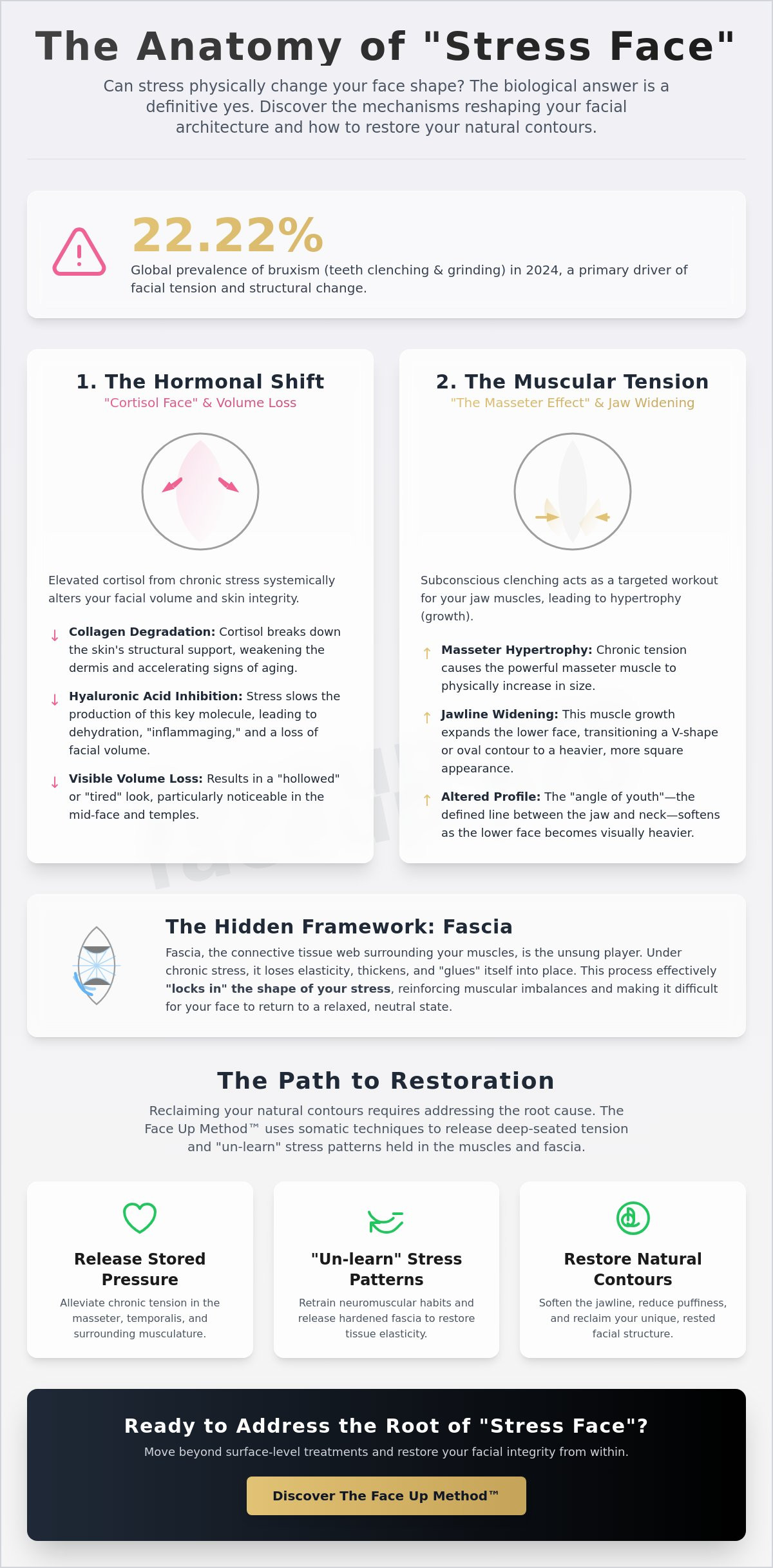
We understand how frustrating it is to feel like you look "angry" or "stressed" even when you're perfectly at rest. With 2024 research showing the global prevalence of bruxism has reached 22.22%, it's clear that millions are physically carrying their professional obligations in their jawlines. This article explores the somatic truth behind "stress face" and how chronic tension physically reshapes your structure. You'll discover how the Face Up Method™ and somatic release can help you release this stored pressure, restoring your natural contours and inviting a sense of calm efficiency back to your appearance.
- Explore the biological blueprint behind "stress face" and find the definitive answer to the question: can stress change your face shape through hormonal and fascial shifts.
- Understand the "Masseter Effect" and how chronic clenching acts as an unintended workout that physically widens your jawline and alters your profile.
- Distinguish between systemic cortisol-related puffiness and structural "Tension Face" to identify the most effective path for restoration.
- Discover how somatic techniques and the Face Up Method™ allow you to "un-learn" deep-seated stress patterns and reclaim your natural facial contours.
The Biological Blueprint: How Stress Physically Alters Facial Structure
When you look in the mirror after a taxing month and notice your features seem different, you aren't imagining things. Many professionals ask, can stress change your face shape, and the biological reality is a definitive yes. "Stress Face" is far more than a tired expression; it's a systemic shift involving hormonal, muscular, and fascial changes. When the body remains in a state of chronic "fight or flight," it redirects resources away from cellular repair, leading to a visible re-sculpting of your facial architecture.
The primary driver of this change is the cortisol-collagen connection. Elevated cortisol levels act as a catalyst for the degradation of the skin’s support scaffolding. By breaking down collagen and elastin fibers, stress weakens the structural integrity of the dermis. This is often compounded by oxidative stress, which accelerates volume loss in the mid-face and temples. Your face has a distinct muscular memory; every furrowed brow or clenched jaw is a repetitive motion that eventually sets into the tissue. Over time, what begins as a temporary reaction to pressure becomes a permanent change in your physical blueprint.
The Cortisol Cascade and Volume Loss
High levels of cortisol do more than just stress your mind; they actively inhibit the production of hyaluronic acid. This molecule is essential for maintaining facial volume and hydration. When its production slows, the skin loses its ability to hold moisture, leading to "inflammaging." This cellular-level inflammation causes the "hollowed" or "tired" look that characterizes many high-performing professionals. It isn't just about surface wrinkles; it's about a fundamental loss of the soft tissue that defines a youthful, rested contour. To help address the cellular-level inflammation caused by stress, you can learn more about how molecular hydrogen technology supports systemic recovery and wellness.
Fascia: The Hidden Web Reshaping Your Face
Fascia is the connective tissue that records our emotional history. This intricate web surrounds your facial muscles, acting as the structural framework that holds everything in place. Under the weight of chronic tension, fascia loses its fluid, elastic quality. It begins to thicken and "glue" itself into place, often reinforcing asymmetrical patterns caused by subconscious habits. For instance, many people suffering from Bruxism find that the fascia around their jaw becomes dense and rigid. This structural "setting" makes it difficult for the face to return to a neutral, relaxed state even when the workday is over. Through this process, your face effectively "learns" the shape of your stress, turning repetitive expressions into a permanent part of your anatomy.
The Masseter Effect: Why Stress Makes Your Jawline Look Wider
While many focus on skin quality or surface-level aesthetics, the actual architecture of your face is heavily influenced by the muscles beneath. If you've wondered can stress change your face shape, the most visible evidence is often found in the jawline. The masseter muscle is the strongest muscle in the human body relative to its size, capable of exerting immense pressure. When we face professional or personal demands, we often clench our teeth subconsciously. This chronic engagement acts like a targeted gym workout for the jaw, leading to masseter hypertrophy. Over time, this muscle growth physically expands the lower face, fundamentally altering your profile.
This growth isn't just a matter of tension; it's a physical transformation. A face that once featured a soft V-shape or an elegant oval can gradually transition into a "square" or "heavy" lower face. This aesthetic shift is often accompanied by persistent discomfort, making TMJ massage therapy an essential tool for both restoring balance and reclaiming your natural contours. By addressing the muscle bulk directly, it's possible to reverse the "widening" effect and return to a more balanced facial structure.
Clenching, Grinding, and Lower Face Widening
The mechanics of stress often manifest during sleep. According to Johns Hopkins Medicine on bruxism, teeth grinding is a common physical response to emotional pressure. This nocturnal activity doesn't just affect your teeth; it forces the masseter and temporalis muscles to overwork. As the temporalis muscle near the temples bulges, the upper face can also appear broader. This combination leads to the loss of the "angle of youth," where the sharp, defined line between the jaw and neck becomes blurred by overdeveloped muscle tissue. Professionals seeking to maintain a high-standard appearance must recognize that these structural changes are often the result of this hidden, repetitive "exercise."
The Downward Pull: Depressor Muscles and Sagging
Stress doesn't just build muscle; it also activates the wrong ones. Chronic tension frequently engages the "depressor" muscles, which are responsible for pulling the corners of the mouth downward. Unlike the lifting muscles used in genuine smiles, these depressors create a constant downward pull on the facial tissue. This persistent tug-of-war leads to the formation of jowls and a "sagging" appearance in the lower face. By understanding these somatic patterns, you can begin to proactively manage how your body processes pressure. If you're ready to explore a more holistic approach to facial integrity, you can learn more about the Face Up Method™ ecosystem and its specialized solutions.
Cortisol vs. Muscle Tension: Debunking the "Stress Face" Myths
The term "Cortisol Face" has recently gained traction in digital wellness circles, often used to describe any unwanted change in facial appearance. However, when exploring if and how can stress change your face shape, it's vital to separate systemic hormonal issues from localized physical tension. While elevated cortisol can lead to water retention and fat redistribution, many of the structural changes professionals notice are actually "Tension Face." This is a result of muscular hypertrophy and fascial thickening rather than just hormonal fluctuations. Understanding this distinction is the first step toward a more effective, somatic approach to restoration.
It is also essential to distinguish between lifestyle-induced changes and serious medical conditions. True "moon face" is a clinical symptom of Cushing’s Syndrome, a condition involving extreme cortisol excess that requires medical intervention. Most people, however, experience a milder version driven by high-pressure environments. According to the University of Miami Health System on stress and facial structure, the physical manifestations of stress often stem from subconscious habits like jaw clenching. These habits don't just cause pain; they physically reshape the lower face by overworking the masseter muscles.
Is it Fat, Fluid, or Muscle?
Determining the root cause of your "stress face" allows for a targeted solution. You can often identify your specific type by observing how your face changes throughout the day. Consider this brief checklist:
- Systemic Edema (Fluid): Your face looks puffiest in the morning and improves with movement or upright posture. This is often exacerbated by tight neck muscles that restrict lymphatic drainage.
- Muscular Hypertrophy (Muscle): Your jawline feels rigid and looks wider or more "square" regardless of the time of day. This indicates the masseter muscle has grown through repetitive clenching.
- Structural Sagging (Tension): The corners of your mouth pull downward, and your mid-face feels "heavy." This is usually due to the chronic activation of depressor muscles.
Why Botox Isn’t Always the Answer for Stress Shape
Many turn to neurotoxins like Botox to slim a widened jawline, but this approach often masks the symptom without addressing the somatic cause. When you paralyze a dominant muscle like the masseter, the body frequently compensates through "recruitment." Other muscles, such as the temporalis or the pterygoids, begin to work harder to perform the same functions. This can lead to new patterns of tension and even further changes in your face shape. Instead of temporary chemical freezing, the Face Up Method™ focuses on somatic awareness and manual release. By retraining the nervous system to let go of these deep-seated patterns, you can achieve a more natural, balanced contour that reflects a state of genuine internal calm.
Somatic Solutions: Practical Techniques to Soften and Reshape
Somatic facial work serves as a sophisticated method for "un-learn" the physical habits that compromise your facial integrity. If you've wondered, can stress change your face shape, you've likely already felt the rigidity that precedes the aesthetic shift. Unlike traditional beauty treatments that focus on the skin, somatic release addresses the nervous system's role in maintaining muscular tension. By consciously engaging with the tissue, you can disrupt the cycle of chronic clenching and guide your features back to their natural, relaxed state.
The Power of Buccal and Deep Tissue Release
Reaching the deep attachments of the facial muscles requires more than surface-level pressure. Intra-oral, or buccal, massage allows for a unique manipulation of the masseter from the inside out. This technique is essential for structural reshaping because it accesses the muscle fibers that are unreachable through external touch alone. Many professionals report a profound "emotional release" during this process, as the jaw is a primary storage site for suppressed stress. It's a highly efficient practice; just 10 minutes of targeted release can counteract 8 hours of subconscious clenching. To enhance these results, selecting a specialized TMJ massage tool can provide the necessary precision for deep tissue access.
To begin your restoration journey, try this 3-step jaw release ritual:
- Localization: Place your clean index finger inside your mouth, reaching toward the back of your lower cheek until you feel the thick masseter muscle.
- Compression: Using your thumb on the outside for support, apply gentle, steady pressure to the tightest points of the muscle.
- Conscious Release: Exhale deeply through your mouth, imagining the muscle melting away from the bone as you hold the pressure for 30 seconds.
Posture and the "Tech Neck" Connection
Your facial structure is inextricably linked to your global alignment. The "tech neck" posture common in modern professional life pulls on the platysma, a thin sheet of muscle in the neck. This chronic tension drags the lower face downward, contributing to the sagging discussed in previous sections. It's a reminder that when considering how can stress change your face shape, we must look at the whole body. To support your jawline, practice "mewing" by resting your entire tongue against the roof of your mouth. Additionally, somatic therapy recognizes a deep connection between the pelvic floor and the jaw; tension in one often mirrors tension in the other. Addressing both is key to holistic facial sculpting.
If you're looking for professional guidance on these techniques, explore the Face Up Method™ ecosystem for expert-led solutions.
The Face Up Method™: Reclaiming Your Natural Contours
Restoring your facial integrity requires a move away from temporary fixes toward a holistic, proprietary ecosystem. Olga Newman’s Face Up Method™ offers a sophisticated alternative to invasive procedures by addressing the intersection of aesthetics and somatic health. While many still wonder, can stress change your face shape, our community focuses on the solution: a specialized approach that combines deep facial sculpting with somatic bodywork. This methodology doesn't just mask the signs of pressure; it targets the root causes of "stress face" by releasing the deep-seated tension held within the musculature and fascia.
By engaging with this method, you enter a specialized professional landscape where the goal is to "un-learn" the physical manifestations of global stress. This isn't a mere beauty routine; it's a disciplined practice of structural restoration. For those looking to bring these high-standard transformations to their own clients, we invite you to explore our facial sculpting certification. Mastering these techniques allows practitioners to facilitate profound shifts in both facial architecture and emotional well-being.
From Daily Rituals to Professional Mastery
The Face Up App serves as a gateway to this restorative journey, providing daily guided rituals that prevent stress from "setting" into your features. Specifically, the "Jaw Release" course within the app targets the masseter hypertrophy we explored earlier, using precise movements to soften a widened jawline. This somatic approach ensures that results are lasting because they are built on a foundation of nervous system regulation. If you prefer a hands-on experience, our global practitioner directory listing connects you with certified experts who provide in-person Face Up Sculpting Treatments and Somatic Bodywork Sessions in diverse international markets.
A Natural Future for Your Face
Understanding that your face shape is not a fixed reality is the first step toward reclaiming your natural contours. Your facial structure is a living, breathing system that responds to how you move, breathe, and process your professional obligations. The journey from recognizing the "Masseter Effect" to active somatic release is one of professional advancement and personal integrity. You have the agency to reshape your reflection through consistent, mindful intervention. We invite you to join our community and begin a new narrative for your appearance. Explore the Face Up App and start your ritual today to experience the power of calm efficiency in your own reflection.
Reclaiming Your Reflection Through Somatic Awareness
The structural shifts you observe in the mirror are not permanent dictates of age; they're the physical records of your nervous system's response to pressure. We've explored how chronic tension leads to masseter hypertrophy and fascial rigidity, fundamentally answering the question: can stress change your face shape? By moving beyond surface-level topicals and embracing the proprietary, non-invasive protocol of the Face Up Method™, you can begin to dismantle these patterns from the inside out.
Founded by Olga Newman, a specialist in somatic bodywork, this method offers a clear path toward restoring your natural contours and emotional equilibrium. You're invited to join a global community of practitioners and self-care enthusiasts who prioritize long-term facial integrity over temporary masks. The tools for this transformation are readily available, allowing you to transition from a state of "stress face" to one of calm, professional readiness. Your face is a living system; it's time to give it the space to breathe and return to its original balance.
Begin your somatic journey with the Face Up App
Frequently Asked Questions
Can stress make your face look wider?
Yes, chronic stress frequently leads to a wider facial appearance through a process called masseter hypertrophy. When you subconsciously clench your jaw in response to professional or personal pressure, you are effectively giving your masseter muscles a constant workout. Over time, these muscles grow in size, which can transform a previously oval or V-shaped face into a more square or heavy lower profile.
What is cortisol face and how do I get rid of it?
"Cortisol face" refers to the systemic puffiness and water retention caused by elevated stress hormones. To address this, it is essential to move beyond surface-level treatments and focus on improving lymphatic drainage and reducing inflammation. Somatic techniques, such as those found in the Face Up Method™, help regulate the nervous system and release the muscular tension in the neck that often restricts fluid flow.
Does jaw clenching change the shape of your chin and jawline?
Jaw clenching significantly impacts the definition of your chin and jawline. Persistent tension in the masseter and mentalis muscles can make the jawline appear less defined or even "recessed" as the muscles pull on the surrounding tissue. This often leads to the loss of the sharp "angle of youth" where the jaw meets the neck, creating a heavier look in the lower third of the face.
How long does it take for stress to change your facial appearance?
The timeline for these changes varies based on the intensity and duration of the stressor. While temporary puffiness can occur overnight, structural changes like muscle growth or fascial thickening typically develop over several weeks or months of consistent tension. If you're asking can stress change your face shape in the long term, the answer depends on how quickly these repetitive muscular habits become "set" in your tissue.
Can facial massage really reverse the effects of stress?
Specialized facial massage, particularly somatic and intra-oral techniques, can effectively reverse many stress-related changes. By manually releasing deep-seated tension in the masseter and surrounding fascia, you can "un-learn" the physical habits that have altered your contours. This process allows the muscles to return to their natural length and the face to regain its original, balanced structure.
Why does my face look asymmetrical when I am stressed?
Facial asymmetry during stressful periods usually stems from uneven muscular engagement. Most people have a dominant side for chewing or clenching, which leads to one masseter muscle becoming more developed than the other. This imbalance pulls the features toward the tighter side, making the face appear asymmetrical. Somatic bodywork helps identify and release these one-sided patterns to restore facial harmony.
Is there a way to release emotional stress stored in the face?
Releasing stored emotional stress requires a somatic approach that connects the mind and body. The Face Up Method™ utilizes deep tissue manipulation and intra-oral massage to access the layers of tissue where emotional tension is physically recorded. This process often triggers a profound sense of relief as the nervous system finally lets go of the "fight or flight" patterns held in the jaw and brow.
What are the best exercises to slim a "stress-widened" jaw?
To slim a jaw widened by stress, the focus should be on release rather than traditional "exercise." Engaging in the Jaw Release Course through the Face Up App provides specific, guided techniques to soften the masseter muscle. By focusing on relaxation and manual decompression instead of further engagement, you can reduce muscle bulk and restore a more slender, natural jawline.


