

That rubber exercise ball you're biting on to "sculpt" your jawline is likely reinforcing the very tension patterns causing your chronic headaches. It's a common mistake; when we feel tightness, our instinct is to work the muscle harder. However, for the 79 percent of people with jaw disorders who suffer from persistent headaches, more effort usually leads to more pain. You deserve a strategy that respects your physiology rather than straining it.
We understand the exhaustion of waking up with a sore face and the frustration of tools that promise much but deliver little. True relief comes from neuromuscular unlearning, not muscular force. In this guide, we'll explore why traditional jaw workouts often fail and introduce you to effective somatic jaw tension release exercises designed to permanently unlock chronic clenching. You'll discover how to transition from a cycle of pain to a naturally relaxed, sculpted appearance by addressing the emotional roots of your tension. Let's begin the journey toward a more comfortable, fluid way of moving.
Key Takeaways
- Understand why popular "jawline trainers" often exacerbate chronic pain by overworking already stressed masseter muscles.
- Learn to identify Sensory Motor Amnesia in your face and why your brain needs to relearn the signal to let go.
- Master five specific somatic jaw tension release exercises that prioritize gentle internal awareness over external performance.
- Discover the connection between your nervous system and the jaw to address the psychological root causes of clenching.
- Explore how the Face Up™ ecosystem provides a structured path for transforming these movements into a restorative daily ritual.
Understanding the Root of Chronic Jaw Tension
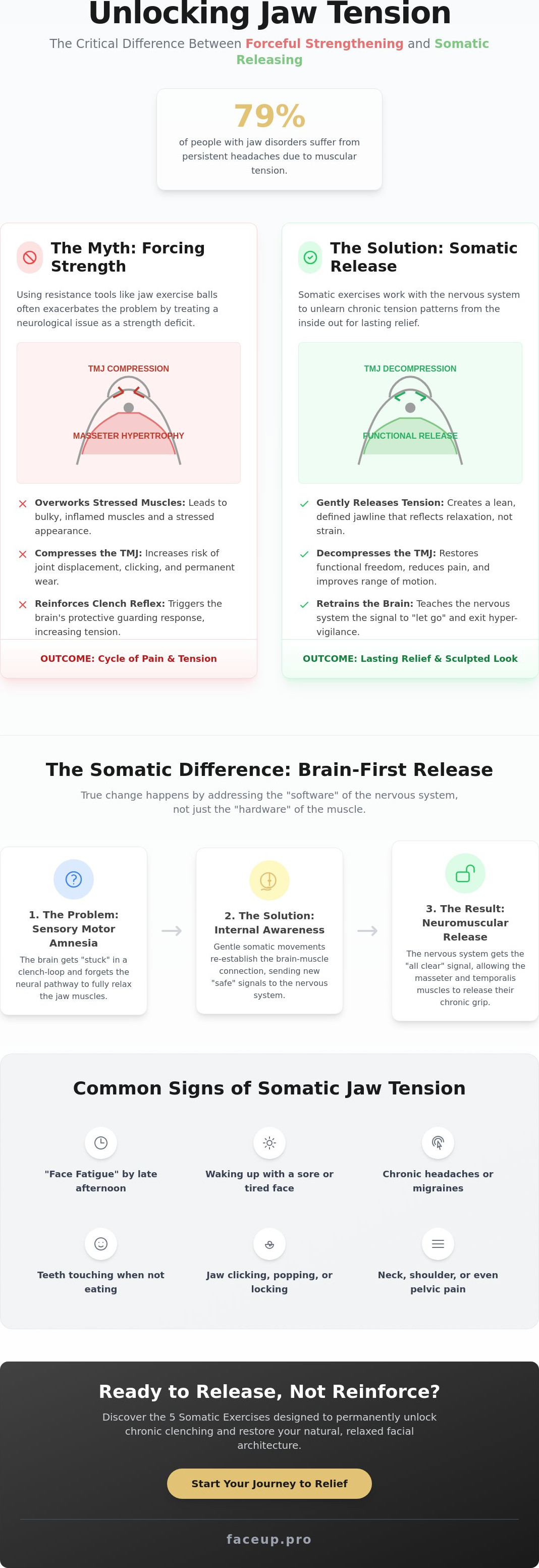
The jaw serves as the body's primary stress container. When the nervous system encounters a perceived threat, it parks that unresolved energy in the muscles of the face and neck. The masseter and temporalis muscles are remarkably efficient at this task. They are the strongest muscles in the human body relative to their size, capable of exerting significant force during moments of concentration or distress. However, treating these muscles as purely mechanical tools often leads to frustration. Traditional stretching techniques frequently fail because they ignore the physiological clench reflex. When you pull on a muscle that the brain is actively telling to contract, you trigger a protective guarding response. The muscle doesn't relax; it fights back harder to prevent what it perceives as a potential injury.
True relief requires a shift in perspective. We must distinguish between simple mechanical tension and deep-seated neuromuscular holding patterns. Mechanical tension might be solved with a quick massage, but a holding pattern is a decision made by the brain. To change the shape of your jaw and the quality of your comfort, you must address the software of the nervous system rather than just the hardware of the muscle fibers. This is where somatic jaw tension release exercises provide a distinct advantage over traditional methods.
The Nervous System Connection
Your jaw is hardwired into your survival circuitry. During a fight or flight response, the trigeminal nerve signals the masseter to brace, preparing the body for impact. This isn't a habit you can simply "stop" through willpower. It's a survival signal. Chronic clenching, often referred to as Bruxism, indicates that the nervous system is stuck in a loop of hyper-vigilance. It hasn't received the signal that the environment is safe. By utilizing somatic jaw tension release exercises, you communicate directly with the brain to down-regulate this response, providing the "all clear" signal your muscles have been waiting for.
Signs You Are Holding Somatic Tension
The Jaw Exercise Ball Myth: Why Strengthening Isn't Releasing
The year 2026 has seen a surge in "mewing" trends and viral videos promoting rubber resistance balls as the ultimate tool for a chiseled jawline. These products promise to sculpt the face through high-intensity biting exercises. However, for most individuals, these tools are fundamentally counterproductive. Biting down on a resistance ball forces the masseter muscles into a state of extreme hypertrophy, or overgrowth. While this might create a "square" appearance, it does so by adding bulk to muscles that are already chronically overactive. This mechanical approach ignores the fact that most facial tension is a neurological issue, not a lack of strength. Instead of building more mass, the goal should be functional freedom through somatic jaw tension release exercises.
The primary danger of these tools lies in the compression of the temporomandibular joint. Constant, forceful biting puts immense pressure on the delicate TMJ disc, which can lead to displacement or permanent wear. This repetitive strain is a significant contributor to the development of TMJ disorders, characterized by clicking sounds, limited range of motion, and persistent pain. There is a distinct aesthetic paradox at play here. A truly attractive, youthful jawline is defined by structural bone clarity and lean tissue, not by bulky, inflamed muscles that pull the face into a permanent scowl. Jaw exercise balls are the 'heavy lifting' of facial mistakes.
Hypertrophy vs. Functional Release
Overworking the masseter creates a face that looks stressed rather than defined. In the specialized community of facial health, we recognize that a tense muscle is actually a "weak" muscle. Because it's stuck in a perpetual state of contraction, it cannot move through its full range of motion or respond effectively to the nervous system. This lack of flexibility often manifests as "TMJ clicks" or even sudden lockjaw. By prioritizing somatic jaw tension release exercises, you teach the muscle how to lengthen, which restores its strength and functional integrity without the risk of joint damage.
Why 'Sculpting' Requires Softening
True facial definition is achieved through softening and drainage, not aggressive loading. The Face Up Method focuses on releasing the fascia and encouraging lymphatic drainage to reveal the natural bone structure beneath. This approach creates a refined, lifted appearance that resistance tools simply cannot replicate. When you release the "holding" patterns in the face, the skin sits more gracefully over the bone. To explore these techniques in depth, you can access our specialized Jaw Release Course, which provides a professional alternative to high-impact exercises. We focus on structural bone definition by removing the fluid and tension that mask your natural contours.
The Somatic Difference: Training the Brain to Let Go
Somatics is the study of the body experienced from within. While traditional fitness focuses on external performance and visible results, somatic work prioritizes internal awareness. This distinction is vital when dealing with the delicate structures of the face. When you use a resistance ball, you are performing for an external goal, often at the expense of your joint health. In contrast, somatic jaw tension release exercises focus on how the movement feels to your nervous system. This approach addresses Sensory-Motor Amnesia, a state where the brain has literally forgotten how to relax a muscle because it has been held in a "stress" position for too long. You cannot force a muscle to remember relaxation; you must guide it back through conscious, slow movement.
The Face Up Method™ operates on the principle that "less is more." Aggressive interventions often trigger the body's defense mechanisms, leading to more clenching. By slowing down, you invite the brain to regain control over the motor patterns of the jaw. This isn't about "fixing" a broken part. It's about restoring a dialogue between your mind and your musculature. When the brain feels safe and aware, it naturally lets go of the holding patterns that create chronic discomfort and facial fatigue.
Pandiculation vs. Stretching
Passive stretching often fails because it triggers the stretch reflex, causing the muscle to tighten in response to the pull. Somatics uses pandiculation instead. This involves a conscious, gentle contraction of the muscle followed by an extremely slow, controlled release. This "active" lengthening signals the brain to reset the muscle's resting length. It acts as a reset button for your masseter. A 30-second somatic shift can be more effective than ten minutes of painful stretching because it addresses the neurological root of the tension rather than just the physical fibers.
The Role of Intraoral Awareness
Effective release requires looking beyond the visible muscles. The "inner" jaw, specifically the pterygoid muscles, plays a vital role in how you hold your face. These muscles are responsible for the side-to-side movement of the jaw and are often the primary site of deep-seated tension. Your tongue's position also dictates your jaw's resting state; it should rest gently on the roof of the mouth, just behind the front teeth, without pressing against them. For those seeking a deeper level of relief, our TMJ Massage: A Somatic How-To Guide for Deep Jaw Release provides specific techniques for accessing these internal structures safely. By cultivating this intraoral awareness, you complete the loop of facial relaxation and structural balance.
5 Somatic Jaw Tension Release Exercises You Can Do Today
To begin your practice, find a quiet space where you won't be interrupted for five minutes. Sit or lie down in a position that allows for a neutral neck and spine. Before you start, adopt what we call a "soft gaze." This involves relaxing the muscles around your eyes and letting your focus broaden. This simple shift signals to your nervous system that you are in a safe environment, which is a prerequisite for any effective neuromuscular change. Consistency is the cornerstone of progress here. A five-minute daily ritual is significantly more effective at retraining the brain than a one-hour monthly massage. You aren't just stretching; you are performing somatic jaw tension release exercises to update your internal body map.
Never push into pain during these movements. If you feel sharp sensations or intense clicking, reduce the range of motion until the movement feels fluid and comfortable. The goal is to move within your current "window of safety." Somatic exercises work by updating the brain's map of the jaw muscles. By moving slowly and consciously, you provide the brain with the high-quality data it needs to release chronic holding patterns.
Exercise 1-3: Releasing the Hinge
The "Micro-Yawn" is a slow-motion exploration of jaw opening. Instead of a full yawn, open your mouth only a few millimeters. Do this so slowly that the movement is almost imperceptible. Notice if the jaw wants to zig-zag and gently guide it back to center before slowly closing. Next, try the "Side-to-Side Glide." With your lips gently closed and teeth slightly apart, slide your lower jaw two millimeters to the right, then back to center. Repeat on the left. This resets the lateral pterygoids with minimal effort. Finally, practice the "Jaw Drop Pandiculation." Gently clench your teeth for three seconds to engage the masseter, then take ten full seconds to slowly let the jaw drop open. This "conscious contraction" is the key to signaling a deep neurological release.
Exercise 4-5: Emotional and Postural Integration
The "Silent Ah" focuses on releasing the throat and jaw simultaneously. Imagine you are making the shape of the letter "A" with your mouth, but don't produce any sound. Focus on the feeling of space opening up at the back of the soft palate. For the "Ear-to-Jaw Breath," use visualization to soften the temporalis muscles. As you inhale, imagine the breath entering through your ears and flowing directly into the jaw hinge. As you exhale, feel the warmth of that breath melting the tension away. These somatic jaw tension release exercises bridge the gap between physical sensation and emotional regulation. To deepen your practice and ensure you are performing these movements with expert precision, we invite you to explore the Face Up App Subscription for guided daily rituals.
Building a Sustainable Ritual with Face Up
Retraining the nervous system is a journey of consistency rather than force. While the five exercises we've explored provide immediate relief, the goal is to transition from "fixing" a temporary flare-up to establishing a sustainable daily ritual. When you integrate somatic jaw tension release exercises into your morning or evening routine, you move beyond simple symptom management. You begin to experience long-term benefits like natural facial rejuvenation, a significant reduction in tension-related headaches, and improved sleep quality. This approach is particularly vital for professionals in the 20 to 40 age demographic, where the prevalence of jaw disorders is statistically highest. For those with complex histories of clenching, seeking the guidance of a certified Face Up Method™ Practitioner can provide the personalized touch needed to navigate deep-seated holding patterns.
Why Digital Guidance Matters
It's difficult to accurately perceive your own facial tension because the brain often accepts a "clenched" state as the new normal. Digital guidance bridges this gap by providing a rhythmic, external reference point for your internal exploration. The Face Up App ensures you don't fall into the trap of "over-exercising" or turning your release work into another high-effort task. It fosters a community-led environment where professionals and enthusiasts alike share the common goal of calm efficiency. This structured support helps maintain the "less is more" philosophy that is central to somatic success, preventing the accidental strain that comes from moving too fast or too hard.
Your Path to Jaw Freedom
Choosing to swap a rigid tmj massage tool for gentle, somatic movement is a proactive step toward lasting health. It requires trusting that softening is more powerful than sculpting through force. Your jaw isn't just a hinge; it's a gateway to your entire nervous system's sense of peace. When the jaw releases, the rest of the body often follows, easing the administrative and physical burden of chronic pain. We invite you to step into this proprietary ecosystem and discover a more refined way of inhabiting your own face. Join the Face Up Community and Release Your Jaw Today to start your progression toward lasting freedom and professional-grade self-care.
Reclaiming Your Natural Facial Ease
True jaw freedom isn't found in a resistance ball or aggressive effort. It's achieved through the patient, intentional work of retraining the nervous system. By prioritizing somatic jaw tension release exercises, you address the neurological root of clenching rather than simply masking the symptoms. This shift from "fixing" to "listening" allows for a more relaxed appearance and a significant reduction in chronic discomfort. You've learned that your jaw is a primary stress container; now you have the tools to empty it effectively.
Founded by somatic expert Olga Newman and trusted by thousands of practitioners worldwide, our methodology focuses on natural, non-invasive rejuvenation. We believe in providing a holistic environment where professionals can find order and reliability in their self-care routines. You don't have to navigate this path alone. Start your 7-day jaw release journey on the Face Up App today to experience the power of guided somatic movement. It's time to let go of the tension that no longer serves you and rediscover a state of calm efficiency. You're just a few gentle movements away from a lighter, more comfortable version of yourself.
Frequently Asked Questions
Can a jaw exercise ball cause TMJ disorders?
Yes, using a jaw exercise ball can significantly increase the risk of developing TMJ disorders. These tools force the masseter muscles to exert extreme pressure on the temporomandibular joint, which can lead to disc displacement or inflammation. While they are marketed for sculpting, the repetitive mechanical strain often results in the clicking and pain associated with TMD, which already affects an estimated 29.5 percent of the global population.
How long does it take for somatic jaw exercises to work?
You may feel a subtle shift in sensation immediately, but long-term results require a consistent daily ritual. Most individuals notice a significant reduction in chronic clenching after 21 to 30 days of practicing somatic jaw tension release exercises. This timeframe allows the nervous system to overwrite old "holding" patterns with new, relaxed motor signals. Consistency in small doses is far more effective than occasional, intense sessions.
Why does my jaw click when I try to do release exercises?
Clicking typically signifies that the articular disc is slightly out of place as it moves over the jawbone. If you hear or feel a click during your practice, it's a signal from your body to slow down and reduce your range of motion. Somatic work isn't about the size of the movement; it's about the quality of awareness. Move only as far as you can without the click to help the joint relearn a smoother path.
Is jaw tension related to neck and shoulder pain?
Yes, the jaw, neck, and shoulders are deeply interconnected through the trigeminal nerve and shared muscle chains. Research indicates that 51 percent of people with jaw disorders also suffer from chronic neck pain. When you clench your jaw, the muscles at the base of the skull often contract in sympathy. This creates a ripple effect of tension that can lead to persistent earaches, headaches, and postural imbalances.
Can I use the Face Up Method if I have Botox in my masseters?
You can certainly use our method alongside Botox, provided you wait at least two weeks for the initial injections to settle. While Botox temporarily weakens the masseter muscle, it doesn't change the brain's desire to clench. Incorporating somatic jaw tension release exercises helps you maintain healthy joint mobility and retrains the nervous system so that you don't rely solely on pharmaceutical interventions for long-term comfort.
What is the best sleeping position for jaw tension relief?
Sleeping on your back with a pillow that supports the natural curve of your neck is the most beneficial position for your jaw. Side sleeping often places uneven pressure on the TMJ, which can exacerbate clenching throughout the night. By staying on your back, you allow the jaw to rest in a neutral, gravity-assisted position, reducing the likelihood of waking up with a sore or tight face.
How do I know if my jaw tension is emotional or physical?
In the somatic landscape, we view the physical and emotional as two sides of the same coin. If your clenching intensifies during deadlines or stressful social interactions, your tension has a strong emotional component. However, if the tightness is constant regardless of your mood, it may have transitioned into a physical habit. Somatic work addresses both by calming the nervous system while physically releasing the muscle fibers.
Are there any 'jaw massagers' that actually work?
Most mechanical "jaw massagers" offer only surface-level relief and fail to address the underlying neuromuscular patterns. While soft-tissue tools can feel pleasant, they don't teach the brain how to stop the clenching reflex. We find that manual, hands-on techniques and intra-oral massage are much more effective. These methods allow for a deeper, more precise release of the internal muscles like the pterygoids that gadgets simply cannot reach.


