

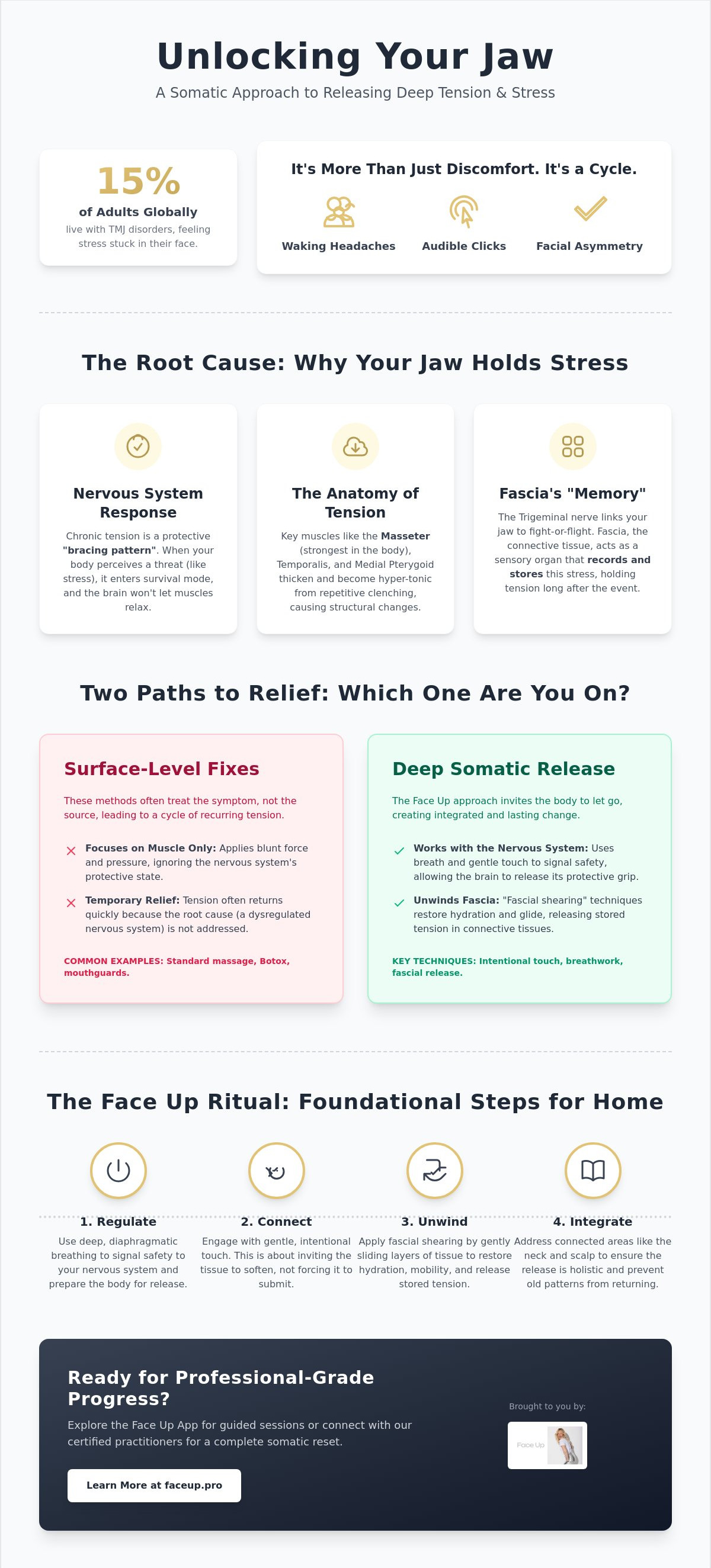
What if the persistent tightness in your jaw isn't just a physical muscle knot, but a silent transcript of every stressor your nervous system has ever recorded? For the 15% of adults globally who live with TMJ disorders, the experience is more than just discomfort; it's a cycle of waking up with headaches, hearing audible clicks, and feeling as though stress is literally stuck in your face. Understanding how to release deep jaw tension requires us to look past temporary fixes and address the root cause where your fascia meets your emotional history.
You aren't alone in feeling like your jaw has a mind of its own. It's exhausting to manage facial asymmetry or chronic pain that seems to resist every standard stretch or night guard. This guide provides a sophisticated shift in perspective, offering somatic techniques designed to unlock your jaw by regulating the nervous system. We will explore the specific movements and emotional insights needed to transition from a state of constant tension to a more relaxed, sculpted, and pain-free life.
Key Takeaways
- Understand that chronic tightness is a protective nervous system response involving the masseter and temporalis muscles rather than just simple muscle fatigue.
- Learn why "unwinding" the fascia is more effective for lasting relief than standard massage techniques that only address surface-level tension.
- Discover how to release deep jaw tension by addressing the emotional and physical root causes instead of relying on temporary measures like Botox or mouthguards.
- Master the foundational steps of the Face Up Ritual to begin your journey toward a more relaxed and sculpted facial appearance from the comfort of home.
- Explore how the Face Up App and our network of certified practitioners provide the structured support needed for professional-grade somatic progress.
Understanding the Root Causes of Chronic Jaw Tension
Chronic jaw tension is rarely a simple case of overused muscles. Instead, it functions as a sophisticated protective response orchestrated by your nervous system. When you search for how to release deep jaw tension, you're often looking for a physical solution to a systemic state. If your body perceives a threat, it initiates a bracing pattern; in these instances, consulting a specialist like Michelle Owen for a postural and orthopedic assessment can help identify if structural issues are fueling this response. This survival mode makes traditional stretching ineffective because the brain won't allow a muscle to relax while it still feels the need to protect the cervical spine and skull. It's a biological lockdown that requires a more nuanced approach than simple force.
The Anatomy of a Tight Jaw
The jaw is a complex mechanical system centered around the Temporomandibular joint dysfunction, or TMD, which involves the joint connecting your mandible to your skull. While many focus solely on the surface, deep tension involves a coordinated effort between the masseter, the temporalis on the sides of your head, and the medial pterygoid tucked inside the jaw. The masseter is the strongest muscle in the human body relative to its size. Over time, a repetitive clench cycle causes these tissues to thicken and become hyper-tonic. This thickening isn't just about strength; it's a structural change in the tissue that makes the jaw feel heavy or immobile during daily function.
Why Your Stress Lives in Your Jaw
The jaw is directly wired into your survival circuitry through the trigeminal nerve. This nerve is a primary driver of the fight-or-flight response, meaning your jaw is often the first place to tighten and the last place to let go. Fascia, the connective tissue wrapping these muscles, acts as a sensory organ that records these moments of stress. When we "hold our tongue" or suppress our needs, the body stores that energy as physical rigidity. This somatic storage means the fascia literally remembers the tension, even after the original stressor has passed. It's as if the tissue is waiting for a signal of safety that never arrives. To find lasting relief, we must address the nervous system's need for security rather than just attacking the muscle fibers themselves. Understanding this link is the first step in moving from a state of bracing to one of open, fluid movement.
The Somatic Approach: Why Rubbing Your Jaw Isn’t Enough
Standard massage often treats the jaw like a mechanical hinge that just needs oiling. If you've tried rubbing your masseters only to find the tension returns within an hour, you've experienced the limits of localized pressure. Truly understanding how to release deep jaw tension involves moving beyond the muscle fibers and into the somatic realm. Somatic bodywork isn't about forcing a muscle to submit; it's about inviting the nervous system to let go of its protective grip. We focus on "unwinding" the tissue, a process that follows the body's subtle internal cues rather than applying blunt force. This method ensures that the release is integrated and lasting rather than a fleeting moment of relief.
Fascia: The Missing Link in Jaw Relief
Fascia is the connective tissue that surrounds every muscle. When it becomes dehydrated or "stuck" due to chronic stress, it acts like a shrink-wrap around your jaw. Unlike deep tissue work, which focuses on intense pressure, somatic release uses fascial shearing. This technique gently slides the layers of tissue to restore hydration and glide. Because the jaw is part of a larger structural chain, you cannot achieve lasting freedom without also addressing the tension held in the neck and scalp. If these surrounding areas remain tight, they will eventually pull the jaw back into its old, restricted patterns.
The Face Up Method™ integrates these principles by combining intentional touch with specific breathwork patterns. Breath is the bridge between the conscious and unconscious mind. By coordinating deep, diaphragmatic breathing with gentle tissue manipulation, we signal the brain that the environment is safe. This dual approach ensures that you aren't just stretching a muscle, but actually resetting the neural pathways that cause the clenching in the first place. For those seeking a structured way to implement these changes, exploring a Somatic Bodywork Session can provide the professional guidance needed for a complete reset.
The Nervous System Connection
The Temporomandibular Disorders (TMDs) often discussed in clinical settings are frequently rooted in a dysregulated nervous system. Releasing the jaw requires signaling safety to the brain, specifically through the vagus nerve. This nerve is a major player in the parasympathetic nervous system, responsible for the "rest and digest" state. When the vagus nerve is stimulated through correct somatic techniques, the jaw muscles naturally drop. This isn't just about comfort; it's about biological signaling. A relaxed jaw is a signal of a regulated nervous system, telling your entire body that the period of "survival mode" is over. This shift allows for deeper healing and prevents the recurrence of chronic pain.
Surface Massage vs. Deep Somatic Release
While clinical interventions like mouthguards and Botox are often presented as the primary solutions for Temporomandibular Disorder (TMD), they frequently act as temporary shields rather than permanent cures. These "quick fixes" manage the symptoms of a tight jaw without addressing the underlying neurological patterns. Learning how to release deep jaw tension requires a shift from simply protecting the teeth or paralyzing the muscle to actively retraining the body's response to stress. A somatic approach offers a sustainable path forward, positioning the Face Up Method™ as a natural alternative to more invasive, clinical procedures.
The Problem with Mouthguards and Botox
Mouthguards are a common recommendation, but many users find that wearing a plastic barrier actually increases the neurological urge to chew or clench during the night. The brain senses an object between the teeth and responds by engaging the masseter muscles even more vigorously. Similarly, relying on muscle paralytics like Botox carries significant long-term risks. Repeated injections in the jaw can lead to muscle atrophy and even potential bone density loss over time. Instead of disabling the muscle, somatic release focuses on restoring healthy function. It's about teaching the tissue how to be soft and responsive again, ensuring that your facial structure remains strong and supported without the need for pharmaceutical intervention.
What Makes Deep Somatic Release Different?
Deep somatic release goes beyond the surface by utilizing specialized intra-oral, or buccal, techniques. These methods allow a practitioner to reach the internal pterygoid muscles, which are key drivers of tension but are impossible to access from the outside of the face. This internal work provides a level of relief that standard facial massage cannot replicate. Beyond the physical manipulation, this process emphasizes emotional integration. Because the jaw often stores suppressed communication or stress, a physical release can often lead to an emotional "unwinding" that provides profound mental clarity.
The results of this deeper work are visible in more than just pain reduction. By releasing chronic holding patterns, many individuals notice a significant improvement in their facial shape and symmetry. For those exploring a more holistic path, TMJ massage therapy serves as an essential tool for restoring balance to the entire cranial structure. This isn't just about feeling better for a day; it's about establishing a new baseline of health and aesthetic harmony that lasts.
Step-by-Step: The Face Up Ritual for Deep Jaw Release
Creating a dedicated space for your practice is the first step in mastering how to release deep jaw tension. This isn't a clinical exercise; it's a somatic ritual designed to transition your nervous system from a state of bracing to one of receptive calm. By approaching these movements with intentionality, you aren't just addressing pain. You're also promoting a more sculpted, symmetrical facial appearance. For enhanced precision and deeper fascial work, many find that incorporating a TMJ massage tool provides the mechanical leverage needed to reach stubborn trigger points without straining the hands.
Step 1: External Masseter Melt
Locate your masseter muscles by gently clenching your teeth; they're the thick bands of tissue just in front of your earlobes. Instead of using aggressive friction, apply a steady, "melting" pressure. Use your knuckles to perform a slow stripping motion, moving from the cheekbone down toward the jawline. As you descend, integrate a slow, audible exhale. This vocalization helps release the heat generated by the muscle and signals the brain to lower its defensive tone. Repeat this three to five times on each side to encourage the tissue to soften and lengthen.
Step 2: The Temporal Sweep
The fan-shaped temporalis muscle sits above the ears and is often the culprit behind tension headaches. Use the pads of your fingers to apply firm pressure to the temples. Slowly sweep your fingers upward and outward, imagining you're creating space within the skull. This movement encourages the fascia to glide rather than stick. It's a vital step for those who find their jaw tension radiating into the forehead or eyes. This gentle expansion helps prevent the "clamping" sensation that often follows a stressful day, restoring a sense of lightness to the upper face.
Step 3: Intra-Oral Awareness (The Buccal Secret)
Reaching the internal pterygoids requires a safe, intra-oral approach. After washing your hands, place a clean thumb inside the mouth against the cheek. Use your index finger on the outside to pinch the tissue gently. Explore the "corners" where the upper and lower jaw meet. You're looking for areas that feel dense or tender. Apply light pressure and hold until you feel a subtle "pulse" or a softening of the tissue. Always prioritize hygiene and move slowly to avoid triggering a gag reflex. This internal work is the secret to a truly deep release that surface massage cannot touch.
Consistency is more important than intensity. Aim to perform this ritual three times a week, or daily if you're navigating a period of high stress. Listen to your body's signals; if a movement feels sharp or painful, back off and focus on your breath. To deepen your practice and receive guided support, consider enrolling in our Jaw Release Course for a comprehensive somatic education.
Advancing Your Journey: Certification and Professional Care
While the at-home ritual provides a solid foundation, some chronic holding patterns require the nuanced touch of a specialist. Knowing when to seek a certified Face Up practitioner is key to moving past plateaus in your healing. These professionals are trained to identify subtle misalignments in the fascia that might be invisible to the untrained eye. Professional intervention is often the catalyst for those who have struggled with how to release deep jaw tension but found that surface-level stretches weren't enough to break the clench cycle. By consulting a professional found in our Practitioner Directory Listing, you gain access to a global standard of care designed for lasting relief.
The Face Up App: Your Daily Somatic Mentor
The Face Up App Subscription serves as a daily somatic mentor, guiding you through the intricacies of the nervous system from any jurisdiction. Within the platform, the Jaw Release Course provides structured, bite-sized lessons that fit into a busy professional lifestyle. The app offers essential education on how to release deep jaw tension through daily integration, ensuring the brain never reverts to its old survival patterns. Consistency is the primary driver of neurological change; a single 60-minute session every few weeks cannot compete with the cumulative power of a daily 10-minute ritual. The app tracks your progress, allowing you to visualize how consistent relaxation leads to a more sculpted and symmetrical facial appearance over time.
For the Professionals: Master the Method
The landscape of holistic beauty is shifting toward more profound, body-oriented results. This is why facial sculpting certification has become a vital asset for modern estheticians and bodyworkers. The Face Up Method Certification moves beyond traditional facial massage by incorporating buccal, somatic, and sculpting techniques. Practitioners learn to address the emotional and physical layers of tension simultaneously, providing a holistic experience that clients can't find in a standard spa setting. By joining this global community, you position yourself at the forefront of a movement that values integrity, professional advancement, and measurable client results.
Ultimately, the path to a tension-free jaw is about reclaiming your own autonomy. When you understand the language of your nervous system, you're no longer at the mercy of "stuck" stress. This journey is an invitation into a proprietary ecosystem where wellness is both a professional standard and a personal practice. Empowerment comes from knowing your body's history and having the tools to write its future. Whether you are seeking relief or looking to provide it for others, the path forward is clear, organized, and ready for your arrival.
Embrace a New Standard of Facial Freedom
Achieving a tension-free jaw requires more than a superficial stretch; it demands a shift in how you communicate with your nervous system. By understanding that your fascia acts as a sensory organ, you've taken the first step toward moving past the "clench cycle" and into a state of regulated calm. This somatic journey doesn't just eliminate pain. It restores your natural facial symmetry and provides a sense of profound empowerment. Learning how to release deep jaw tension is a skill that serves you for a lifetime, allowing you to navigate stress without it becoming physically stuck in your face.
Founded by somatic specialist Olga Newman, the proprietary Face Up Method™ is now a global standard for holistic relief. With over 500 certified practitioners in our directory, you're joining a community dedicated to professional excellence and personal transformation. You don't have to navigate this path alone. Begin your journey with the Jaw Release Course on the Face Up App to access daily guided rituals that turn somatic theory into lasting physical freedom. Your body is ready to let go; it's simply waiting for the right signal of safety.
Frequently Asked Questions
Is it normal for my jaw release to feel emotional?
Yes, experiencing an emotional release is a standard part of the somatic process. The jaw often serves as a storage site for suppressed communication and stress. When you physically release the tissue, the nervous system may also discharge the associated emotional energy. This can manifest as a sudden sense of relief, tearfulness, or even a deep sigh as your body finally feels safe enough to let go of its protective bracing.
How often should I perform these jaw release techniques?
Consistency is more effective than intensity, so aim for three times a week or daily during high-stress periods. Short, 10-minute sessions are generally better for retraining the nervous system than a single, long session every few weeks. If you are learning how to release deep jaw tension through a structured program, following a daily ritual helps prevent the tissues from reverting to their old, tight patterns.
Can releasing jaw tension really change my face shape?
Releasing chronic tension can significantly alter your facial appearance by softening the lower face and restoring symmetry. When the masseter muscles are constantly engaged, they can become hypertrophic, which widens the jawline and creates a boxy look. Somatic release allows these muscles to return to their natural state, often resulting in a more sculpted, lifted, and balanced facial profile that reflects a state of internal ease.
What is the "Z-line" in jaw tension, and how do I find it?
The Z-line refers to the specific pathway of tension that runs from the jaw joint along the zygomatic bone toward the temple. You can find it by placing your fingers on the cheekbone and sliding them back toward the ear until you feel a dense ridge of tissue. Addressing this line is essential for a complete release, as it connects the primary chewing muscles to the fascia of the upper face and scalp.
Will these techniques help with my chronic tension headaches?
These techniques are highly effective for reducing the frequency and intensity of chronic tension headaches. Because the temporalis muscle is directly involved in jaw function, tightness in the jaw often radiates upward, causing pressure around the temples and eyes. By focusing on how to release deep jaw tension, you simultaneously address the root cause of many headaches, providing a holistic solution that moves beyond temporary pain relief.
How do I know if my jaw tension is muscular or joint-related (TMJ)?
Muscular tension typically feels like a dull, heavy ache in the cheeks, while joint-related issues often involve sharp pain, clicking, or locking of the jaw itself. If your discomfort is primarily related to the muscles, somatic bodywork can provide profound relief. However, if you suspect structural joint issues, it's wise to consult a professional from our Practitioner Directory Listing to ensure a comprehensive assessment of your specific needs.
Can I do buccal massage on myself safely at home?
You can perform buccal massage safely at home if you prioritize hygiene and move with extreme gentleness. It's important to use a clean thumb and follow a guided process to avoid over-stimulating the delicate internal tissues. For those who want to master this technique, our Jaw Release Course provides the professional instruction needed to perform intra-oral work with confidence and precision, ensuring you achieve the best results without irritation.
What is the best time of day to perform a jaw release ritual?
The best time for a jaw release ritual is either in the evening to unwind from daily stress or in the morning to prevent daytime clenching. An evening practice helps signal the nervous system that it's safe to rest, which can improve sleep quality and reduce nighttime grinding. Conversely, a quick morning session sets a baseline of relaxation, making you more aware of your jaw position as you navigate your professional obligations.


