

What if the persistent tension in your jaw isn't just a physical habit, but a stored emotional map that's actually accelerating how your face ages? Many professionals now recognize that emotional stress manifests as physical rigidity, contributing to the premature sagging and puffiness that many of us struggle to mask. You've likely felt that heavy, tired sensation after a long day, or perhaps you've hesitated at the thought of injectables, fearing a "frozen" look that doesn't feel like you.
To complement this structural rejuvenation, many clients seek out high-end styling to complete their look. Professional artistry from Make Yourself Up provides expert hair and makeup services that highlight your natural features, ensuring your external presentation matches your inner vitality.
Welcome to the World of Face Up™, where we view facial sculpting as a sophisticated blend of physical art and somatic release. With the global cosmetic market projected to exceed $61 billion by the end of 2026, it's more important than ever to understand which methods actually deliver long-term lifting without invasive surgery. This article compares manual techniques, machine-based technologies like HIFU, and the psychosomatic approach. You'll learn how to achieve professional-grade results, from a defined jawline to the release of deep TMJ tension, ensuring your reflection matches your inner vitality and professional confidence.
Key Takeaways
- Understand how your nervous system and emotional stress patterns dictate facial muscle tone and contribute to visible aging.
- Compare modern facial sculpting techniques to traditional injectables to understand how building muscle volume offers a natural alternative to synthetic fillers.
- Discover why a consistent ten-minute daily ritual is more effective for long-term rejuvenation than infrequent, high-cost professional treatments.
- Identify whether your primary aesthetic concerns stem from lymphatic puffiness or deep muscular tension to choose the most effective treatment path.
- Explore how the Face Up Method™ integrates somatic bodywork and advanced sculpting to lead the industry's shift toward holistic, manual rejuvenation.
What is Facial Sculpting? Defining the Modern Approach to Rejuvenation
Facial sculpting is the intentional manipulation of facial muscles and connective tissues to enhance structural contour while releasing deep-seated tension. By 2026, the beauty industry has moved past the era of "frozen" aesthetics. Clients are increasingly rejecting the heavy use of neurotoxins in favor of functional beauty that preserves movement and expression. This modern approach evolved from simple relaxation massage into a sophisticated discipline involving buccal (intraoral) techniques and somatic bodywork. It's a shift from merely treating the skin to addressing the underlying architecture of the face.
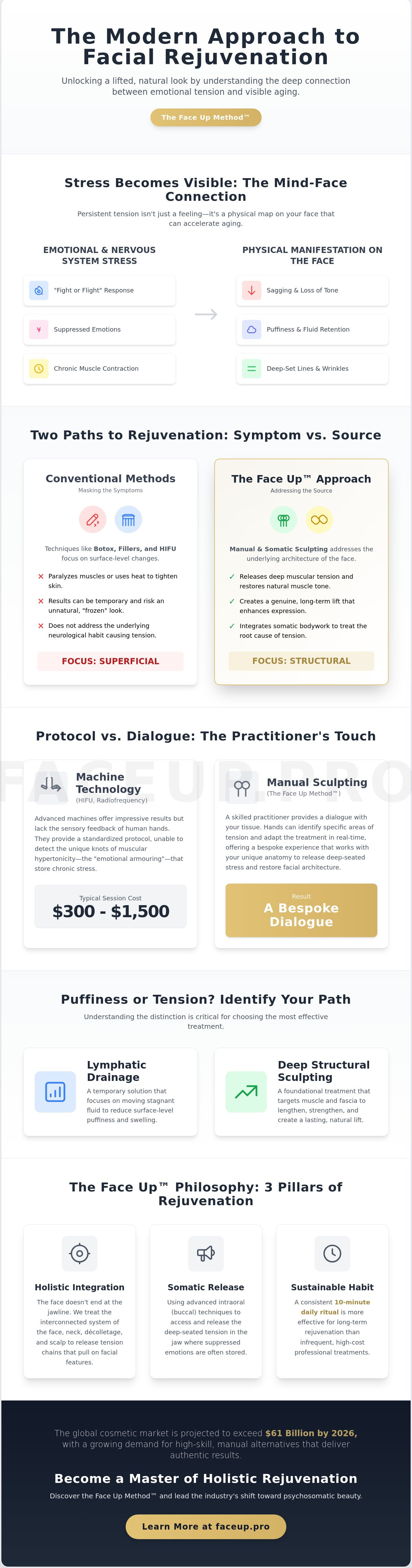
There's a critical distinction between temporary lymphatic drainage and deep structural sculpting. While lymphatic work focuses on moving fluid to reduce puffiness, sculpting targets the muscle fibers and fascia. It aims to lengthen muscles that have shortened due to chronic stress and strengthen those that have lost tone. This dual action creates a lifted appearance that looks entirely natural because it's based on your own anatomy rather than synthetic volume. With the global cosmetic market projected to exceed $61 billion by the end of 2026, the demand for these high-skill, manual alternatives has never been higher.
Manual Sculpting vs. Machine-Based Technology
High-tech devices like HIFU and radiofrequency offer impressive results, with sessions often costing between $300 and $1,500. However, even the most advanced machine lacks the sensory feedback of human hands. Manual facial sculpting allows a practitioner to identify specific areas of muscular hypertonicity; those tight knots of "emotional armouring" that a laser or ultrasound probe simply cannot detect. Facial toning through manual methods provides a bespoke experience that adapts to the unique density and tension of your tissues in real time. Machines provide a protocol; hands provide a dialogue.
The Rise of the Holistic Beauty Practitioner
Welcome to the World of Face Up™, where the modern therapist acts as a professional guide rather than just a technician. Today's clients seek practitioners who understand that the face doesn't end at the jawline. A comprehensive session now integrates work on the neck, décolletage, and scalp to release the tension chains that pull on facial features. This holistic perspective acknowledges that a furrowed brow often begins with tension in the neck or even the cranial fascia. By treating the muscles and bone structure beneath the surface, practitioners offer a path to rejuvenation that is both physically restorative and emotionally grounding.
The Somatic Difference: How Tension and Emotions Shape Your Face
Your face acts as a dynamic dashboard for your nervous system. While traditional beauty treatments focus on the surface, somatic facial sculpting addresses the physiological link between your emotions and your muscle tone. When you experience chronic stress, your body's "fight or flight" response triggers specific muscle groups to contract. Over time, these contractions become habitual, creating deep-set lines and altering your natural bone structure. This isn't just an aesthetic concern; it's a physical record of your internal state. By 2026, we've moved toward a deeper understanding of how releasing the mind can fundamentally rejuvenate the face.
Specific stress patterns often manifest as brow furrowing, pursed lips, or a perpetually clenched jaw. These repetitive movements do more than just create wrinkles. They actually restrict blood flow and lymphatic drainage, which eventually leads to the breakdown of collagen and elastin. Unlike the temporary paralysis offered by some medical interventions, somatic work restores the muscle's ability to relax and lengthen. When comparing Botox vs. Fillers, it's clear that while injectables can mask the signs of tension, they don't address the underlying neurological habit that caused the tension in the first place.
The Jaw-Emotion Connection
Suppressed emotions often find a home in the masseter muscles. This leads to masseter hypertrophy, which widens the lower face and contributes to TMJ pain. Buccal massage, a specialized intraoral technique, allows practitioners to access this deep tension from the inside out. Releasing the jaw instantly softens the entire facial expression, lifting the corners of the mouth and brightening the eyes. This profound emotional release is a cornerstone of the facial sculpting journey within the World of Face Up™, where we prioritize functional relief alongside aesthetic refinement.
Fascia: The Living Web of Your Face
Facial fascia is the connective tissue web that holds everything in place. When this fascia becomes "glued" or dehydrated due to lack of movement, it can pull features downward, contributing to sagging jowls and heavy lids. Myofascial release techniques create a visible "lifted" effect by separating these stuck layers and encouraging fluid flow. Hydrating the fascia through targeted manual work and proper internal hydration is significantly more effective than applying topical creams, which rarely penetrate deep enough to affect this structural layer. If you're ready to master these advanced techniques, you can explore our professional certification pathways to deepen your expertise.
Facial Sculpting vs. Botox and Fillers: A Comparative Analysis
Choosing between needles and manual manipulation often comes down to a choice between instant camouflage and long-term structural health. While dermal fillers can cost between $650 and $1,200 per syringe in 2026, they primarily act as a synthetic substitute for lost volume. In contrast, facial sculpting works to restore the muscle's natural fullness and tone. By engaging the muscles through specific resistance and release techniques, you're effectively building a foundation that supports the skin from within. It's the difference between stuffing a pillow with foam and actually repairing the springs of a mattress.
The "Botox Trap" is a phenomenon many long-term users are beginning to recognize. When you freeze a specific muscle group, such as the forehead, the surrounding muscles must work harder to create facial expressions. This often leads to compensatory aging, where new wrinkles appear in unexpected places because the face is no longer moving as a cohesive unit. Maintaining a natural expression is vital for emotional communication; research shows that facial paralysis can actually dampen our ability to feel the very emotions we're trying to express. Sculpting avoids this by encouraging balanced movement across all 43 facial muscles.
Longevity and Muscular Health
Manual rejuvenation acts as a "gym for the face," significantly improving blood circulation and nutrient delivery to the cells. This process is vital for maintaining the skin's glow and elasticity. On the other hand, heavy reliance on injectables can lead to "filler fatigue." Over years of use, the weight of synthetic substances can actually stretch the skin tissues, requiring even more filler to maintain the same look. A facial sculpting practice avoids this cycle by focusing on the health of the fascia and the strength of the underlying musculature. It's a sustainable investment in your future reflection.
The Aesthetic Outcome: Defined vs. Inflated
The goal of a modern aesthetic is often a "snatched" jawline; a look characterized by sharp, clean angles rather than the rounded, inflated appearance that often results from overfilling. You can achieve this definition through precise lymphatic drainage and muscle repositioning. This creates a dynamic beauty that moves naturally when you laugh or speak. If you're interested in providing these results for others, you can explore the Facial Sculpting Certification: Master the Face Up Method™. This training provides the professional grade knowledge needed to move beyond the "Botox Trap" and into the world of regenerative aesthetics.
How to Choose the Right Sculpting Method for Your Goals
Selecting the ideal approach to facial sculpting depends entirely on your specific biological needs and lifestyle. If your primary concern is morning puffiness or a "heavy" feeling in the face, your focus should be on lymphatic drainage to move fluid and toxins. Conversely, if you're observing premature sagging or a loss of contour, you'll benefit most from deep structural lifting that targets the muscles. For those experiencing deep-seated pain or a "locked" jaw, a somatic approach is necessary to address the nervous system's role in muscle tension. The most transformative results occur when you combine these techniques, creating a synergy between buccal, lymphatic, and somatic work.
Beyond manual methods, many find that advanced clinical technology can provide a powerful boost to their rejuvenation goals; Viora MedSpa specializes in non-invasive treatments like Ultherapy Prime and NEOGEN Plasma that support structural skin health without the need for surgery.
A monthly professional treatment is a powerful tool, but it can't compete with the impact of a daily ritual. With a single manual sculpting session costing between $219 and $280 in 2026, relying solely on professional visits can become a significant financial commitment. Your face performs thousands of micro-expressions every day; one hour of therapy every four weeks isn't enough to permanently re-train those habits. We recommend a "10-minute rule" for all our clients. Dedicating a small window of time each morning to manual manipulation ensures that tension doesn't have the chance to accumulate and settle into the fascia.
For the Busy Professional: The Power of Rituals
Consistency is the secret to lasting rejuvenation. By using the Face Up™ app, you can seamlessly integrate facial sculpting into your existing morning routine. We've designed "quick-win" moves specifically for those with limited time. A three-minute lymphatic sweep can significantly reduce under-eye bags, while a targeted forehead release can instantly open the eyes and lift the brow. These small, daily actions are what truly re-train muscle memory and prevent the "stress-mask" from forming. It's about taking proactive management of your facial health rather than waiting for issues to arise.
For Chronic Tension: Seeking Specialized Therapy
While self-practice is vital for maintenance, chronic issues like TMJ or severe masseter hypertrophy require the expertise of a professional guide. If you find yourself clenching your teeth throughout the day or waking up with a sore jaw, you likely need a specialist trained in somatic facial therapy. These practitioners understand the complex relationship between emotional holding patterns and physical rigidity. You can learn more about these specialized techniques in The Ultimate Guide to TMJ Massage Therapy. When looking for a provider, ensure they are listed in a verified directory to guarantee they have mastered the advanced intraoral and myofascial release methods required for safe, effective treatment. To find a certified expert near you, visit our global practitioner network.
Becoming a Master: The Face Up Method™ Certification
The beauty industry is currently experiencing a profound pivot. As we move through 2026, the demand for manual, holistic alternatives to invasive procedures has reached an all-time high. Clients are no longer satisfied with temporary fixes that mask their natural expressions; they're seeking practitioners who can offer genuine structural change and emotional release. This shift has created a lucrative niche for those who master facial sculpting. By becoming a certified practitioner, you position yourself as a professional guide in a landscape that's increasingly moving away from synthetic "frozen" looks toward functional, regenerative beauty.
What sets the Face Up Method™ apart is the seamless integration of somatic bodywork with advanced facial sculpting techniques. While traditional courses might focus on surface-level aesthetics, our approach dives into the psychosomatic connection between the mind and the muscles. You aren't just treating skin; you're facilitating a deep release of the nervous system. This level of expertise allows you to command higher session rates, as a single manual sculpting session in 2026 often costs between $219 and $280. Joining the World of Face Up™ means entering a community of high-standard partners dedicated to global readiness and professional integrity.
The Curriculum of Rejuvenation
The path to mastery is a rigorous but rewarding journey. The Face Up Method™ Certification is a 5-day training program that covers everything from deep anatomical mastery to specialized "Jaw Release" protocols. You'll learn to navigate the complexities of intraoral massage and myofascial release, ensuring you can address even the most persistent TMJ tension. Beyond the physical techniques, the curriculum focuses on the business of holistic beauty. We provide clear guidance on pricing strategies and client retention, helping you build a sustainable practice that values your specialized skills. The process culminates in a comprehensive certification exam, providing you with the professional accreditation needed to stand out in a global market projected to exceed $61 billion by the end of 2026.
Join the Movement
Transitioning from a traditional aesthetician to a Face Up™ specialist is a strategic move for your career advancement. Once certified, you gain access to our exclusive practitioner directory, connecting you with a global client base seeking verified quality. This isn't just about learning a new skill; it's about joining a movement that values transparency and proactive management in facial health. If you're ready to elevate your professional standing and offer results that truly transform your clients' lives, it's time to take the next step. Explore the Face Up Method™ Certification today and begin your journey into the World of Face Up™.
Embrace the Future of Regenerative Beauty
The shift toward functional beauty in 2026 reflects a deeper understanding that our faces are living, emotional maps. You've now discovered that true rejuvenation isn't found in a syringe; it's achieved through the release of deep muscular tension and the restoration of facial fascia. By prioritizing somatic awareness and manual structural work, you bypass the "Botox Trap" and build a foundation of lasting health. Choosing facial sculpting is a commitment to your long-term vitality and an expressive, natural reflection that purely aesthetic treatments cannot match.
Founded by somatic specialist Olga Newman, the Face Up Method™ represents the pinnacle of this holistic evolution. This unique framework integrates advanced facial anatomy with somatic bodywork to provide professional results that machines simply cannot replicate. Whether you're a professional looking to join our global directory of certified practitioners or an individual seeking to reclaim your natural contour, there's a clear path forward. Step into the World of Face Up™ – Start Your Certification Journey today. Your journey toward a more vibrant, tension-free future starts now.
Frequently Asked Questions
Is facial sculpting better than Botox for wrinkles?
The choice depends on whether you seek a temporary mask or a long-term structural solution. Botox provides rapid smoothing by paralyzing muscles, but it doesn't address the underlying tension or muscle atrophy that causes the wrinkle. Sculpting restores muscle health and improves circulation, offering a natural rejuvenation that preserves your ability to express emotion without the "frozen" look. It targets the root cause of aging rather than just camouflaging the symptoms.
How long does it take to see results from facial sculpting?
You'll see immediate improvements in lymphatic drainage and a visible reduction in puffiness after a single twenty-minute session. However, structural changes to muscle tone and facial contour typically require consistent practice over a period of four to six weeks. This timeline allows the facial fascia to rehydrate and the muscles to re-train their resting position, resulting in a more permanent and natural lift.
Can facial sculpting help with TMJ and jaw pain?
Yes, specialized techniques are highly effective for relieving TMJ and chronic jaw pain by addressing the masseter muscles. By targeting these areas through both intraoral and external manipulation, practitioners can release the "emotional armouring" that leads to habitual clenching. This somatic approach reduces local inflammation and restores a healthy range of motion to the jaw joint, providing relief that topical treatments cannot offer.
Is buccal massage painful?
Buccal massage shouldn't be painful, though it involves a sensation of deep pressure as the practitioner works inside the mouth. Most clients describe the experience as a "productive" intensity, similar to a deep tissue body massage. A skilled practitioner in the World of Face Up™ will always communicate with you to ensure the pressure remains within your comfort zone while still achieving an effective release of deep-seated tension.
Do I need special tools for facial sculpting at home?
You don't need expensive devices or stones to begin an effective home practice. Your hands are the most sophisticated instruments available, providing the sensory feedback necessary to identify specific knots and areas of rigidity. While tools like gua sha stones can assist with surface-level lymphatic drainage, the core work of muscle repositioning and structural lifting is best achieved through the precision and warmth of manual touch.
Can I do facial sculpting if I already have fillers?
You can safely perform facial sculpting if you have fillers, provided you wait at least twenty-eight days after your injection. It's crucial to inform your therapist so they can avoid direct, heavy pressure on the specific areas where the product was placed. Sculpting can actually help fillers look more natural by reducing surrounding fluid retention and improving the overall health of the skin tissues.
What is the difference between a normal facial and a sculpting facial?
A standard facial primarily focuses on the skin's surface through cleansing, exfoliation, and topical hydration. A sculpting facial goes much deeper, targeting the 43 muscles of the face and the connective fascia. This approach prioritizes structural lifting, tension release, and metabolic health rather than just improving the complexion's temporary glow. It's a functional treatment designed to change the face's underlying shape.
How often should I perform facial sculpting rituals?
We recommend performing a short home ritual daily to maintain muscle memory and prevent the accumulation of daily stress. Consistency is more important than duration; even a five-minute targeted routine each morning can prevent fluid buildup and sagging. For deeper structural work and emotional release, a professional session once every four weeks provides the expert manipulation needed to address chronic holding patterns that home practice might miss.


