

What if the secret to a snatched profile isn't found in a syringe, but in the way you release the stress held within your own muscles? You've likely seen the endless "face yoga" trends and felt a healthy dose of skepticism, especially if you're searching for effective exercises for a sharper jawline 2026 while dealing with chronic TMJ. It's frustrating to feel like your natural bone structure is hiding behind layers of tension and fluid. You aren't alone in wanting a more defined look without resorting to invasive measures.
This guide will show you how to reveal your true profile by integrating somatic tension release with natural facial sculpting. By shifting the focus from simply "working out" the face to releasing the deep-seated tension that pulls on your features, you can achieve a more refined, tension-free appearance. We'll walk you through the somatic principles that define the Face Up Method™ ecosystem and explain how targeted movements can reduce facial puffiness. It's time to discover how a professional, holistic approach can help you reclaim your most confident profile and a relaxed, defined jawline.
Key Takeaways
- Identify how fluid retention and chronic tension contribute to a "heavy" lower face and learn how to reclaim your natural bone structure.
- Discover effective exercises for a sharper jawline 2026 that focus on tongue posture and neck stability to provide a foundation for natural sculpting.
- Uncover the somatic connection between nervous system stress and jaw clenching, allowing you to physically release the tension that masks your profile.
- Transition from temporary face yoga trends to sustainable somatic re-patterning through simple habit-stacking techniques you can use anywhere.
- Learn how the Face Up Method™ provides a holistic approach to rejuvenation by addressing the root causes of aging rather than just the symptoms.
The Science of Facial Sculpting: Why Your Jawline Loses Definition
Defining the natural jawline requires looking at more than just the shape of your chin. It's the delicate intersection of your underlying bone structure, the tonicity of your facial muscles, and the elasticity of your skin. When these three elements work in harmony, the result is a crisp, defined profile. However, many people find that their lower face begins to feel "heavy" or saggy over time. This isn't always a matter of simple aging or fat accumulation. Often, it's the result of chronic tension and fluid retention masking your actual features.
Understanding The Science of Facial Sculpting is essential for anyone seeking exercises for a sharper jawline 2026. Modern facial fitness focuses on tonicity, which is the healthy state of partial contraction in a relaxed muscle. We aren't trying to build massive muscle volume in the face. Instead, we're aiming for a balanced tension that supports the skin without creating a bulky or widened appearance. This sophisticated approach moves beyond the "face yoga" trends of the past, focusing on how the nervous system interacts with facial tissue.
One major culprit in a receding jawline is the platysma muscle. This thin sheet of muscle extends from your chest and shoulders up to your jaw. When it becomes tight or overactive, it acts like a literal anchor, pulling the soft tissues of the lower face and neck downward. This "heavy lower face" syndrome is often exacerbated by poor posture, which shortens the platysma and compresses the jaw. By the time we reach 2026, the focus has shifted toward releasing these downward anchors to let the natural jawline lift itself.
Hypertonicity vs. Atrophy: The Two Enemies of a Sharp Profile
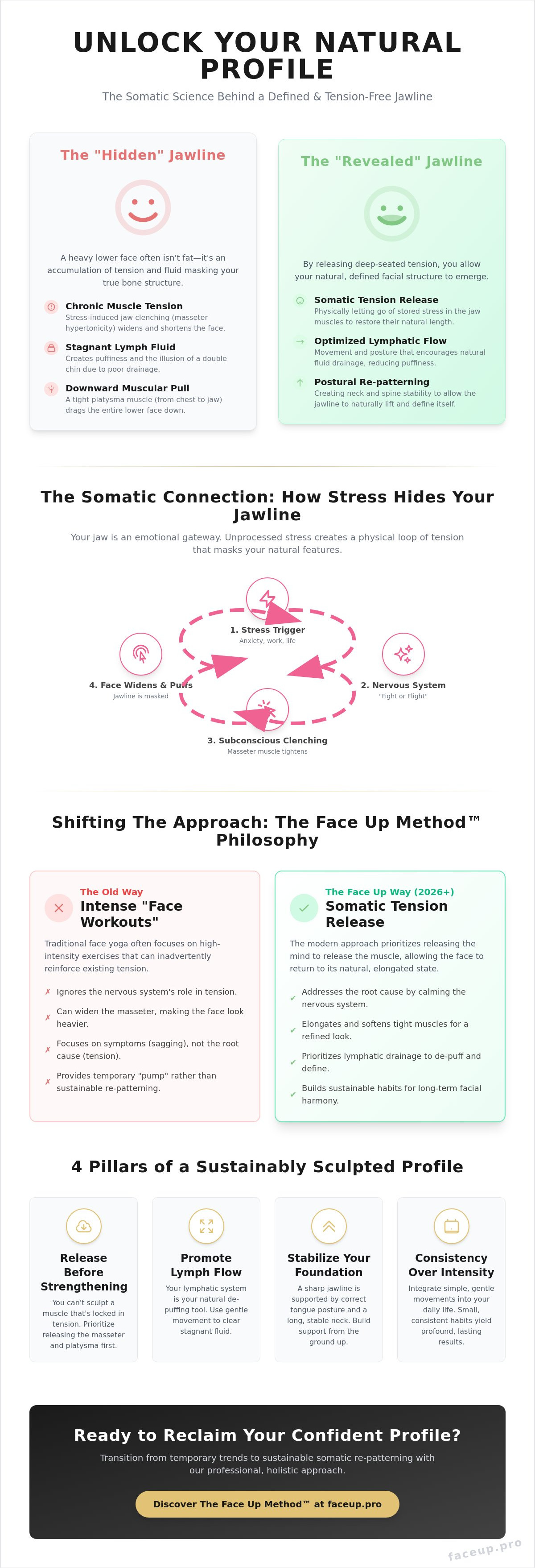
Hypertonicity refers to muscles that are chronically over-tight. In the jaw, this usually involves the masseter, the powerful muscle used for chewing. When you clench your teeth due to stress, this muscle becomes hypertonic, shortening and pulling your features into a wider, more aggressive shape. Conversely, atrophy occurs when muscles lack engagement, leading to a soft, undefined contour. The key is finding the middle ground. Working out a muscle that is already tight only increases the width of the lower face, making it look heavier. This is why many traditional exercises for a sharper jawline 2026 fail if they don't address somatic tension first.
The Lymphatic Connection to Facial Definition
Stagnant lymph fluid is a silent enemy of facial definition. It often creates the illusion of a double chin or a soft, puffy jawline even in individuals with low body fat. Because the lymphatic system lacks its own pump, it relies on movement and correct posture to flow. If your neck is compressed or your muscles are locked in tension, fluid pools in the lower face. Effective sculpting must prioritize drainage. Clearing these pathways through somatic release allows your natural bone structure to emerge before you begin any strengthening work. Maintaining clear drainage pathways through proper neck alignment is the foundation of the Face Up Method™ philosophy.
The Somatic Connection: How Stress 'Hides' Your Natural Bone Structure
Your jaw serves as more than just a mechanical joint; it's a profound emotional gateway for the entire body. The nervous system frequently stores unprocessed stress and trauma within the masseter muscles, leading to a physical hardening of the lower face. When you experience anxiety, your body instinctively prepares for a threat, often resulting in subconscious clenching. This "stress-jaw" loop creates a cycle where the muscles thicken and widen, effectively masking the very bone structure you're trying to highlight. If you're looking for exercises for a sharper jawline 2026, you must first address this internal tension.
Traditional "gym-style" facial exercises often fail because they ignore the state of the nervous system. If your body is trapped in a "fight or flight" response, adding more repetitive movement to an already tight jaw can actually backfire. It reinforces the tension rather than releasing it. The Face Up philosophy prioritizes a different approach: we believe in releasing the mind to release the muscle. By shifting your focus from "working out" to "letting go," you allow the facial tissues to return to their natural, elongated state. This foundational shift is what makes modern somatic sculpting so effective compared to older, high-intensity methods.
The Masseter Muscle and the Autonomic Nervous System
There's a direct physiological link between the trigeminal nerve and your stress response. This nerve, which governs the masseter, is intimately connected to the parts of the brain that manage survival instincts. Chronic clenching, also known as bruxism, causes the masseter to hypertrophy, or overgrow, which results in a square and heavy-looking jawline. Somatic facial release is a method to reset the nervous system through touch. By using specific manual techniques found in the Jaw Release Course, you can signal to your brain that it's safe to relax the muscles of the lower face.
Identifying Your Tension Patterns
Before beginning any routine, you must determine if your jawline is hidden by muscle bulk or fluid. You can perform a simple "clench test" to locate your emotional holding patterns. Place your fingertips on the corners of your jaw and bite down firmly. If the muscle under your fingers feels like a hard, protruding knot, you're likely dealing with hypertonicity. Releasing this specific area doesn't just improve your profile; it often has a global effect on the body's somatic state. When the jaw lets go, the neck and shoulders often follow, creating a more elegant and relaxed posture. Understanding these patterns ensures that your exercises for a sharper jawline 2026 are working with your body, not against it.
Top 5 Exercises for a Sharper Jawline in 2026
The evolution of facial fitness has moved away from high-intensity "face gyms" toward a more nuanced, somatic approach. In the Face Up Method™ ecosystem, we prioritize dynamic movement combined with conscious release. This ensures you aren't just building muscle on top of existing tension, which often leads to a bulky or asymmetrical appearance. Instead, these exercises for a sharper jawline 2026 focus on decompressing the joints and lengthening the tissues of the neck and lower face.
Before you begin, remember that your tongue and neck serve as the structural foundation for your mandible. If these areas are tight or misaligned, no amount of jaw-clenching exercises will produce a crisp profile. Start by finding a comfortable, upright seated position where you can feel your breath move freely. This sets the stage for the nervous system to accept the new movement patterns you're about to introduce.
Step-by-Step: The 2026 Sculpting Routine
- The Somatic Jaw Drop: Gently place your clean index fingers on your lower molars. Slowly allow the weight of your hands to draw your jaw downward while you consciously "melt" the muscles in front of your ears. This decompressing move helps reset the TMJ joint and reduces the width caused by chronic clenching.
- The Platysma Sweep: Tilt your head back slightly and place your palms at the base of your neck. Sweep your hands upward toward the jawline while simultaneously jutting your lower lip out. It's like ironing out the neck tissue to reveal the bone structure beneath.
- The Tongue Press (Modern Mewing): Flatten your entire tongue against the roof of your mouth, ensuring the back third is engaged. This creates an immediate submental lift, pulling the soft tissue under the chin tight against the jawbone.
- The 'V' Sculpt: Form a "V" with your index and middle fingers. Glide your knuckles firmly along the mandible from the chin toward the ears. This manual drainage technique clears stagnant fluid that often creates the illusion of a sagging jaw.
- Jawline Resistance: Place your fist under your chin. Try to open your mouth slightly while providing gentle upward resistance with your hand. These isometric holds wake up the suprahyoid muscles without overtaxing the masseters.
Correcting 'Tech Neck' to Reveal the Mandible
Your phone habits might be the primary reason your jawline lacks definition. Constant forward-head posture shortens the muscles of the front neck and pulls the facial skin downward, creating a heavy, saggy look. To combat this, practice the "Chin Tuck" reset: pull your head straight back as if making a double chin, aligning your cervical spine. This simple adjustment creates a natural lift for the entire lower face. A sharp jawline starts at the shoulder blades. For guided tutorials on these techniques, you can explore the Face Up App Subscription to ensure your form is precise and effective.
Creating a Sustainable Jawline Ritual: Consistency vs. Intensity
The biggest hurdle to achieving a snatched profile isn't the difficulty of the movements; it's the belief that you don't have enough time. Many people approach facial fitness as a temporary "challenge" or a grueling workout. However, the true secret to revealing your bone structure lies in neurological re-patterning. Five minutes of daily practice is far more effective than a grueling one-hour session once a week. This is because your nervous system requires frequent, gentle reminders to let go of chronic clenching and adopt a more lifted state. When performing exercises for a sharper jawline 2026, your goal is to create a ritual that feels like a natural extension of your day rather than a chore.
There is a fundamental difference between traditional face yoga and somatic sculpting. While face yoga often focuses on stretching or "exhausting" the muscles to create change, somatic sculpting is about re-patterning how your brain communicates with your face. We aren't just trying to move the tissue; we're trying to change the baseline tension of the muscles. This shift from intensity to consistency allows for long-term structural changes that don't disappear the moment you stop "working out." By using bio-feedback and guided rituals, you can ensure that you're engaging the correct muscles without creating new tension patterns.
Integrating Rituals into Your Daily Life
Habit stacking is the most effective way to ensure your routine sticks. You don't need to carve out a separate block of time. Instead, pair your movements with existing habits like your morning coffee or evening skincare routine. You can use the Face Up App for guided 3-minute "Jaw Release" sessions that fit perfectly into a busy schedule. It's also vital to incorporate a night-time release ritual. Releasing the masseters before sleep prevents the overnight clenching that often leads to a heavy, widened lower face by morning. If you're ready to start your journey, you can subscribe to the Face Up App Subscription for daily guided support.
When to Seek Professional Help
While at-home rituals are powerful, certain structural issues require a more targeted approach. If you experience persistent clicking, pain, or a sense that your lower face remains "heavy" despite consistent practice, it may be time to consult a specialist. Professional TMJ massage therapy can address deep-seated tension that is difficult to reach on your own. Additionally, an intra-oral or buccal massage performed by a certified practitioner can effectively reset muscle memory from the inside out. These professional treatments provide a "hard reset" for your facial tissues, making your daily exercises for a sharper jawline 2026 significantly more effective.
Beyond the Surface: Integrating the Face Up Method™ for Total Rejuvenation
The Face Up Method™ represents the gold standard in non-invasive sculpting, bridging the gap between simple at-home movements and professional-grade structural work. While you've learned the essential exercises for a sharper jawline 2026, these techniques work best when they're integrated into a larger ecosystem of care. Somatic bodywork doesn't just treat the sagging skin or muscle atrophy you see in the mirror. It addresses the nervous system's role in facial aging, targeting the chronic stress patterns that pull your features downward. This approach treats the person as a whole, ensuring that your results are sustainable and deeply rooted in your body's natural architecture.
There's a powerful synergy between your daily rituals and professional treatments. Think of your at-home practice as the "physiotherapy" that maintains the work done during a Somatic Bodywork Session. For individuals who require clinical support for pain or injury recovery, Zenko Physiotherapy & Sports Therapy offers the professional expertise needed to complement these somatic practices. Professional intervention allows for a level of tissue release that's difficult to achieve alone, especially in the deeper layers of the masseter and the intra-oral muscles. By joining our global community of practitioners and self-care enthusiasts, you gain access to a wealth of knowledge dedicated to honest, courageous, and effective facial health. It's time to move beyond the surface and embrace a holistic path to rejuvenation.
The Path to Mastery: Professional Certification
The Facial Sculpting Certification provides a rigorous training ground for those who wish to offer these transformative techniques to others. We've seen a clear trend in 2026 where clients are moving toward somatic beauty models that prioritize long-term health over quick, artificial fixes. Practitioners who master buccal and somatic techniques can offer a unique value proposition, providing structural changes that enhance the face's natural bone structure. This certification is more than just a credential; it's an entry into a high-standard community of global facilitators who are redefining the aesthetic landscape.
Your Next Steps for a Defined Profile
Taking the next step in your journey is simple and measurable. You can begin by downloading the Face Up app to access guided rituals that keep your form precise and your routine consistent. If you're seeking a more intensive experience, use our directory to find a certified provider for an in-person Face Up Sculpting Treatment. For those who want to master the art of release from the comfort of home, the 'Jaw Release' digital course offers a deep dive into the somatic principles that reveal your natural profile. You don't have to navigate this journey alone. Our community is here to guide you toward a more confident, tension-free profile through the most effective exercises for a sharper jawline 2026 available today.
Reclaim Your Profile through Somatic Awareness
Revealing your natural bone structure is a journey of release rather than just a workout. We've explored how chronic tension and fluid retention often mask the definition you seek; shifting your focus to somatic awareness allows your true profile to emerge. By prioritizing consistency and correcting modern postural habits, you ensure that your exercises for a sharper jawline 2026 deliver lasting, structural change. This methodology is rooted in somatic nervous system science and is used by certified practitioners globally to provide non-invasive, natural results that honor your body's internal balance.
It's time to stop fighting against your facial muscles and start working with them. You now have the foundational tools to transition from temporary trends to a professional standard of self-care that respects your unique architecture. Your path to a more defined, tension-free jawline begins with a single conscious breath and a commitment to your own well-being.
Start your transformation with the Face Up Jaw Release Course today
We look forward to welcoming you into our global community of professionals and enthusiasts dedicated to authentic, somatic beauty. Your most confident profile is waiting to be revealed.
Frequently Asked Questions
Do jawline exercises actually work for a double chin?
Yes, targeted movements effectively address the appearance of a double chin by improving muscle tonicity in the suprahyoid group and promoting lymphatic drainage. While weight loss affects fat distribution, somatic exercises help tighten the muscular "sling" under the chin. This creates a firmer foundation for the skin and reduces the fluid pooling that often causes a heavy lower face appearance.
How long does it take to see a sharper jawline from exercises?
Most individuals notice a reduction in puffiness and improved facial lift almost immediately after a somatic release session. For lasting structural changes to the muscle and posture, consistent daily practice typically yields visible results within four to six weeks. The key to success is neurological re-patterning, which requires frequent, short sessions rather than intense, occasional workouts.
Can jawline exercises cause wrinkles or skin sagging?
Somatic exercises are designed to prevent wrinkles by releasing the chronic tension that causes skin to fold and sag. Traditional high-intensity movements that involve excessive clenching can inadvertently create expression lines. However, the Face Up approach prioritizes lengthening and decompressing tissues, which supports skin elasticity and prevents the downward pull of hypertonic muscles like the platysma.
Is it better to use a jaw exercise ball or manual exercises?
Manual exercises and somatic release are far superior to using resistance devices like jaw exercise balls. Biting down on external objects can lead to masseter hypertrophy and severe TMJ joint compression, which often makes the face look wider and more stressed. Using your hands and specific tongue postures allows for precise control and ensures you're releasing tension while you sculpt.
Can I get a sharper jawline if I have TMJ?
Yes, and focusing on exercises for a sharper jawline 2026 through a somatic lens is often highly beneficial for those with TMJ. By learning to decompress the joint and release the masseter muscles, you reduce the inflammation and tension that mask your bone structure. Releasing the "stress-jaw" loop is the first step toward achieving a defined profile while simultaneously managing TMJ symptoms.
What is the best age to start facial sculpting exercises?
There is no single "best" age, as the benefits of somatic facial work apply across the lifespan. Younger individuals in their 20s and 30s often use these techniques as a preventative measure to maintain structural integrity and prevent "tech neck" patterns. For those in later decades, the focus shifts toward reclaiming definition by addressing fluid retention and releasing the downward muscular pull that occurs over time.
Does 'mewing' really work for adults in 2026?
Mewing, or proper tongue posture, remains a cornerstone of facial aesthetics in 2026 because it provides immediate structural support for the submental area. While it won't change adult bone structure overnight, it corrects the soft tissue sag caused by a low tongue position. Consistently resting the tongue against the palate helps maintain a sharp, defined angle between the neck and the jawline.
How often should I do jawline exercises for the best results?
For the best results, you should perform your exercises for a sharper jawline 2026 daily in short, three to five minute bursts. Consistency is more important than intensity because the goal is to retrain the nervous system's baseline for muscle tension. Integrating these small rituals into your existing morning or evening habits ensures the longevity of your results without overwhelming your schedule.


