

Your clients aren't looking for another surface-level facial. They're seeking an architectural shift that needles and fillers simply cannot replicate. If you've felt your results plateau or your hands ache from repetitive, basic protocols, it's time to evolve your practice. Mastering connective tissue massage for face training is the key to unlocking a deeper somatic dialogue with living tissue. This approach moves beyond simple skin manipulation, positioning you as a high-standard partner in your client's long-term wellness journey.
We understand that as a professional, you're navigating a market that increasingly demands non-invasive, holistic alternatives to traditional aesthetics. You want to provide visible lifting and contouring without the administrative burden of medical-grade interventions. This guide promises to help you master the architectural secrets of the face through professional training that blends somatic healing with advanced sculptural lifting. We'll explore the science of fascia, the release of emotional storage in the tissue, and the pathway to obtaining a Face Up Method Certification to elevate your global standing in 2026.
Key Takeaways
- Master the science of fascia and the specific manual skills required to achieve architectural lifting through advanced connective tissue massage for face training.
- Shift your practice from mechanical skin manipulation to a somatic dialogue that addresses the nervous system and emotional storage within facial tissues.
- Learn to evaluate professional training programs based on 2026 global standards, ensuring your certification provides the anatomical depth needed for a sustainable career.
- Discover how the Face Up Method Certification offers a proprietary ecosystem for practitioners seeking to master non-invasive sculptural lifting and deep tissue release.
Understanding Connective Tissue Massage for Face: The Science of Fascia
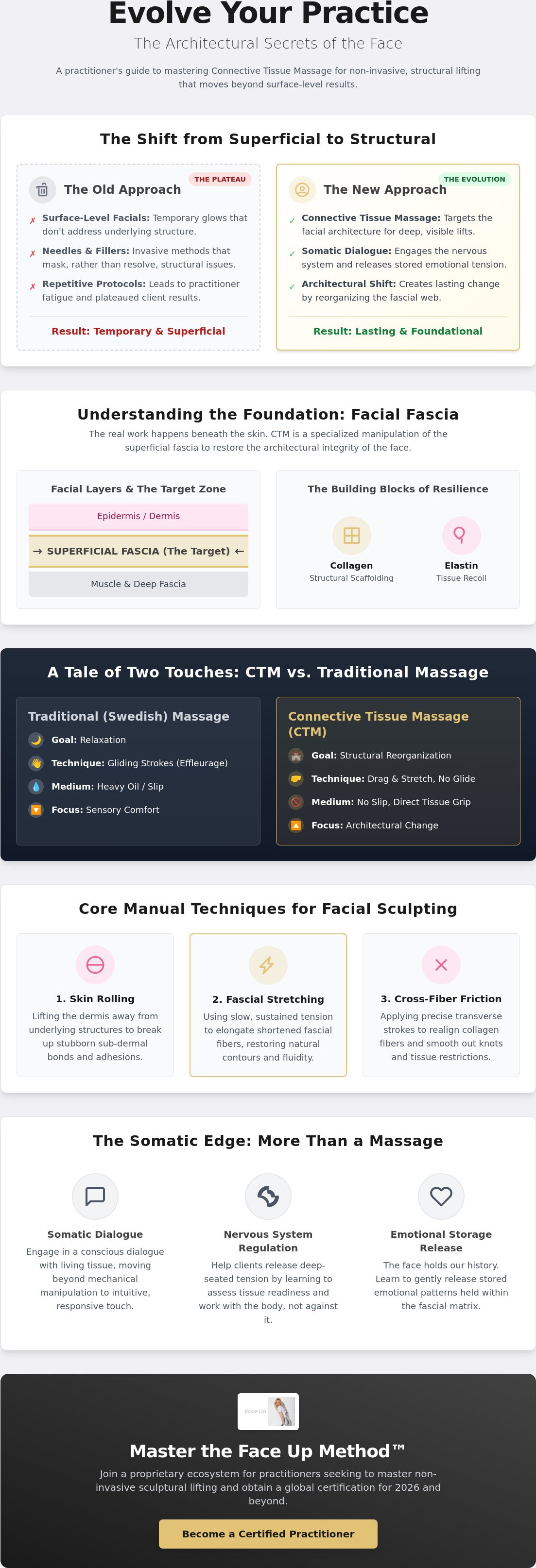
To master the art of facial sculpting, you must first understand that the skin is merely the envelope. The real work happens beneath. Connective tissue massage (CTM) is a specialized manipulation of the superficial fascia, the layer of fibrous tissue that sits just below the dermis. Unlike standard treatments, connective tissue massage for face training focuses on the architectural integrity of the face rather than a superficial glow. It's an intervention that targets the very foundation of facial structure to create lasting change.
Within the extracellular matrix, collagen and elastin act as the building blocks of resilience. Collagen provides the structural scaffolding, while elastin allows the tissue to recoil after movement. As we age or experience chronic stress, this matrix can become congested or "stuck." CTM works by stimulating the interstitial fluid, which is vital for delivering nutrients to cells and removing metabolic waste. By improving this fluid exchange, we don't just lift the face; we revitalize the environment where cells live, encouraging a healthier, more vibrant complexion from the inside out.
Traditional Swedish massage relies on effleurage or gliding strokes to induce relaxation. In contrast, CTM utilizes a distinct drag and stretch technique. There is no slip or heavy oil used here. Instead, the practitioner engages directly with the resistance of the tissue. This creates a mechanical signal that encourages the fascia to reorganize and hydrate. It's a targeted approach that prioritizes structural change over simple sensory comfort, making it a powerful tool for the modern aesthetician.
The Elizabeth Dicke Influence and Modern Evolution
The roots of these techniques reach back to Elizabeth Dicke, a German physical therapist who developed Bindegewebsmassage in the 1920s. Originally used to treat systemic internal disorders through reflex zones in the connective tissue, these clinical standards have evolved significantly. Practitioners pursuing connective tissue massage for face training today are essentially learning a refined version of these century-old principles. Modern facial sculpting has adapted these rigorous protocols, shifting from a purely medical application to a holistic beauty discipline that honors both clinical efficacy and aesthetic refinement.
Why Fascia is the Secret to Non-Invasive Lifting
Fascia is the architectural framework of the face, a continuous web that supports every muscle and vessel. Over time, repetitive facial expressions and gravity cause the fascia to lock into place, creating permanent lines and a heavy appearance. This process, often addressed through myofascial release, involves breaking down dense fascial adhesions. When these restrictive bonds are released, the natural contours of the face are restored. This restores the face's ability to move fluidly, providing a visible lift that feels authentic and looks entirely natural.
Core Techniques in Advanced Facial Massage Training
Transitioning from theory to practice requires a refined tactile sensitivity. In the world of connective tissue massage for face training, success isn't measured by the amount of pressure applied, but by the precision of the engagement. The primary manual skills you'll master include skin rolling, fascial stretching, and cross-fiber friction. Skin rolling involves lifting the dermis away from the underlying structures to break sub-dermal bonds. Fascial stretching uses slow, sustained tension to elongate shortened fibers, while cross-fiber friction applies transverse strokes to realign collagen and smooth out adhesions. These techniques require a "grip" on the tissue that is firm yet respectful, avoiding the sliding motion common in traditional relaxation massage.
A critical differentiator in high-level practice is the assessment of tissue readiness. Before you dive into deep work, you must determine if the tissue is receptive. This involves palpating for temperature, hydration, and the subtle "give" that signals the nervous system has relaxed. Forcing a release in "cold" or resistant tissue often leads to inflammation rather than restoration. Understanding The Science of Fascia helps practitioners recognize that we are communicating with a living, reactive system. When the tissue is properly prepared, it feels more like melting butter than rigid plastic, allowing for deeper access without causing trauma.
Lymphatic drainage is a non-negotiable prerequisite for any deep connective tissue work. Think of it as clearing the construction site before the building begins. Stagnant interstitial fluid acts as a buffer that prevents you from reaching the fascial layers effectively. By opening the major nodes and pathways first, you ensure that the metabolic waste released during the massage is efficiently cleared from the system. This prevents post-treatment puffiness and ensures the results are crisp and defined.
Buccal Massage: Releasing the Deepest Tension
Buccal or intraoral massage is a transformative addition to any professional protocol. It allows you to access the masseter and pterygoid muscles from the inside of the mouth, providing a 360-degree release that is impossible to achieve through external work alone. This technique is a game-changer for clients who carry chronic tension in the lower face. It's particularly effective for those dealing with TMJ disorders or the structural changes caused by teeth grinding. If you're interested in how these techniques specifically address jaw health, our Ultimate Guide to TMJ Massage Therapy offers a deep dive into restorative balance.
The Power of Intentional Sequencing
A professional treatment must follow a logical, physiological flow. You don't start with sculptural lifting; you build toward it. The sequence should always move from superficial to deep: Lymphatic opening → Fascial release → Sculptural lifting. During the fascial phase, you'll notice the skin begin to "pink up." This hyperemic response is a visual cue that microcirculation has increased and the tissue is becoming more pliable. Mastering this rhythm is what separates a technician from a true artist. Professionals looking to refine these sequences often find that a structured Face Up Method Certification provides the clinical framework needed for consistent, high-end results.
The Somatic Edge: Why Your Training Must Go Beyond Lifting
A common misconception persists in the aesthetic industry: that facial work is purely a pursuit of youth. While the lifting results are undeniable, the most profound transformations occur when we treat the face as a living map of the nervous system. This is the essence of Somatic Facial Therapy. When you engage in connective tissue massage for face training, you aren't just learning to manipulate skin; you're learning to communicate with the autonomic nervous system. The face, neck, and jaw are primary sites where we store "emotional armor," the physical manifestation of chronic stress and unresolved tension.
The brow often holds the weight of cognitive overload, while the neck and jaw act as the body's primary gatekeepers for suppressed expression. By targeting these areas, we can influence the Vagus nerve, the master controller of our relaxation response. Stimulating this nerve through precise fascial work doesn't just soften the features. It signals to the entire body that it's safe to downshift from a state of "fight or flight" into "rest and digest." This systemic shift is why clients often report feeling a deep sense of peace that extends far beyond the treatment room. It's a holistic approach that redefines beauty as a byproduct of internal balance.
Releasing Emotional Imprints in the Fascia
The fascia is more than just a structural web; it's a sensory organ that records our life experiences. Chronic stress patterns can cause the tissue to become dense and restrictive, literally "locking" certain expressions onto the face. During a session, a practitioner must create a "safe container," an environment of calm, steady presence that allows these imprints to surface and dissolve. For example, releasing the masseter muscle through intraoral work often triggers an immediate, systemic relaxation response. It's not uncommon for a client to experience a sudden sigh or a visible shift in breath as the jaw "armor" finally lets go, revealing a softer, more authentic version of themselves.
Breath Awareness and Nervous System Regulation
Your results as a practitioner are deeply tied to your own state of regulation. If your hands are tense or your breath is shallow, the client's nervous system will sense that "noise" and remain guarded. Premium connective tissue massage for face training emphasizes the "dialogue" between your hands and the client's living tissue. Incorporating rhythmic, diaphragmatic breathing into your protocol helps synchronize your energy with the client. This co-regulation ensures that your touch is perceived as a supportive invitation rather than an invasive force. When the practitioner is grounded, the fascia hydrates and reorganizes with far less resistance, leading to more sustainable sculptural results.
Evaluating Professional Certification Programs in 2026
Choosing a path for your professional development is a significant decision that impacts both your clinical confidence and your business trajectory. As the demand for non-invasive sculpting grows, the market has become saturated with various workshops. However, high-quality connective tissue massage for face training must meet rigorous global standards to ensure you're prepared for the complexities of living tissue. A reputable program in 2026 should offer deep anatomical instruction, hands-on practical assessments, and recognized accreditation. Without these pillars, you risk practicing techniques that are either ineffective or, worse, non-compliant with evolving state regulations.
The choice between online and in-person training often depends on your learning style and location. In-person intensives, such as those capped at 8 to 18 participants to ensure personalized attention, provide immediate tactile feedback that is invaluable for mastering the "drag and stretch" of fascial work. Conversely, a modern digital curriculum can be equally effective if it includes 1:1 mentorship and a robust community platform. Look for programs that offer ongoing support rather than a one-time transaction. A professional mentor should guide you through the nuances of the "Face Up" approach, helping you navigate everything from hand fatigue to complex client cases.
A often overlooked component of elite training is the business of aesthetics. Mastering the technique is only half the battle. You also need a framework for pricing, marketing, and client retention. High-end certification programs now integrate business modules that teach you how to position these advanced services within a competitive market. Understanding how to communicate the value of somatic work ensures that your investment in education translates directly into a sustainable, thriving practice.
The ROI of Advanced Facial Certification
Specialized training allows you to move away from the "commodity" pricing of basic facials. Certified practitioners in this field often command rates of $250 or more per session, reflecting the high-level skill and visible results they provide. This certification positions you as a leading expert in the "alternative to injectables" market, appealing to a growing demographic of clients who prioritize natural longevity over temporary fillers. By offering a sophisticated, science-backed service, you build a foundation of trust with high-end clientele who value professional integrity and global standards.
Checklist for Choosing Your Training Path
- Comprehensive Scope: Does the course cover both superficial fascia and deep tissue techniques, including intraoral access?
- Somatic Integration: Is there a clear focus on nervous system regulation and the release of emotional imprints?
- Post-Graduation Support: Does the program offer a practitioner directory listing or access to a global professional community?
- Regulatory Guidance: Does the curriculum address regional scope of practice, such as the 2026 changes in Maryland or Florida's specific massage therapy definitions?
If you are ready to transition from basic protocols to an architectural mastery of the face, the right mentorship is essential. Explore how a Face Up Method Certification can provide the professional ecosystem you need to excel in the global landscape of 2026.
Mastering the Face Up Method™: Your Path to Global Certification
The Face Up Method™ isn't merely a set of manual maneuvers; it's a proprietary ecosystem designed for professionals who refuse to settle for the status quo. By integrating advanced sculptural lifting with deep somatic bodywork, this method offers a clear path for practitioners to transition into a high-standard, international landscape. When you embark on connective tissue massage for face training through our specific lens, you're entering a community that values integrity, proactive management, and clinical excellence. While our Auckland studio remains the heart of our research and development, the method's reach is truly global, preparing you to serve diverse markets with a unified, high-tier standard.
Obtaining a Face Up Method Certification involves a structured journey that moves beyond basic aesthetics. It requires a commitment to understanding the living architecture of the face and the courage to address the emotional storage within the tissue. This process ensures that every certified practitioner carries a symbol of verified quality, positioning them as a reliable partner in their clients' long-term wellness journeys. Our certification doesn't just teach you how to move your hands; it teaches you how to manage a specialized professional practice with calm efficiency and global readiness.
What’s Included in the Face Up Method™ Certification
The curriculum is designed to be as expansive as it is practical. You'll master the nuances of sculptural lifting and somatic release while also gaining the business acumen needed to thrive in a specialized professional landscape. We believe that technical skill must be matched by administrative clarity, which is why we include modules on pricing and professional positioning. To ensure a high standard of decorum and efficacy, the program features rigorous practical assessments. These evaluations guarantee that every graduate can deliver the visible results and deep relaxation that define our brand. For a detailed breakdown of the curriculum and requirements, see our Facial Sculpting Certification Guide.
Joining a Global Community of Practitioners
Graduation is just the beginning of your journey within our ecosystem. Every certified professional gains access to a practitioner directory listing, a vital tool for connecting with local clients who are actively seeking the Face Up Method™ experience. This directory serves as a linguistic and professional anchor, reinforcing your standing as a high-standard facilitator. Beyond the directory, the Face Up App provides ongoing support, ensuring you're never navigating complex professional requirements alone. You're not just a graduate; you're part of a specialized community that prioritizes global readiness and professional integrity. If you're ready to elevate your practice and join our international network, apply for the Face Up Method Certification today.
Elevating Your Practice into the Future of Facial Wellness
Mastering the architectural secrets of the face is both a professional advancement and a personal evolution. By prioritizing the science of fascia and the somatic response of the nervous system, you're positioning yourself at the forefront of a global shift in aesthetics. Clients are no longer satisfied with temporary fixes; they want sustainable, non-invasive results that honor their body's living tissue. Engaging in connective tissue massage for face training ensures you have the clinical depth and tactile precision to meet this demand with confidence and integrity.
Our proprietary Somatic Facial Sculpting Method provides a clear, high-standard framework for those ready to lead in 2026. Through our certification, you'll gain access to a verified global practitioner directory, helping you build a practice that reduces client reliance on invasive procedures. This isn't just about learning a new manual technique; it's about entering a proprietary ecosystem designed for your long-term success and professional growth. You're capable of transforming your practice into a sanctuary of architectural healing and somatic restoration.
Join the Global Community: Apply for Face Up Method™ Certification
We look forward to welcoming you into our international network of dedicated professionals as you take this courageous step forward in your career.
Frequently Asked Questions
What is the difference between connective tissue massage and a standard facial?
Connective tissue massage focuses on the architectural manipulation of the superficial fascia, whereas a standard facial primarily addresses the skin's surface. While a standard facial uses gliding strokes for relaxation and product absorption, this method utilizes a "drag and stretch" technique. It targets the structural foundation of the face to achieve visible lifting and contouring results that last longer than superficial treatments.
Can I learn connective tissue massage for face training online effectively?
You can effectively master connective tissue massage for face training online if the program provides 1:1 mentorship and a robust community ecosystem. Modern digital curriculums use high-definition video and interactive support to bridge the gap between physical locations. Success depends on the practitioner’s dedication to practicing the tactile dialogue with living tissue and receiving feedback from established mentors within the global network.
How long does it take to become certified in the Face Up Method™?
The Face Up Method Certification process is designed to be a thorough professional journey rather than a rushed workshop. It involves completing a comprehensive curriculum that covers sculpting, somatic release, and business fundamentals. After finishing the modules, you must pass practical assessments to ensure your work meets our verified quality standards. This structured approach guarantees you're ready to serve a high-end international clientele.
Do I need to be a licensed esthetician to take this training?
Professional requirements often vary by jurisdiction, but most practitioners are licensed estheticians, massage therapists, or cosmetologists. It's vital to understand your local scope of practice, as states like Florida and Maryland have specific regulations regarding soft tissue manipulation. Our training is designed for professionals who seek to expand their clinical skills within their existing legal framework for therapeutic or aesthetic services.
What are the career benefits of specializing in somatic facial therapy?
Specializing in somatic facial therapy allows you to command higher service rates and attract a demographic looking for natural alternatives to injectables. By treating the face as a map of the nervous system, you offer a unique value proposition that basic protocols can't match. This expertise builds deep trust with clients, leading to higher retention and a distinguished reputation in the global wellness market.
How does connective tissue massage help with TMJ and jaw pain?
This approach addresses the root cause of jaw discomfort by releasing dense fascial adhesions and muscular armor in the masseter and neck. By restoring hydration and pliability to the connective tissue, you reduce the structural tension that contributes to teeth grinding and TMJ disorders. This work often triggers a systemic relaxation response, helping the client’s entire nervous system downshift into a more balanced state. To explore how clinical-grade treatments can further assist with targeted pain relief, discover Level Up Acupuncture & Wellness Center.
What tools are required for professional connective tissue massage training?
The primary tools for professional connective tissue massage for face training are your own hands and a refined sense of tactile sensitivity. Unlike other methods that rely on heavy oils or specialized machines, this work requires a clean, no-slip surface to properly engage the fascia. This allows you to feel the subtle resistance of the tissue and apply the precise amount of tension needed for an architectural lift.
Is there a difference between buccal massage and connective tissue work?
Buccal massage is an intraoral technique that accesses facial muscles from inside the mouth, while connective tissue work is an external manipulation of the fascial layers. While they are different skills, they are highly complementary. Connective tissue work prepares the surface and superficial fascia, while buccal massage provides 360-degree access to deep tension in the jaw and cheeks for a more comprehensive sculptural result.


