

What if the persistent ache in your jaw is actually a silent language your nervous system uses to communicate years of stored stress? While many people seek out traditional treatments, data from the TMJ Association shows that nearly 35 million Americans suffer from jaw-related tension that often resists standard physical therapy. You likely recognize the sensation of being disconnected from your own skin, where emotional fatigue manifests as a heavy brow or a locked jaw. Welcome to the World of Face Up™, a space where we understand that your face is the gateway to your emotional state. A dedicated somatic bodywork session provides the necessary bridge between physical release and true internal regulation.
You probably agree that a quick fix rarely addresses the underlying fatigue that settles into your neck and facial muscles. We promise to show you how the Face Up Method™ transforms these stubborn patterns of tension into a clearer, more lifted appearance and a sense of deep emotional lightness. This guide explores the mechanics of mind-body integration and introduces the specific tools you need to regulate your nervous system for long term health.
Key Takeaways
- Discover how somatic bodywork bridges the gap between physical sensation and emotional history to release stored tension within the fascia.
- Learn the science behind the Face Up Method™ and how manual touch can recalibrate your nervous system for lasting well-being.
- Gain a clear understanding of what happens during a professional somatic bodywork session, including the essential intake process and mindful sculpting techniques.
- Identify the key differences between traditional massage and somatic therapy to choose the right path for your specific physical and emotional goals.
- Find out how to connect with the World of Face Up™ through our global directory of certified practitioners or our dedicated Auckland studio.
What is a Somatic Bodywork Session? Defining the Experience
A somatic bodywork session represents a departure from conventional massage. It's a holistic therapy that centers on your internal physical perception and the release of fascial restrictions. The core philosophy is simple yet profound: your body, or soma, is a living record that stores emotional history in its muscular patterns. While a traditional beauty treatment might approach the skin from the "outside-in" to achieve a specific aesthetic, somatics works from the "inside-out." This method focuses on how you feel within your own skin. By entering the World of Face Up™, you're engaging with a professional standard that prioritizes this deep, physiological integration over temporary surface changes.
Somatic work recognizes that the body isn't just a vessel but an intelligent system. This understanding of the body's innate potential is also explored by experts like Ray Maor, who teaches how to sustain and vitalize the system through life force energy. During a session, the practitioner uses manual techniques to address the fascia, the connective tissue that wraps around every muscle and organ. When this tissue becomes restricted due to trauma or repetitive stress, it limits movement and traps emotional energy. A professional somatic bodywork session aims to hydrate and release these tissues, allowing for a more fluid and grounded physical experience.
The Origins of Somatic Practice
The roots of this practice trace back to the mid-20th century, specifically the 1970s when Thomas Hanna began formalizing the study of Somatics. Hanna's work emphasized that our bodies respond to stress with specific muscular contractions that can become habitual. Today's somatic bodywork integrates this 20th-century theory with modern neuroscience to create a more comprehensive healing model. It isn't about a practitioner "fixing" a client. Instead, it's about the practitioner and client "listening" to the body's signals together. This collaborative approach helps resolve sensory-motor amnesia, a state where the brain has forgotten how to relax certain muscle groups.
Why the Face is the Ultimate Somatic Gateway
The face, neck, and jaw are the body's most frequent sites for emotional "armouring." These areas are physically small but hold immense neurological weight. The trigeminal nerve, which manages sensations for the entire face, acts as a primary trigger for the body's stress response. When the jaw is tight or the brow is furrowed, the brain receives a constant signal that the environment is unsafe. By targeting these specific facial regions, we can interrupt the feedback loop of chronic stress. Facial somatics serves as a biological gateway that can instantly shift the entire body's nervous system from a state of fight-or-flight into a profound parasympathetic rest.
- Internal Perception: Shifting focus from how the body looks to how it feels from within.
- Fascial Release: Using manual pressure to melt restrictions in the connective tissue.
- Emotional Storage: Addressing the physical patterns left behind by past experiences.
- Professional Excellence: Utilizing the World of Face Up™ standards to ensure safe, effective, and global-ready practice.
The Science of Somatics: Fascia, Emotions, and the Nervous System
Somatic bodywork is often misunderstood as a purely psychological practice. In reality, it targets the physiological architecture of the human body. Fascia, the connective tissue wrapping every muscle and organ, functions as a sophisticated sensory organ. It doesn't just hold us together; it records every repetitive movement and emotional trauma we experience. When stress becomes chronic, the liquid crystalline matrix of our fascia thickens. This isn't a metaphor. It's a physical change where collagen fibers densify, creating adhesions that restrict mobility and trap metabolic waste. During a somatic bodywork session, the goal is to address these physical densities to allow for emotional and structural release.
Fascia: The Body's Emotional Map
The balance of collagen and elastin determines how our skin and muscles bounce back from tension. Chronic cortisol elevation leads to fascial dehydration, a process that causes visible changes like premature wrinkles, sagging, or a "frozen" facial expression. Within the World of Face Up™, we recognize these patterns as physical records of a history of stress. Professionals who pursue a facial sculpting certification learn to read these maps, identifying where the body has set itself in a defensive posture. By applying targeted pressure, practitioners can manually melt these adhesions, restoring the tissue's natural elasticity and flow.
The Vagus Nerve and Manual Regulation
Central to this work is the Polyvagal Theory, which explains how the nervous system regulates safety. Manual techniques like buccal massage, or intra-oral work, directly stimulate the vagus nerve. This triggers an immediate shift from the sympathetic "fight or flight" state into the parasympathetic "rest and digest" mode. There's a fascinating anatomical link called the "deep front line" that connects the jaw directly to the pelvic floor. When a practitioner releases tension in the masseter muscle, it often leads to a spontaneous relaxation of the hips and lower back. A successful somatic bodywork session facilitates biological safety for the client, allowing the brain to stop scanning for threats and start the process of repair.
While talk therapy addresses the narrative of trauma, Somatic experiencing research published in 2021 highlights how the body stores memory at a cellular level. When cognitive processing plateaus, physical touch becomes the necessary key to unlock stored tension. This isn't just about relaxation; it's about neurological recalibration. For those looking to master these advanced techniques, exploring the Face Up™ educational ecosystem provides a clear path toward professional mastery and global standards in somatic care.
What Happens During a Face Up™ Somatic Session: A Step-by-Step Guide
Welcome to the World of Face Up™, where each 60 to 90 minute encounter is designed with professional precision. You aren't just receiving a passive treatment; you're engaging in a collaborative process. The practitioner acts as a facilitator, guiding your nervous system toward a state of regulated calm. This professional environment ensures every somatic bodywork session is grounded in safety and clinical excellence, moving beyond the traditional spa model into a realm of functional integration.
Step 1: The Somatic Consultation and Grounding
The experience starts with a detailed consultation to align your physical needs with emotional intentions. Facilitators assess your posture, breathing patterns, and specific facial "holding" patterns that signal chronic stress. By using conscious breathing techniques, the session prepares your nervous system for deeper intervention. This phase ensures you feel proactively managed, allowing you to transition from the external world into a focused internal state. It's a vital step for establishing the trust required for deep fascial release.
Step 2: Deep Fascial and Sculptural Work
Once grounded, the practitioner employs the proprietary Face Up™ Method to address deep muscular layers. This involves precise sculptural movements designed to lift and define facial contours without the use of invasive needles. A pivotal moment in the somatic bodywork session is the Jaw Release protocol. This includes intra-oral, or buccal, work where the facilitator releases tension from inside the mouth. Research indicates that the masseter muscle can exert up to 200 pounds of pressure, making this deep release essential for systemic relaxation and structural clarity.
Step 3: Integration and Aftercare
The final minutes involve a dedicated "cool down" to help the body integrate these structural changes. It's common to experience an emotional purge or a sense of extreme mental clarity as the fascia releases stored tension. To maintain these results, the Face Up app provides daily rituals that extend the life of your session. Consistent practice helps solidify the new neural pathways created during your time in the studio, ensuring the benefits of the session become a permanent part of your wellness profile.
- Duration: 60-90 minutes of dedicated facilitator contact.
- Technique: Non-invasive sculptural and intra-oral (buccal) movements.
- Focus: Release of the masseter and pterygoid muscles to lower systemic cortisol.
- Maintenance: Digital rituals via the Face Up app for long-term integration.
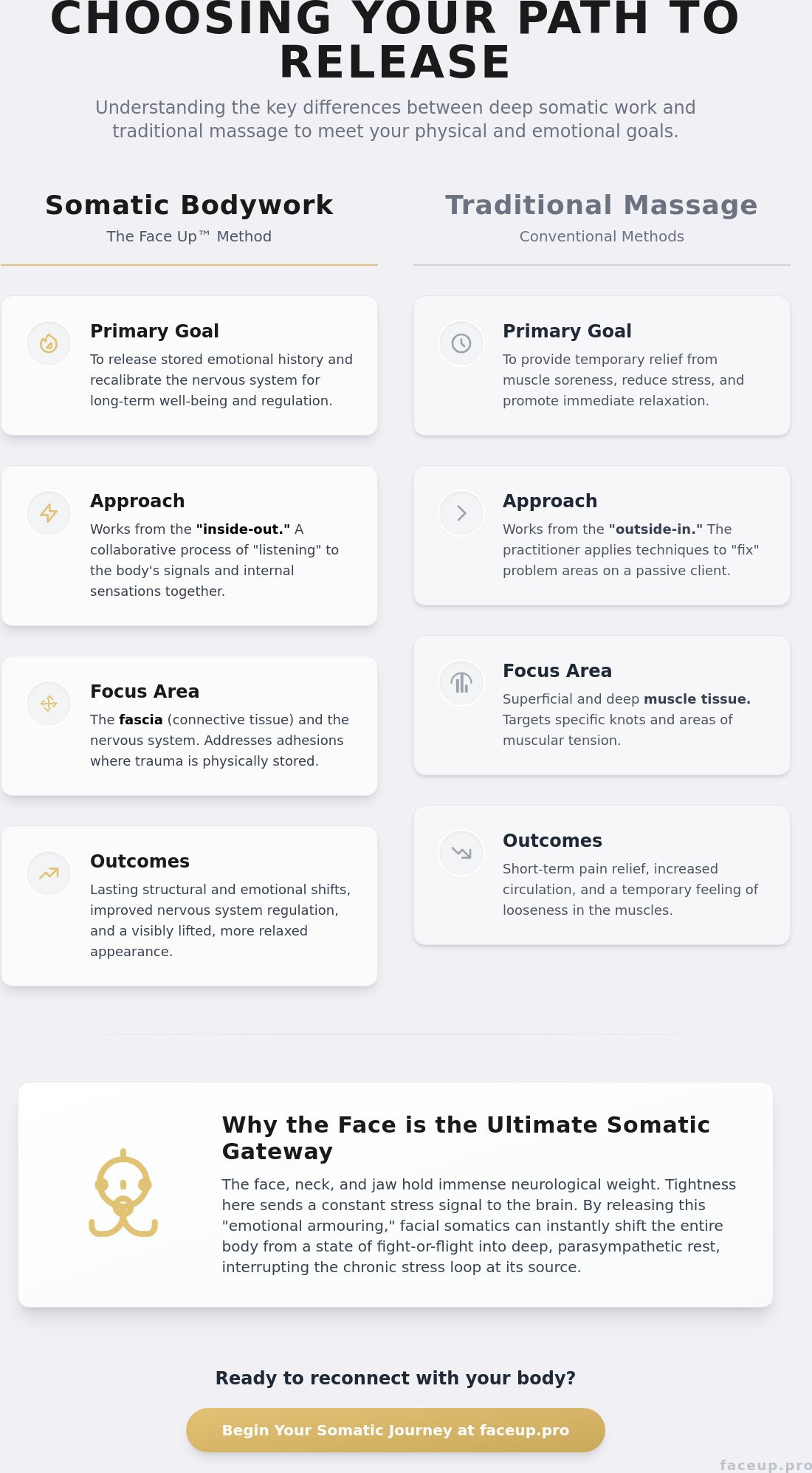
Somatic Bodywork vs. Traditional Massage: Key Differences
While both modalities involve therapeutic touch, their core intentions set them apart. Traditional massage focuses on immediate relaxation and the temporary relief of surface-level tension. In contrast, a somatic bodywork session serves as a deep recalibration of the nervous system. It isn't just about feeling good for an hour; it's about changing how your body holds itself in your daily life.
- Intent: Traditional massage seeks systemic relaxation. Somatic work targets nervous system regulation and the release of stored emotional patterns.
- Technique: Instead of repetitive, gliding strokes, practitioners use mindful 'listening' and sculpting. They wait for the tissue to respond rather than forcing it to relax.
- Duration of Results: A 2023 industry survey noted that while spa massage relief typically lasts 48 to 72 hours, somatic shifts can persist for weeks.
Professional standards also differ significantly. While a general massage license covers basic anatomy, somatic facial therapy requires specialized certification. This ensures the practitioner understands the complex intersection of cranial nerves and emotional expression. This level of expertise is a hallmark of the high-standard partners found within the World of Face Up™.
The Role of Active Participation
In a standard spa environment, you're encouraged to "zone out" or even fall asleep. Somatic work flips this script. You're an active participant. Your job is to notice sensations as they arise. This practice builds interoception, which is the internal sense of the body's state. A 2022 study on neuro-fascial processing found that clients who practiced active interoception reported a 40% greater reduction in chronic tension compared to passive recipients. You learn to feel the "why" behind a tight jaw or a furrowed brow, turning the session into a collaborative discovery.
Aesthetic Outcomes: Beyond the Surface
Somatic work offers a sophisticated alternative to invasive procedures. By restoring natural muscle tone and releasing deep-seated patterns of contraction, it creates a look that's more authentic than Botox or fillers. The result is often described as the "Face Up Glow." This radiance comes from improved lymphatic drainage and increased oxygenation at a cellular level. It respects the World of Face Up™ commitment to non-invasive beauty. You aren't masking your face; you're revealing its most vibrant, relaxed state through structural integrity.
Ready to elevate your professional practice with these specialized techniques? Discover your path to certification at Face Up™.
How to Begin Your Somatic Journey: Professional and Self-Practice
Welcome to the World of Face Up™. Starting your path toward somatic integration requires a blend of expert guidance and personal commitment. Whether you're seeking a single somatic bodywork session or a long-term lifestyle transformation, the right framework ensures results that last. Healing isn't a race; it's a rhythm. We provide the structure you need to move from chronic tension to fluid ease.
Finding Your Professional Somatic Guide
Choosing a facilitator who understands the Face Up Method™ is crucial for both safety and efficacy. Our global directory connects you with practitioners who adhere to strict international standards of professional integrity. If you're based in New Zealand, our Auckland studio offers a flagship environment for in-person sessions. To maximize the emotional and physical benefits, prepare for your first visit by identifying specific areas of physical holding. This clarity helps your practitioner tailor the experience to your unique nervous system. We prioritize global readiness, ensuring every session meets high-level somatic education benchmarks regardless of your location.
Daily Rituals and the Face Up App
Consistency transforms temporary relief into permanent change. The Face Up app facilitates this through 10-minute daily rituals designed to sustain the progress made during a professional somatic bodywork session. For those who can't reach a physical studio, the 'Jaw Release' course provides a targeted entry point. Clinical observations suggest that people store up to 70% of their daily stress in the temporomandibular region. By focusing on this area, you begin a courageous approach to self-care that prioritizes long-term health over quick fixes. These rituals turn healing into a consistent habit rather than an occasional event, giving you the tools to manage your own physiological state.
For individuals who feel called to guide others, we offer a structured path to becoming a practitioner. This somatic therapy training equips you with the tools to facilitate deep mind-body integration for clients across multiple jurisdictions. It's an opportunity to join a global network dedicated to professional advancement and somatic excellence. You'll learn to navigate the complexities of the human nervous system with calm efficiency and authority.
Start releasing your stored tension today. You don't have to wait for a crisis to begin your journey. Follow these immediate steps to engage with our community:
- Explore the global directory to find a certified Face Up™ practitioner in your region.
- Download the Face Up app to start the 'Jaw Release' course from your own home.
- Book an in-person session at our Auckland studio for a direct experience of the method.
- Inquire about our practitioner training programs if you're ready to advance your professional career in somatic therapy.
Step Into a New Standard of Well-Being
Your journey toward deeper mind-body alignment starts with understanding how the nervous system and fascia hold onto life experiences. Unlike traditional massage that focuses purely on muscle tension, a somatic bodywork session addresses the root causes of physical and emotional holding patterns. Olga Newman's proprietary Face Up Method™ provides a structured path for this transformation; it bridges the gap between aesthetic results and internal regulation. By working with the 12 cranial nerves and the body's connective tissues, you can unlock a level of vitality that goes beyond the surface.
The tools for nervous system regulation are now within reach. You can find support through our global directory of certified practitioners who are trained to redefine beauty from the inside out. It's time to move past temporary fixes and embrace a proven framework for physiological health. You deserve a body that feels as vibrant as it looks. This approach offers more than just relaxation; it provides a direct path to professional and personal growth.
Explore the World of Face Up™ and book your first session today
Take this courageous step toward a more balanced and integrated version of yourself.
Frequently Asked Questions
Is a somatic bodywork session painful?
A somatic bodywork session is generally not painful, as the practice prioritizes your comfort and nervous system regulation. While you might experience 2 or 3 moments of mild intensity during deep tissue release, the practitioner stays within your window of tolerance. This approach ensures that 100% of the work remains restorative rather than stressful. You'll find that staying relaxed allows your muscles to release more effectively than forcing through pain.
Can somatic bodywork help with chronic TMJ or jaw pain?
Yes, somatic bodywork effectively addresses chronic TMJ by releasing tension in the masseter and temporal muscles. Research from the National Institute of Dental and Craniofacial Research suggests that over 10 million Americans suffer from TMJ disorders. By focusing on the emotional and physical triggers of jaw clenching, this method provides a long-term solution. You'll learn to recognize the 5 specific signs of tension before they lead to a painful flare-up.
How many sessions do I need to see a difference in my face?
Most clients observe a visible reduction in facial tension after just 3 sessions in the World of Face Up™. For lasting structural integration, a series of 6 to 10 weekly appointments is typically recommended. This timeframe allows the nervous system to rewire its habitual patterns. You'll likely notice a softer jawline and more open eyes as the 43 muscles in your face begin to release chronic holding patterns.
What should I wear to a somatic bodywork session?
You should wear comfortable, loose-fitting clothing that allows for a full range of motion. Think of what you'd wear to a yoga class or a restorative stretching session. Natural fabrics like cotton or bamboo are ideal because they breathe well during the 60 to 90 minutes of your somatic bodywork session. Avoid restrictive items like jeans or underwired bras, as these can interfere with your ability to breathe deeply and feel subtle bodily sensations.
Is it normal to cry or feel emotional during a session?
It's completely normal and quite common to experience an emotional release, including crying, during your time with us. The body stores traumatic memories in the fascia, and releasing that physical tension often unlocks suppressed feelings. Practitioners at Face Up™ are trained to hold space for these moments with 100% confidentiality and care. This process is a vital part of mind-body integration, helping you clear internal blockages that have been held for years.
How is this different from a regular buccal massage?
While a buccal massage focuses specifically on the internal and external muscles of the cheek, a somatic bodywork session integrates the entire nervous system. Buccal techniques are often purely aesthetic, but somatic work addresses the root cause of tension, such as stress or trauma. This holistic approach ensures that the physical relaxation you feel in your face is supported by a regulated internal state. It's a deeper, more comprehensive journey than a standard facial massage.
Can I do somatic bodywork if I have had Botox or fillers?
You can participate in somatic sessions, but you must wait at least 14 to 21 days after receiving Botox or fillers. This waiting period ensures that the injectables have fully settled into the targeted muscles. Once that window has passed, the work can actually help maintain a natural look by preventing the surrounding muscles from overcompensating. Always inform your Face Up™ practitioner about the exact date of your last procedure to ensure a safe experience.
What is the best way to maintain results between sessions?
The best way to maintain your results is through 5 to 10 minutes of daily mindfulness and gentle self-massage. We recommend a specific routine of 4 facial releases that you can do at home to keep the fascia hydrated. Consistency is key, as daily repetition helps reinforce the new neural pathways created during your professional sessions. This proactive management ensures that you remain integrated and relaxed as you navigate your daily life in the World of Face Up™.


